Dongxiaokou rubbish hub to be recycled into new urban development
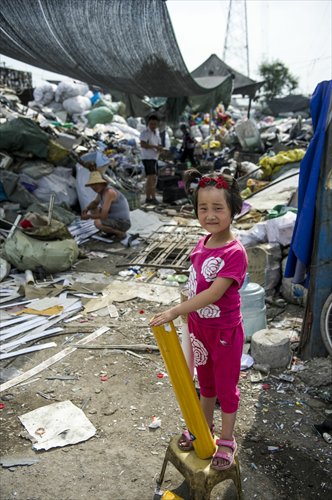
A girl poses in front of mounds of waste at Dongxiaokou, a former farming community in the northern outskirts of Beijing. Over the past 15 years, the vast majority of waste in the capital has ended up in the village. Hundreds of families make their living by stripping components and reselling parts, but now most have moved away amid the village's demolition. Photo: Li Hao/GT
For more than a decade, scrap peddlers in Dongxiaokou village have been turning Beijingers' trash into their own treasure. At its peak it was home to nearly 30,000 migrant workers who sought to improve their livelihoods by recycling electronic waste, construction materials and anything else worth salvaging. But in 2011 the village was itself cast on the scrapheap when the government announced plans to transform it into Changping district's newest residential and commercial hub.
Around 700 families have left Dongxiaokou since demolition work began last year, but about 100 families remain as they try to squeeze the last few yuan out of the village's waning recycling boom.
Meng Ni, 26, moved to Dongxiaokou in 2005. She joined her parents and younger sister and brother, who settled there five years earlier after leaving the family home in Gushi county of Xinyang, Henan Province. She shares a 10-square-meter shack in the village with her husband and 4-year-old daughter.
A short, tanned woman with her long hair tied in a neat ponytail, Meng apologizes for the stifling heat inside the shack. Daytime supplies of power and water were cut more than a month ago to persuade families to hasten their move.
"We line the walls and ceiling with cardboard when it rains to limit leaks. We don't want to live in such a poor environment, but it allows us to save money," Meng explained of her self-built shack, one of several rented by the family on a 300-square-meter plot of land.
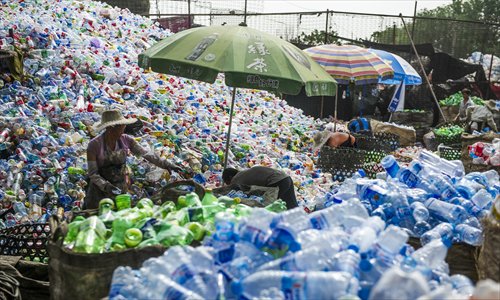
Scrap peddlers sort plastic bottles by brand before returning them to manufacturers. Photo: Li Hao/GT
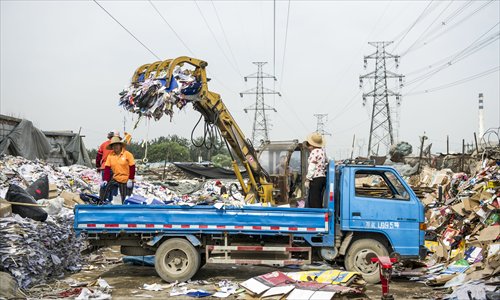
Heavy machinery is used to sort through trash to salvage recycable materials. Photo: Li Hao/GT
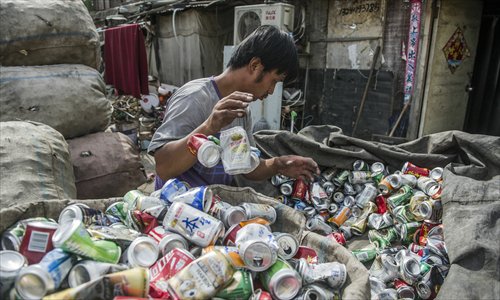
A scrap peddler sorts through aluminum cans at Dongxiaokou village. Photo: Li Hao/GT
Life in a 'waste wonderland'
Almost a quarter of all rubbish in Beijing is processed at Dongxiaokou's more than 1,000 recycling plants run by migrant workers, according to a January report by China Central Television (CCTV).
Located just a couple of kilometers from Lishuiqiao, a transfer subway station for lines 5 and 13, Dongxiaokou has long been in property developers' cross hairs. Its eastern section has already been razed, while the western section has rows of shacks rented by Meng and other holdout scrap peddlers between mountains of aluminum cans, parceled cardboard, plastic bottles and other waste.
Although there hasn't been any resistance from Dongxiaokou's lingering residents against eviction, some have voiced concern about how they will ply their trades at the next "trash village" further away in Beijing's outskirts while others are still unsure about where they will go.
Meng Qingyuan, Meng Ni's 15-year-old brother, said some of his fondest memories are of playing with fellow children in Dongxiaokou's maze of trash mountains. Although his days exposed to e-waste rich in heavy metals are now numbered, Qingyuan is reluctant to leave the village that has been his home and playground since he was an infant.
"I have hardly any friends to play with now. I don't care where we go in the future. What bothers me now is that we don't have any power or water," Qingyuan told Metropolitan.
Meng Ni, who also earns a living as a vendor on e-commerce website ganji.com, said life in the village is much quieter now than just a year ago, when each night it would bustle with scrap peddlers returning from town on tricycles loaded with cardboard, metal, plastic bottles and old appliances.
"They were so happy, like they had discovered treasure during their day's work. But now that bustling vibe has left the village forever," said Meng Ni.
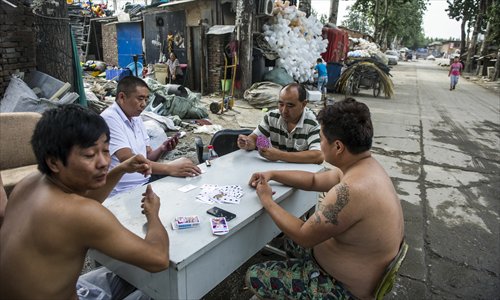
Scrap peddlers relax over a game of cards while waiting for materials to strip and resell. Photo: Li Hao/GT
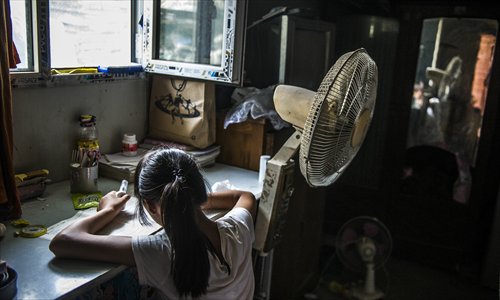
A girl works on her homework inside a shack. Photo: Li Hao/GT
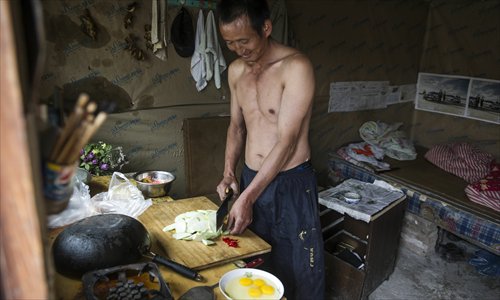
A man prepares lunch from inside his rented shack. Photo: Li Hao/GT
Scrapping together a living
Wang Dedong trawls city streets daily on his tricycle eyeing leftover construction materials. The 39-year-old Gushi native's 10 years as a scrap peddler have taken an obvious toll on his body. With scars crisscrossing his face and arms, he has had a few scares from accidentally picking up medical waste and cutting himself with broken glass.
"Some people who used to live here have moved far away to continue scrap peddling, while others have left the business because there are slim profits amid falling prices for raw materials," he said. "I don't want to move because it's not worth living far from the city center where we get scrap materials."
In 2003, several villagers from Gushi collectively rented 60 hectares at Dongxiaokou that they used to set up hundreds of recycling plants. Most families at Dongxiaokou are from Gushi and other counties of Xinyang. Hundreds of families were lured in the early 2000s by the stories of peddlers earning millions of yuan through recycling, CCTV reported. Wang's average monthly income is around 2,000 yuan, which is barely enough to make ends meet yet still more than he used to make as a farmer.
Li Dinghong, a 50-year-old recycling plant manager at Dongxiaokou, began subleasing land in the village in 2003. His plant spans four hectares in the western part of the village.
"In 2011, local government officials told me to move after they accused recyclers on my land of littering and dumping," said Li, from Guangshan county, Xinyang.
Chen Liwen, a research fellow with local environmental NGO Nature University, stressed the importance of promoting a sustainable citywide recycling scheme amid Beijing's continued urbanization.
"Turning the village into an urban development project with high-rises is more important in the eyes of government officials because of the revenue it can generate, but recycling is also very important and needs government support," she said.
Newspaper headline: ‘Trash village’ to kick the can