Australia blind to Asia’s national fault lines
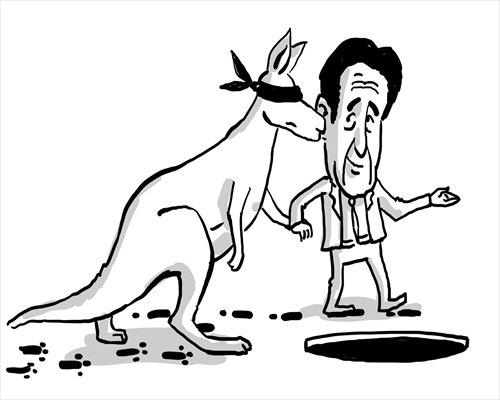
Illustration: Liu Rui/GT
Since WWII, Japan and Australia have built a strong relationship based on trade, tourism and growing personal connections. But over the past few years, defense and strategic issues have become more and more central to the links between them. Both countries are increasingly speaking and acting as if they see one another as close strategic partners, and perhaps even as allies.
They are likely to draw even closer when Japan's Prime Minister Shinzo Abe visits Canberra and addresses Australia's national parliament on Tuesday. Abe's visit comes just a few days after he radically changed Japan's strategic posture. Under the newly-authorized doctrine of collective self-defense, Japan's military will be able to fight in coalition operations alongside the forces of allies.
This makes the timing of Abe's visit to Australia very significant. He clearly sees Australia as a key potential ally for Japan. And there is not much doubt that the country, he believes, that Japan is most likely to confront strategically over coming decades, is China. So it is hard to avoid the conclusion that Abe wants Australia to be Japan's ally against China.
It is not surprising that Abe has these ambitions, because they fit his wider political and strategic agenda. It is much more surprising that Australia's Prime Minister Tony Abbott seems to have the same idea. Abbott has praised Japan's new defense policy and said he welcomes opportunities for closer military cooperation. He is thinking about buying submarines from Japan. And last year he described Japan as Australia's "strong ally."
It is natural to ask why Abbott is so keen to build this much closer strategic partnership with Japan, as Japan's relations with China are growing so tense. Australia's own relationship with China is vital to Australia's economy and also to its broader political and strategic interests in Asia. Surely Abbott does not want to damage that relationship by building an alliance with Japan which will inevitably be seen in Beijing as directed against China.
To understand Abbott's actions, we need to recognize that Australia's strategic choices have become much more complex in the last few years. Asia's strategic order is being transformed by major shifts in relative power between China, the US and Japan, and as a result, Australia faces new and unfamiliar decisions about how to best protect its long-term interests in this very different situation.
Australia's political leaders, including Abbott, are still struggling to comprehend the new strategic realties of the "Asian Century." It is possible that they do not understand how serious the strategic tensions have become in Northeast Asia in recent years or the growing rivalry between the US and China over their future roles in Asia.
Australian leaders thus do not see how careful they need to be in developing new strategic relationships and commitments with major regional countries.
Just as former prime minister Julia Gillard did not see that hosting US marines in Darwin would be seen as siding with the US against China, Abbott does not see that building an alliance with Japan will be seen as siding with Japan against China.
This shows how much they still have to learn about the realities of power politics in the new Asia, and about how to balance Australia's interests with different great powers when those powers' relationships with one another are under strain.
Like everyone in the Asia-Pacific region, Australia's interests are best served by a stable regional order in which all countries can feel secure, and which realistically reflects the new distribution of power that is emerging as Asian economies grow. That means Asia needs a new order that acknowledges and accommodates China's growing power.
But at the same time, that new order must provide a secure, responsible position for Japan which is appropriate to its own standing as a major country. Asia cannot be stable over coming decades unless Japan feels secure and respected. That may well require Japan to move away from dependence on the US for its security and build a different place for itself in the new Asia.
However, Abe's current policy does not offer a credible basis to build the kind of new role in Asia that Japan needs. Japan cannot create a secure role for itself in Asia by building a coalition of regional allies against Beijing, as Abe seems to be trying to do. Nor can it be built by Abe trying to rewrite the history of Japan's regional role before 1945. Both Abe and Abbott need to understand that.
The author is professor of strategic studies at the Australian National University in Canberra. His book The China Choice: Why America should share power was published in a Chinese translation last year. opinion@globaltimes.com.cn