Traditional cartoon paintings
Artists try to reinvent people’s love for ancient Chinese artworks

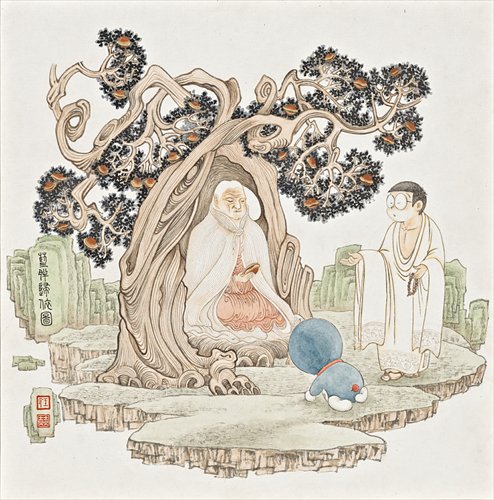
Modern elements like Doraemon and Nintendo computer games have been integrated into traditional Chinese paintings. Photos: Courtesy of Wang He
Wang He, a copier of traditional Chinese paintings and calligraphy did not expect that his creative works of integrating cartoon characters into traditional Chinese paintings would trigger so much attention on the Internet.
Wang posted his paintings of Doraemon traveling through ancient times on Sina Weibo, China's microblogging platform this May. Within a short space of time they had been reposted thousands of times.
His creations of animated cartoon characters in ancient landscapes are a creative attempt to attract more young people to traditional Chinese paintings. By using Chinese traditional ways to paint, the works resemble the original ancient paintings in style.
"This old art can strike a chord with more people by using cartoons and other new technology," said Wang.
As a copier, Wang's job is to copy the traditional Chinese paintings to protect the original authentic works. Since his initial posts on Weibo in May, Wang has also added more modern elements that people are familiar with into other traditional works.
"For the post-80s generation, we live in a culture with too many imported trends from abroad. We are relatively far from traditional Chinese culture, and few people have the patience to carefully appreciate traditional Chinese paintings," said Wang. "There is a divide between traditional works and modern aesthetic ideas. I hope that I can bridge that divide with these works."
Many Web users praised Wang for his creativity on Weibo. Some also hoped that he could produce similar animated videos, albums or postcards, and advised him to use the classic Chinese cartoon figures such as the Calabash Brothers.
At the same time, a group of nine flash animations of Emperor Yongzheng of the Qing Dynasty (1644-1911) accompanied by fun illustrations have gone viral, attracting more than 800,000 clicks since it was launched on Weibo by the Palace Museum on August 1. Many Web users said the emperor is "cute" in these pictures.
"The Palace Museum wants more people to feel close to the cultural relics by creatively making Yongzheng 'come to life' by digital techniques, which are based on the Paintings of Amusement of Emperor Yongzheng in the museum," said a letter sent to the Metropolitan by the Palace Museum.
Since the Palace Museum launched its online store via Weibo, WeChat and several other apps in 2008, it has tried to make young people realize the glamour of cultural relics with digital technology, the letter said.
One app called "Mascots of the Palace Museum" allows users to paint the eyes and fur of the mascots of the Palace Museum such as a dragon and a phoenix.
Nevertheless, there are some Web users who believe that such innovation is inappropriate and will destroy the flavor of the original paintings.
"The cartoon characters can hardly be integrated into the scene of the paintings," a Weibo user commented. Another Weibo user said the way of reinventing paintings by digital techniques shows little respect to the original works.
But George Tan, an independent critic of art doesn't agree.
"As long as the painting skills and technologies are good enough to make art works a feast for the eyes, the use of cartoons won't hurt the charm of the original works, which have existed for hundreds of years," said Tan.
Tan suggested artists held exhibitions of the art works combing tradition and modern elements such as 3D technology and animation to attract the younger generations.
"Exhibitions can make modern art innovations 'get onto the ground' rather than just staying online,"said Tan.
"Commodities and souvenirs adapted by these innovated works can also be developed to spread the communication of traditional culture in children and people not in the artistry circle."