A good man is hard to find
Why Chinese women are dissatisfied with their men folk

A recent spate of articles disparaging Chinese men as being too ugly for their female counterparts has received widespread support from women in China. Photo: Li Hao/GT
A photograph post on a popular Chinese Internet message board poking fun at a number of couples made up of an attractive-looking girl saddled with a less than attractive-looking man recently sent netizens all over the country into a titter.
Submitted under the heading, "Female hotties, male perverts," the post is comprised of just 10 photographs. Each photograph shows a "female hottie" with a male suitor whose complexions or countenances leave something to be desired. The post has been viewed by almost 1 million users, and has become a topic of conversation in a number of articles in print and on the Internet.
One article on QQ news, carrying the headline, "Are Chinese men too ugly for Chinese women?" has received more than 67,000 comments, and a follow-up to that article, published in the Guangzhou Daily, even went to the trouble of surveying more than 1,000 people to find out whether they agreed with the statement.
The majority of women surveyed did.
How did we arrive at such a dire state of affairs? And is the public commotion in the wake of this seemingly innocuous Internet post really about a man's looks, or is it indicative of deeper resentments held by Chinese women towards their male counterparts that have been brewing for some time?
Don't judge a bookworm by its cover
Li Yinhe, a sociologist at the Chinese Academy of Social Sciences, said in comments made to Guangzhou Daily that she was not surprised at the general consensus that Chinese men are no match for their female peers when it came to looks.
Li attributed the disparity to the different emphasis of values that Chinese culture has historically placed upon men and women. According to a Chinese idiom, men are to rely on their talents, women on their countenance. This traditional prescription of gender roles has meant that while a woman's social worth derives from her appearance, for man, looks mean little so long as he is possessed of tremendous ability or wealth.
Li suggested that even in terms of what little value was attached to a man's appearance, what was considered a desirable countenance for a man differed from what many might consider to be an attractive comportment today.
"In contrast to muscular, athletic ideal of beauty of men perpetuated in the West, the type of men celebrated in the ancient times in China were pale-faced scholars," said Li.
In an article for Singaporean newspaper Lianhe Zaobao, media personality Zhao Lingmin summed up the double standards that are applied to Chinese women as opposed to Chinese men rather more bluntly, in an article depicting China's lingering attachment to traditional cultural values despite its rapid economic modernization.
"As long as he's rich, a man, no matter how dreadful, rude, fat or unfaithful to his family, doesn't really present a problem," Zhao wrote.
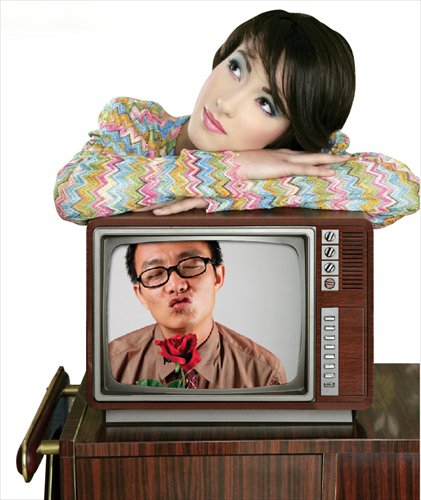
The influx of Western media in China has challenged long-held notions regarding the traditional roles of women in this country, and led women to expect more from men. Photo: IC
Working girls
Given that a man's looks have historically been deemed to be insignificant in China, the widespread public enthusiasm for disparaging men's looks represents a shift in the perception of gender roles.
Part of this shift can be attributed to economic liberation of women. With a large number of women no longer reliant on men to achieve a high standard of living, men must now compete on the same playing field that has traditionally only been the domain of the "fairer sex" - that of looks.
Qi Cui is a 34-year-old media industry professional who holds a master's degree in international relations from a university in Beijing. By her own admission, she attracts no small amount of interest from the men she meets, but she has thus far chosen to remain single.
"Educated, economically independent women don't need to settle for just anyone," she said.
With reference to the message board post that has sparked such intense public debate, Qi agreed that the men photographed left something to be desired in terms of their looks, but considered that focusing only a man's looks was a "shallow" approach to the issue.
Qi attributed her own dissatisfaction with the men she has met to other factors, such as social etiquette.
"From my own experience, the ones who barge and fight for seats on the bus are actually the men that look respectable," she said.
More importantly to Qi was the flipside that besides looks, men must now also compete with women in terms of their education and income levels.
"A common reason for a woman staying single is perhaps that the men they have met are not as successful as they are," said Qi. "It is difficult for women [who are educated and earn a good salary] to find men of a similar age and social standing."
If an educated, economically independent woman wants to get married these days, said Qi, she often must resign herself being with a man who is below her station. Qi used an informal classification system common in China to make her point: an "A-standard" woman must settle for a "B-standard," "C-standard," or even "D-standard" man, she said.
The problem however, according to articles published in the New York Times, the International Business Times, and CNN, is that Chinese men often remain reticent to marry women who are better educated, or earn higher salaries than them.
Foreigner fixation
Another possible reason for the sudden interest in a man's looks as a criterion for his social worth is the widespread influence of Western media in determining cultural trends in China, said Xia Xueluan, a sociologist at Peking University.
Not only has the influx of Western television shows and films influenced some women's perceptions about marriage and the role of women in society in relation to men, said Xia, but on a more superficial level, it has altered the criteria for what some Chinese women consider to be a "good-looking" man.
"Certain Chinese women idealize foreigners as 'Prince Charmings,'" said Xia.
Lü Pin, the founder of Gender Watch and a former journalist, agreed with Xia, noting that the denigration of the physical attributes of Chinese men is made in direct comparison to Western men.
"The criteria are very Westernized, and express the desire for Western cultivation and gentlemanly refinement," said Lü.
Zoraida Xu, a 27-year-old Chinese-English interpreter who has only ever dated non-Chinese men, said that her preference for foreigners had nothing to do with the way they look.
"It's not a question of looks," said Xu.
Rather, her choice of romantic mates is based upon shared personal values and cultural world view. She met her current boyfriend at a Halloween costume party, where she dressed up as the videogame character Super Mario. The man who is now her boyfriend had serendipitously come as the Yoshi, Mario's pet dinosaur.
Xu grew up in France and Luxembourg, before later emigrating with her family to the United States.
Xu noted however, that the question of whether a man's looks were important to a woman in China was strongly correlated with their economic means and social class.
"I think most Chinese women who think that Chinese men are not good enough are those who are comparatively highly educated and have a good career themselves," she said.
Show some class
Although the sudden scrutiny about the physical appearance of men in China signals a step forward for gender equality in China, said Lü, it also deeply pragmatic, and indicates how far China still needs to go in terms of gender rights.
"To gain greater social recognition, [women] are disparaging the way men look," she said. But in rejecting men who lack sartorial sense, said Lü, women are also making a pragmatic choice.
"Men who have the time and money to invest in their looks are generally wealthier, more refined, and belong to a higher social class," said Lü. "Meeting a man of a higher class is still how women are able to climb up the social ladder, and improve their own lot."
Xu agrees.
"Most migrant workers or small business owners probably do not have the most sophisticated sartorial sense, but I know a lot of Chinese men who are better at dressing up than many Chinese girls," she said.
"In large cities like Beijing, the pressure of simply being able to survive is relatively high. Everybody has practical views in choosing spouses," added Qi. But she maintained her stance that how well or poorly a man presented himself was beside the point.
"Parents these days usually raise their daughters to be independent, confident and self-sufficient. But they spoil their sons," said Qi.
"I feel that many men are not very independent, bold, responsible or resolute."