3D optical illusions
New art show amazes crowds
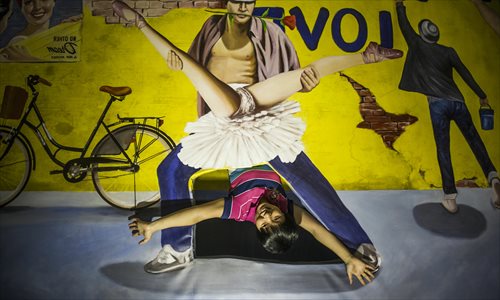
3D art uses lighting and depth to allow viewers to become part of the artwork. Photo: Li Hao/GT
Normally there would only be a few people hovering outside Glory Mall shopping center in Dongcheng district at 10 am on a Saturday morning. However, with the center hosting a 3D art show, over 1,000 people queued at the entrance to get photos of themselves being kicked by Bruce Lee or served hot buns by Spiderman.
The 3D art show, which was held in Beijing last weekend by Tongyi Culture Media Company, displayed more than 100 art projects including 3D paintings, trick devices and motion sensing games. All artworks provided stunning realistic effects through depth and lighting. Depending on what display visitors stepped into, they could have found themselves shaking hands with Barack Obama, or found that their head had been severed from their body.
The miracle of 3D art originated from urban street art in the West. Artists would "vandalize" public buildings with 3D-form graffiti. These street paintings can appear either flat and distorted when looked at from one angle, or can become incredible three-dimensional images when looked at from another angle.
"The great shortfall of 3D street art is that the art tends to be very large, hard to preserve, and viewers can't interact with the paintings," said Huang Hui, CEO of Tongyi Culture Media Company which is dedicated to developing 3D art. "The 3D art show, however, has gathered more than 100 3D art projects that viewers can interact with. This allows visitors to get a lot of great photos."
Dang Tianheng, a student from Washington State University who returned to Beijing for the summer, said that although there is a lot of 3D street art in American cities, most are scattered and hard to locate. "In here you can see all kinds of 3D art projects in one place. You can experience things you could not imagine in real life," said Dang, as he took a photo of his girlfriend with the green monster Shrek. "Although it is fun, I probably wouldn't come again because I already have all these wacky picture from this visit," Dang added.
Tongyi Culture Media already held the 3D art show in 11 cities around China before arriving in Beijing. However, the art format is still fresh and novel to most of the Chinese people.
Several teenagers said they came after they saw 3D art photos posted by their friends online. "I came with my friends because I think it's a great way to bond with them," said Di Zi, who will start at Beijing University of Technology as a freshman this fall.
"The pictures are dead but we are alive, so we can match the pictures with different gestures from our imaginations," he explained.
Soon, Di was arching his back and feigning a photo of Bruce Lee kicking him in the face.
Apart from obviously attracting excited youngsters, a couple of elderly Beijingers were also in attendance. A woman surnamed Shi, 60, had no problem crouching down in front of a painting and pretending to use her handbag to collect water from a Chinese dragon's mouth.
"I like to experience new things. I have been to a lot of art exhibitions, but this is different. It's more creative," said Shi. "You have Vladimir Putin holding an umbrella for you on your left, and Chairman Mao attempting to shake your hand on your right, where else would you get that?"
The 3D art show has attracted large crowds and earned glowing reviews in all venues that have hosted it. Saturday's show alone entertained more than 2,000 people, and they are expecting more visitors in the coming week.
"It is a combination of art and science. We plan to open a bigger 3D museum in Beijing by the end of the year," said Huang. " We want to introduce more trick instruments and motion sensing games to the show, which will allow more people experience 3D art."
Newspaper headline: New art show amazes crowds