Teachers of the world unite!
Educators share their experiences of working in Beijing’s international schools
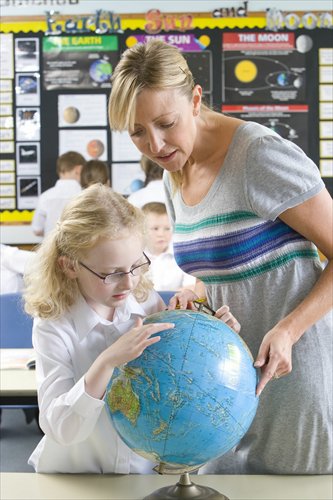
Teachers at Beijing's international schools bring a wealth of experience from around the world into their classrooms. Photo: IC
Shawn Hutchinson, a secondary school principal at Beijing City International School, settles down at a wooden desk in a small, secluded study room nestled in the cozy confines of the secondary school library. A man of the world, Hutchinson has had stints teaching and serving as an educational administrator all over East Asia, from Singapore to Vietnam to Tokyo.
Hutchinson was attracted to Beijing three years ago, both by a personal curiosity about China's expansive culture and a professional curiosity about pedagogical practices in the country.
"For students who come directly out of the Chinese education system, the teaching methods and practices [at our school] are different from what they are used to experiencing," he told Metropolitan in a mellifluous baritone. "They're used to lots of memorization and working through a particular textbook. But we take an inquiry-based approach, in which we encourage students not only to pose questions, to answer questions, but to engage in discussion with teachers and students."
A global classroom
Beijing City International School (BCIS) is one of roughly 40 international schools in the capital that offer alternative courses of education to the national curriculum. Many of these schools offer programs from nursery or kindergarten all the way through to the end of high school, with the International Baccalaureate (IB) or the Cambridge International Examinations (CIE) popularly offered as alternatives to China's national college entrance examination (gaokao). Many of the schools also offer support and resources for students preparing for SAT examinations to pursue tertiary education in the US. At a majority of the schools, classes are primarily taught in English.
As well as hiring staff that have a wealth of experience teaching abroad, international schools are frequently far better funded and resourced than regular Chinese public schools.
Though some international schools in Beijing accept only students who hold foreign passports, an increasing number have opened their doors to domestic Chinese families who intend their children to pursue tertiary studies abroad.
"Fifty years ago, [international schools] were for people traveling around the world who wanted their children to have the similar education as they would have in their home county," said Hutchinson. "But in the last 10 to 15 years, the concept of international schools changed rapidly, especially in Asia. More and more populations are attracted to international schools as opposed to the national system."
Receiving such an education comes with a price. Tuition fees for international schools in Beijing range around 200,000 yuan ($32,495) per year, compared to 2,000 to 3,000 yuan per year at regular Chinese public schools.
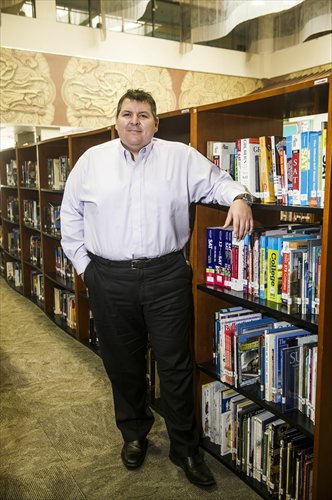
Shawn Hutchinson, a secondary school principal at Beijing City International School (BCIS), poses in one of the school's libraries. Photo: Li Hao/GT
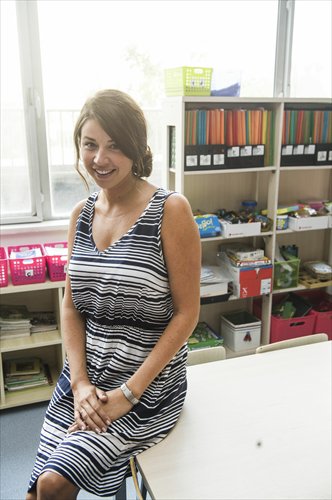
Katrina McDonnell, the vice-principal for preschool and primary school education at the Canadian International School in Beijing. Photo: Li Hao/GT
Creating a sense of wonder
Fake mustaches plastered onto their faces, Grace McCallum and Katrina McDonnell burst into an unsuspecting classroom on the campus of the Canadian International School in Beijing (CISB).
But McCallum and McDonnell are not mischievous children pulling a capricious prank. They are experienced teachers who serve as the preschool and elementary school principal and vice-principal respectively.
Though they hold positions of responsibility at CISB, they are not above dressing up and engaging in such horseplay to create a sense of wonder in the classroom.
"We pretended we were the [Wright] brothers [Orville and Wilbur, inventors and early aviation pioneers], to try to make the story come alive for them," explained McDonnell.
Both originally from Canada, McDonnell has been working at CISB for the past four years, and McCallum the past eight. Both were attracted to teaching because of their own sense of wonder at working with children, with the understanding that they are educating the future generation.
McDonnell and McCallum both admit that they have come up against parents that are suspicious of their seemingly irreverent approach to teaching, but both insist that such a pedagogical approach pays dividends.
"It's our job as well to educate some parents about how the North American school system works, and how our philosophy and perspective on teaching differs from some traditional Chinese approaches," said McCallum. "We really strive to educate the child as a whole, instead of focusing on [academic rankings denoting] who is first, who is the second. That's not important in our system."
"We're in this field because we truly care about children, and believe that they are capable of great things," McDonnell added. "Not only do we have high academic expectations, but we are also educating these children and young adults to be better people as a whole. We want them to be good problem solvers and global citizens."
As well as offering an alternative to the national curriculum for entry into institutions for higher learning, international schools offer an alternative approach to education. Both CISB and BCIS offer the IB curriculum, which in addition to standard classes in the natural and human sciences, arts, mathematics and history, also have mandatory learning components in ethics, emotion, imagination and intuition.
"The students themselves, especially in elementary school, are very adaptable and generally have little difficulty transitioning from one system to another. As far as differences between Chinese and foreign students go, I believe they have far more in common than they do differences," said McDonnell.
Rather, the two teachers agreed, the biggest challenge for students was acquiring adequate proficiency in English to make the most of the classes.
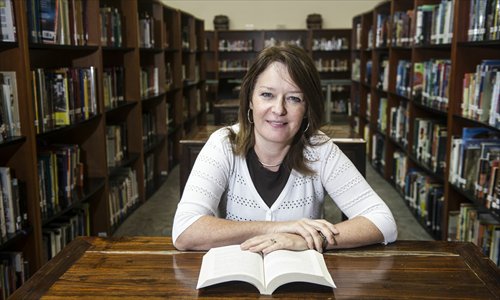
Colleen Drisner, the diploma program coordinator at BCIS. Photo: Li Hao/GT
Pressures on pedagogues
Although McCallum, McDonnell and Hutchinson all said that they preferred to take a holistic approach to pedagogy, they conceded that there are certain realities that come with teaching at an international school.
A large number of parents expect that their expense will eventually result in a placement for their child at a prestigious university in the US or Europe.
"Let's face it, not all of us are able to go to Ivy League schools," said Hutchinson. "Some of us go to very good schools that provide quality education that enable us to contribute beyond university."
As for how he negotiates family expectations and pressures, Hutchinson said that BCIS tries to set up individual consultations.
"Some families have their sights set on a particular university or school," he said. "We don't just discount that. We listen to what the family is wanting. We listen to what the student is wanting. And we are trying to work through a process with our university and college guidance counselor, but never telling them what to do. If they really want to apply for Havard, that's up to them."
Although Hutchinson admitted that these conversations were sometimes challenging, he said that he sympathized with parents.
"Many of our parents are very successful individuals, growing up in very competitive environments. So some of the families believe that if you go to a higher ranking university, you will increase your chance of success."
Colleen Drisner, the diploma program coordinator of BCIS, said that the school's insistence on a learning-based pedagogical approach could sometimes present difficulties.
"We have 50 minutes [for one class] and large class [numbers]. You only have so much time. Inquiry takes time. Lecturing is quick. So sometimes time is one of the biggest constraints," she said.
If a student was performing academically below their expectations, she added, teachers will work with both parents and the student who is struggling to find ways of improving his or her results.
Teaching as its own reward
Despite the pressures of the job, McCallum and McDonnell both said that the positives of being an international school teacher in Beijing far outweighed the negatives.
"The best part of being in education is seeing our students progress, make achievements and reach goals. Teaching is the best job in the world," said McCallum.
"As for the most enjoyable [part of teaching], that would have to be the relationships and bonds that are built between a teacher and student," added McDonnell. "It is truly amazing to watch these young people grow and develop, not to mention the laughter and fun that happens when they are around every day!"