Beijing’s forgotten missionary schools
A history of Protestant-run places of learning in China’s capital
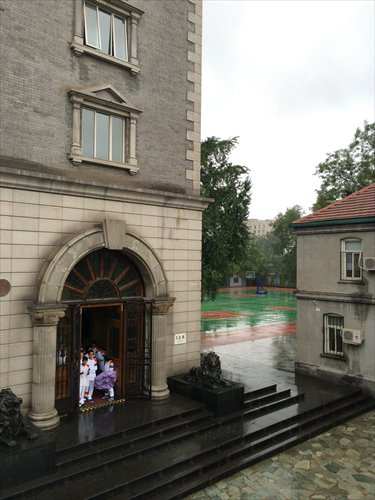
One of the buildings on the campus of Beijing No.25 Middle School, which was formerly a missionary school known as Yu Ying. Photo: Li Ying/GT
Many years later, as he compiled the official documents, personal memoirs, and faded photographs that would be displayed to commemorate the 150th anniversary of the school once run by Christian missionaries, Qi Bing remembered the magnificent Dengshikou Congregational Church that for many years kept vigil over its grounds.
"As a child, I was able to go inside, because my mother worked at the school. The architecture was so intricate, so exquisite," Qi recalled. "The floor was made of wood that had been imported from America, and inside, there was the most majestic organ."
Qi stares out the window, lost in his own memories. The head of the worker's union at the school, Qi is sitting in a small room in one of only three buildings which were built about a century ago. The room overlooks the empty playgrounds of what today is known as Beijing No.25 Middle School.
It is a school that now looks much like any other in Beijing. Where the church once stood, with its looming gothic spire and intricate stained glass windows, is now a four-story classroom building that also more or less resembles any other.
But back then, at the calamitous end of the 19th century, it was one of Beijing's first Protestant-run schools. Founded by Christian missionaries after China's defeat in the Second Opium War, it served both as a place for learning, and a tabernacle to spread the word of God.
"At the time, there were only privately-run home schools in China, said Qi. "The missionary schools represented an alternative to the Chinese system of education."
There would be classes in the natural and social sciences, but above all, it was a place where Christian values could be nurtured and flourish. Back then, it was known as Yu Ying School.

One of the buildings that still remain intact from the old Bridgeman Girl's School campus. Photo: Li Hao/GT
A tabernacle for Beijing's social elite
Yu Ying was one of two missionary schools set up by the American Board of Commissioners for Foreign Missions in 1864, four years after China's defeat in the Second Opium War.
Yu Ying was set up for the education of boys, and a neighboring school, Bridgeman, was set up for the education of girls.
"At the beginning, Yu Ying mainly provided religious instruction and studies in the Bible," said Qi. But it was the school's instruction in subjects considered by its missionary founders to be secondary that saw its appeal broaden beyond those families who were already inclined toward Christianity. Coupled with the school's penchant for encouraging its students to explore, with a spirit of inquisitive curiosity, whatever hobbies or interests might tickle their fancy, it gained a reputation for providing the kind of education that student needed to navigate the tumultuous, rapidly transforming society of China before the turn of the 19th century.
"The school started attracting children from middle and upper-class families in Beijing, who were not necessarily interested in converting to Christianity," said Qi.
The status the two schools enjoyed as the breeding ground of Beijing's social elite was however, short-lived. By the beginning of 1900, the Boxer Rebellion, a populist revolt against what its instigators saw as the corruptive influence of foreign powers in China, had reached the zenith of its violent outrage. Targeting sites of Christian fellowship as symbolic of foreign imperialism, both the Yu Ying and Bridgeman schools suffered heavy damage. Among the casualties was the church which Qi today recalls with such fondness.
The church and the school were rebuilt in 1904 with the support of the Qing government, but after 1911, with the founding of the Republic of China, the schools were forced to make concessions.
Rather than operating outside of the jurisdiction of Chinese authority, they were obligated to conduct its affairs under local administration. Along with its foreign headmasters, a Chinese headmaster would be appointed to each of the missionary schools. Furthermore, the schools' curriculums would be overseen by the Chinese bureaucracy, meaning that more and more classes would be taught in Chinese, responding to the cultural and vocational needs of the emerging state.
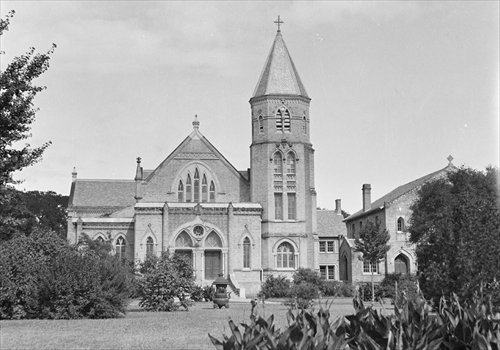
The church which was an indispensable part of the Yu Ying School grounds until 1978. Photo: Courtesy of Liu Yang
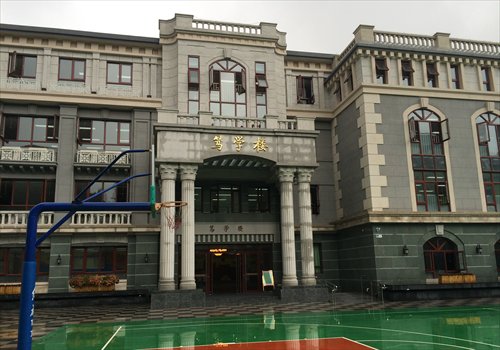
The classroom building that has been erected at where the former Dengshikou Congregational Church stood. Photo: Li Ying/GT
Chronicles of a schoolgirl
Under the new arrangement, missionary schools in China began to flourish again. By 1916, there were 291 missionary schools in China registered with the authorities, making up about 40 percent of all schools registered in China at the time.
During this period, the missionary schools produced a number of outstanding alumni. Among them was Xie Wanying (1900-1999), a renowned essayist, translator, and author of children's books whose works in her latter period are considered among the most important contributions to modern Chinese literature.
In an 1984 essay published in Harvest, a literary bimonthly, Xie recounted her four years spent at Bridgeman Girl's School (1914-1918) with a mixture of veneration and vexation, but ultimately, gratitude.
"Most of my schoolmates were Protestants," Xie wrote. "Permanently adorned in [the school's uniform of] a blue blouse matched with a green skirt, their expressions too, seemed to be fixed: they were always severe, rigid and humorless."
On Sundays, all students were required to attend mass, as well as go to "Sunday School," which consisted of listening to stories from the bible.
"Mass and bible time was a bother. I sometimes skipped Sunday School, because it was the only time during the week I could otherwise spend with my parents and siblings. It was also the only time that I could help my mother with the household chores," wrote Xie.
However, Xie concludes the essay on a note of affirmation for her religious education.
"The solemnity of the education I received tempered my natural unruliness, and gave me a stable foundation for the color that was awaiting me in university life."
Ideological struggle
It was not long however, before China's missionary schools again came under ideological scrutiny. This time, the pressure came from China's intellectual classes, who, under the banner of the New Culture Movement, were persistent in their critique that if China wanted to survive, it would have to go through the same process of modernization as the Western states did.
Central to the project of modernization was legitimizing science as the foundation of society. Because certain scientific precepts were seen as antithetical to the Christian church's teachings, the missionary schools, which had in fact played a large role in disseminating Western theories of science in China, were again the target of public resentment.
"If traditional culture was the main ideological obstacle that prevented Christianity from becoming widespread in China during the late Qing period, the New Culture Movement, promoting ideas of democracy and science…made the dissemination of Christian teachings even more difficult," wrote Ji Hong, a research fellow with the Institute of American Studies of Chinese Academy of Social Sciences, in an essay titled "Studies on American Protestant Missionary Middle-Schools in Beijing between 1920-1941."
"[The missionary schools] were criticized by progressive intellectuals," wrote Ji.
By 1950, with the realization of the modern Chinese state under the Communist Party of China, the missionary schools faced another twist of their fate, with any that remained being converted into public schools run under the administration of central and provincial State apparatus. The schools were widely condemned as a painful reminder of China's humiliating earlier defeats, and symbols of Western imperialism.
The persecution of the former missionary schools however, was not over. During the ideological struggle of the Cultural Revolution (1966-76), despite their official status as public schools like any other, both students and faculty at the former missionary schools suffered.
Students and staff at the school were seen as more likely to have come from privileged or bourgeois backgrounds.
"I witnessed some really sad things during the Cultural Revolution," said Liu Chuanzhi, a student of Beijing No.25 Middle School at the time, in comments made to Caijing magazine in October 2012.
Liu later founded China-based PC maker Lenovo Group.
An enduring legacy
The Dengshikou Congregational Church was demolished once and for all in 1978.
In Beijing, few of the original buildings from any of the missionary school campuses remain. And yet, in present-day China's more open, inclusive social and political climate, these lost missionary schools are being remembered with increasing fondness.
"A century ago, Yu Ying had already adopted an approach to education that encouraged students to pursue their hobbies and interests outside of class, which today is still considered progressive," said Qi. The school's clubs at the time, he added, included music and dancing, literature and photography, football, tennis and even ice hockey.
The school's attitude toward extra-curricular activities was summed up thus by Ernest T. Shaw, one of Yu Ying's early headmasters, in their 1931 Year Book: "No curriculum or organization, no matter how carefully put together, can provide for every student's needs. These clubs furnish the best possible setting for students to acquire the habit of coordinating their desires and the demands of life when the need arises for doing things together."
Efforts are also being made by scholars to restore the forgotten history of Beijing's missionary schools.
"It was a pity that the church was destroyed," said Liu Yang, an expert on Beijing's regional architecture. Liu is currently writing a book on the capital's religious buildings, and has been collecting stories about Beijing's lost missionary schools.
"These stories should be kept and passed on," he said.