The forgetfulness of youth
Memory loss is most often associated with the elderly, but more and more young people today are having trouble remembering things
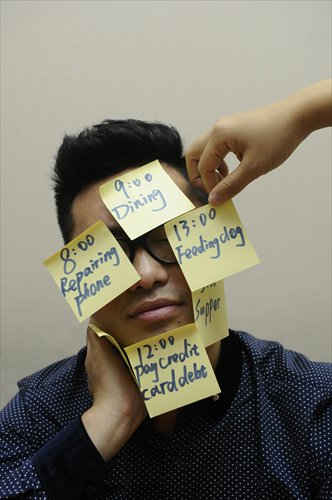
Young people are resorting to to-do lists and post-it notes to compensate for memory lapses. Photo: Li Hao/GT
Since finishing her graduate studies earlier this year, 25-year-old Chang Lu has found that she has become more and more forgetful.
She is prone to forgetting the dates of appointments she's made, and has attended parties where she was the only guest because she misremembered the date. She has even started forgetting the names of familiar acquaintances.
"It's just like in that South Korean movie, A Moment To Remember, where the main character can't remember the man she loves because of severe memory loss," said Chang. "I don't think I have amnesia, but sometimes I'll just suddenly forget what I wanted to say five seconds ago."
Though memory loss has traditionally been understood as an affliction of the elderly, recent studies have shown that a significant number of people begin having trouble with remembering things before they have even entered middle age.
In June, a study of 18,614 people conducted by the University of California, Los Angeles found that 14 percent of people aged 18-39 admitted to experiencing memory problems. For people aged 60-99, this number was 26 percent.
"The difference is much smaller than we expected," said Zhou Liang, a postdoctoral research fellow at the University of Helsinki's Neuroscience Center. "This isn't to suggest, necessarily, that the memory of young people today is poorer than of young people in earlier decades or eras. But what we can say is that more and more young people are struggling with forgetfulness."
A similar survey in China, conducted by news portal ifeng.com in which more than 80 percent of the 71,722 respondents were under the age of 50, found that 45 percent of those surveyed admitted to frequently experiencing lapses of memory.

Experts attribute forgetfulness experienced by younger people to the overloading of information and dependence on technology wrought by modern life. Photo: IC
To-do: go to work
In order not to neglect any of her duties as an IT worker at an office in Xi'an, Shaanxi Province, Chang has taken to writing meticulous work logs and to-do lists on her smart phone.
"When I first started working, I often forgot to accomplish the assigned tasks," said Chang. After speaking with her friends and colleagues about her difficulties with remembering things, she discovered she was not the only one.
"They all told me that their memories had deteriorated as well, compared to when they were younger. So I've just accepted it as a matter of course," said Chang.
Chang speculates that her memory loss is due to difficulties with sleeping while finishing her master's degree, combined with the repetitive banality of her present occupation.
"There are no new elements. The brain operates in the same way one day after another without needing to think anything new," said Chang.
A 28-year-old woman surnamed Zhang, who spoke to Metropolitan on condition of partial anonymity for fear that it would affect her career prospects, also admitted to experiencing memory lapses that have affected her ability to do her job. Zhang works as a civil servant in Hubei Province.
"During one work banquet, there was a woman who was talking excitedly with me, but I just couldn't remember who she was," said Zhang. "Eventually, she caught onto the fact that I had forgotten who she was, and said that we had met three days earlier. It is so embarrassing!"
Zhang said that her memory has become worse since starting her job as a civil servant two years ago.
"I am not very interested in socializing with people during work; at the same time, I frequently have to work overtime, which means I'm often exhausted," said Zhang. "Working in a department which involves a lot of paperwork and communication, it's difficult to retain all the information."
Reasons for forgetfulness
Psychology experts suggest that the causes of forgetfulness among younger people are related to modern lifestyle habits and people's increasing dependence on technology to do the thinking for them.
"Putting aside pathological reasons for memory loss, there are several reasons for forgetfulness among younger people," said Lü Jihui, director of the psychology department at Beijing Geriatric Hospital. "These days, people's brains are bombarded with too many forms of stimulation each day, beyond the brain's capacity to handle it. In addition, the ever-increasing pace of life and constant pressure that people experience mean they have less time to rest, which also adversely affects memory."
Sue Halpern, author of Can't Remember What I Forgot: The Good News From the Front Lines Of Memory Research, said that it was normal for people's memories to begin declining from their early 20s onwards. But she also suggested physiological and cultural factors could affect memory.
"Depression and smoking impair memory, and so does diet - a diet high in fats and carbohydrates is bad for the brain," said Halpern. "Another aspect of memory is attention - if you don't or can't pay attention, you can't form memories - so people who are highly distracted by electronic devices, for instance, can also be influenced in their ability to remember."
Both Halpern and Lü suggested that if people were concerned, they should seek professional help.
"If memory loss is affecting your work and your everyday life, you should consult a doctor to determine whether it is pathological or benign, short-term or irreversible," said Lü.
Warding off memory loss
Both Chang and Zhang have begun to adopt various strategies to try to mitigate the deterioration of their memories.
"I eat more bananas and am playing more puzzle games than before, both of which are said to increase memory," said Chang. "I'm also planning to use some scientific memory methods."
"I've started making a conscious effort to remember people's faces and names," said Zhang. "I read up on some techniques from famous memory trainers to retain names and faces, and I'm going to give them a try."
Halpern said that aerobic exercise has been shown to improve memory.
"All the studies show that people who get at least 30 minutes of aerobic exercise do better on memory tests. Studies also seem to show that a "heart healthy" diet is good for the brain too," she said.
Finally, Zhou suggested a couple of simple lifestyle changes for people who were worried about their memories deteriorating.
"Always challenge your brain. Try to reduce dependence on the Internet and to remember work-related tasks without technological aids," said Zhang. "Reduce the time you spend on Weibo and WeChat so you're not overloaded with information."
"Try to focus on one thing to avoid distraction of attention. Finally, learn to adjust your feelings to reduce the influence of pressure," said Zhou.