Blackwater case shows PMC dangers
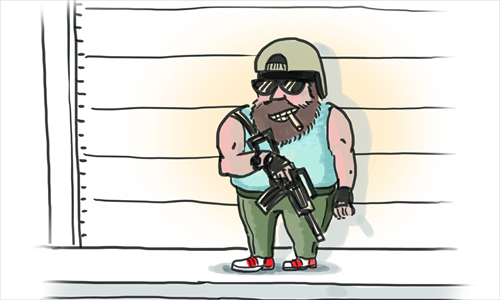
Illustration: Liu Rui/GT
From one perspective, the October 22 convictions of four former Blackwater contractors of murder and manslaughter in the 2007 Baghdad shooting incident that left 17 Iraqis dead and 20 wounded can be seen as an example of the US legal system functioning as it should. However, the problems associated with the use of armed private military companies (PMCs) must be confronted, especially given the temptation to use PMCs to address the current Middle Eastern crisis.
The US has refused to accept the findings of a UN report that many PMCs carry out duties that make them indistinguishable from mercenary units. But these private groups are increasingly taking on the duties of a government military with only a fraction of the accountability that a regular military has to its government.
In one case, Blackwater's top manager in Iraq threatened a State Department investigator with death should an investigation continue. Were such an action to be taken by a military officer, it is likely that the outcome would have been far different.
In fact, far more US soldiers have been brought up on charges for crimes related to their actions in Iraq and Afghanistan than have members of the numerous PMCs serving in those areas.
PMCs immunity to local law was enshrined by the American-led Coalition Provisional Authority (CPA) in order to ensure that they would not face action by the Iraqi courts.
As early as 2003, the CPA issued the following order: "In accordance with international law, the CPA, Coalition Forces and the military and civilian personnel accompanying them, are not subject to local law or the jurisdiction of local courts."
Although contractors who violated local laws could face prosecution in federal court, in practice the recent convictions have been very much the exception to the rule.
In many cases, it has proven difficult or impossible to take legal action against contractors for many alleged crimes due to the inability to directly contact the victims or witnesses of the crime.
The reason for hiring a PMC is not, contrary to some claims, budgetary. In fact, it is often more costly to hire a PMC than it is to make use of regular military formations. The main advantage of using a PMC is that it can be deployed without raising the domestic political questions created by committing ground forces to a crisis.
In addition, a PMC can offer its employer a certain degree of plausible deniability when an incident does occur. It must be noted that in this current affair, only the specific Blackwater employees who were at the scene are facing prosecution, rather than their superiors or the government employees who hired them.
The misdeeds of these PMCs are not simply harmful to their direct victims, but can also dramatically harm the relationship between the locals and the nation employing the PMC. The presence of swaggering "security guards" who act as if they are immune to the consequences of their actions usually inflames local feelings, making an already tense situation even worse.
Furthermore, it is increasingly clear that most PMCs' professional standards fall far short of the accepted norms for the US military. Far from being elite units, many armed PMCs behave more like a trigger-happy militia.
There is an easy way to rectify this issue, but it is a method that many in the US will not like. In a combat zone or occupied country, only the military should deploy armed personnel in order to ensure that they will have clearly defined duties both to their superiors and the populations they are working among.
Furthermore, the military has proven itself far more effective in maintaining discipline among soldiers and officers alike than most PMCs.
In order to avoid future tragedies, the vast majority of PMCs should be restricted to non-combatant and unarmed roles only, especially in nations where they will not be subject to local legal jurisdiction.
To use a PMC in any other role is to court disaster. For many Iraqis, the face of the US was an armed PMC guard who in far too many cases behaved in an undisciplined and violent manner.
Today, as in the past, the use of PMCs or mercenaries, as most see them, has proven to be a shortsighted policy that ultimately costs far more than it is worth.
The author is a freelance writer based in Corona, California. charlesgray109@gmail.com