AIIB vital in creation of ‘Asian Century’
Editor's Note:
China along with 20 other countries signed an agreement to become the founding members of the Asian Infrastructure Investment Bank (AIIB) recently in Beijing. Pakistan, which is in growing demands for infrastructure construction to boost economy and the nation's development, has backed the AIIB initiative from the very beginning. How will the AIIB benefit Asian countries that have a growing appetite for infrastructure such as Pakistan? What's the relationship between the AIIB and other financial institutions such as the World Bank and IMF? Global Times (GT) reporter Yu Jincui talked to Ishaq Dar(Dar), finance minister of Pakistan, over these issues.
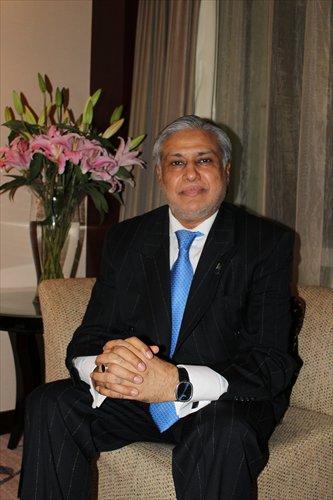
Ishaq Dar Photo: Yu Jincui/GT
GT: Why does Pakistan have a positive attitude toward the establishment of the AIIB?
Dar: China is a long-trusted friend of Pakistan. The AIIB proposal is a very good one. A collective regional approach will benefit both countries. The AIIB is a landmark decision and will provide financing support to developing countries in Asia for infrastructure development in order to promote regional connectivity.
Pakistan has supported the initiative right from the initial announcement. We believe that the bank will be an important platform to convert the abundant savings available in the region into investment to help regional economies achieve sustainable and rapid development, thereby contributing to the world economy.
The bank will help meet Asia's financing needs for infrastructure development and regional connectivity. As China eases restrictions on inflows and outflows of capital and the yuan becomes convertible, the bank will be important for tapping China's excess savings and putting them to good use in developing other parts of Asia.
In Pakistan, the need for new infrastructure is immense. We are happy that the bank would provide financing support for meeting infrastructure deficits in Pakistan and help improve connectivity within the region.
GT: There are concerns that the AIIB will become a rival to the established institutions such as the World Bank and IMF. Are they reasonable?
Dar: I was in Washington recently, attending the annual meeting of the World Bank and IMF on October 10-12. They knew we were going to be among the founding members of the AIIB, but nobody issued any concerns there.
The AIIB is not going to be a rival to these two banks, but a complement. The demands for infrastructure investment are becoming bigger and bigger, and there should be more institutions set up for the good of the international financial community. I haven't been told by anybody during my trip that the two institutions will treat the AIIB as a rival or a hurdle.
The bank will complement the efforts of the existing multilateral development banks (MDBs) rather than compete. It will cooperate because, for many large projects, co-financing makes sense. However, the bank will aim to be leaner and faster than the existing institutions. That is the kind of healthy competition that it will give to the other MDBs.
GT: Some Asian countries such as Japan, Australia and South Korea have refrained from taking part in the AIIB. There are worries that China is using the bank as a tool to expand its influence in Asia. How do you view this?
Dar: I personally hope these countries will join the AIIB in the near future. Financial institutions shouldn't be politicized. Financial institutions serve humanity and the need of sovereign countries. They indirectly help development, inclusive growth and poverty alleviation. So I hope the three countries will soon join this bank, making contribution to the regional development with us.
China is now the second largest economy in the world. We continue to hear that the 21st century is the Asian century. However this can only happen if Asia, which has all other fundamentals right, can supplement these fundamentals by meeting the infrastructure deficits.
China's leadership has shown great vision and farsightedness in assuming the role of leading this initiative. China supports the existing international economic architecture while evolving its governance.
There is no doubt that China will play a leading role in the working of the bank, not only through the provision of finance, but also in identifying and prioritizing infrastructure development projects throughout the region.
Those who blame China or criticize China for expanding its influence by holding a majority stake of this bank have misunderstandings. There seems to be a communication gap. Chinese authorities have stated very clearly: They have a large share in the AIIB now, but in future, if more members come, and if the founding members decide to take them, China will be happy to reduce its shareholding.
Generally, the shareholding should be based on the founding members' GDP. China takes a bold step to create the bank, deciding it will provide a very big part of the capital. This shouldn't be seen negatively but positively.
GT: The US currently objects to the bank. Some have suggested that the AIIB will become a new area of China-US confrontation. Do you think so?
Dar: China and the US are political and economic heavyweights in the world. I would not like to see it in a negative way. The present-day reality is that the US has an important role in the World Bank, the Asian Development Bank and other international financial institutions. And the establishment of the AIIB will give leverage to China. But these are all "ifs" and we could only get to know the real outcome of this effort when things, which are fluid at the moment, eventually firm up.