Parental compliance
The introduction of filial piety courses in Chinese schools has sparked public debate
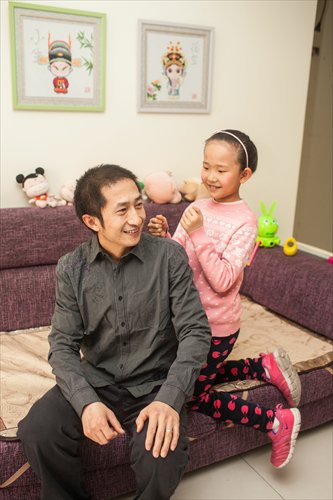
Filial piety has long been regarded as a cornerstone of traditional Chinese values. Photo: Li Hao/GT
As part of a course in filial piety, a 15-year-old student surnamed Sun was asked to write down the names of his parents and close relatives during one of his high school classes in Heilongjiang Province.
"We were asked to cross out the names one by one. The crossed out name indicated the family member dying," said Sun. "Each time we removed a name, we were told to talk about the relative. The whole class would burst into tears."
The class, designed to evoke students' feelings of affection toward their parents and other elders in the family, was part of a series of workshops and lectures meant to cultivate filial piety among Chinese youth.
The concept of filial piety, or xiaodao, is a fundamental tenet of Confucian thought, and has been a cornerstone of Chinese society for thousands of years. But with the erosion of traditional values in the face of China's rapid modernization in recent decades, some schools like Sun's have taken the initiative to remind their students of the importance of filial piety.
Meanwhile, the introduction of filial piety activities in Chinese schools, and the methods adopted, have been controversial. Besides activities like those described by Sun, ceremonies in which hundreds of students are made to kowtow before their parents as a show of filial obedience have been widely reported in recent weeks.
Amid the fervor, some media commentators and education experts have questioned the value of filial piety in modern society. Others are challenging the sincerity of such displays, as well as the efficacy of such courses in fostering genuine filial devotion.
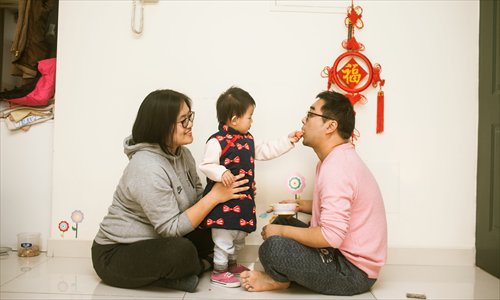
Many education experts have questioned whether the methods adopted by schools to instill filial piety are appropriate in contemporary society. Photo: Li Hao/GT
A controversial issue
The Global Times reported on January 11 that up to 750 students participated in a ceremony where students were made to kneel before their parents at Binxin School, a private school in Shanghai, during which parents and children were moved to tears.
Five days later, an article appeared on the People's Daily website, criticizing such ceremonies as insincere. "In many places, [these ceremonies] are becoming more and more formulaic, with kneeling down, kowtowing and crying as a par for the course," commentator Qin Chuan wrote. "They have become commercialized performances."
A recent poll carried out by the Beijing News showed that only 31 percent of more than 1,000 respondents supported such ceremonies unreservedly. An additional 44 percent said they endorsed the idea of filial piety activities in schools, as long as it was not only for show, while 25 percent objected to the ceremonies entirely.
Fu Jianqing, the principal of Binxin School, responded to criticisms in an interview with Shanghai-based news portal thepaper.cn. "The ritual is only one part of the school's Filial Piety Cultural Festival activities," said Fu. "[The point] is not the ritual itself, but whether the students have their minds opened by the ceremony."
Fu said that 97 percent of the school's students supported the idea of prostrating themselves before their parents. He said that the school was committed to continuing its education program in filial piety next year, but whether there will be a kowtowing ceremony would be up to parents and students.
The activities in filial piety adopted in some schools appear to be part of a concerted effort in recent years to revive filial piety in the national psyche, as a response to China's aging population.
In January 2011, 15 members of the Beijing Municipal People's Congress made a proposal to include lessons on filial piety in elementary and middle school textbooks, dividing public opinion. In 2013, an amendment to the Law on the Protection of the Rights and Interests of the Elderly caused much discussion, which states that a child who doesn't live with his or her parents should visit them often.
In November last year, China's first "filial piety museum" was opened in Qionglai, Sichuan Province. Funded by more than 500 local residents and enterprises, the museum features photographs, videos and selected objects that give testimony to the stories of dutiful children in ancient and modern China, the Xinhua News Agency reported.
Ineffective methods
Xiong Bingqi, an education expert and vice president of 21st Century Education Research Institute, said that while kowtowing ceremonies may please parents, they were completely ineffective as a way of promoting filial piety in daily life.
"Students and parents are certainly moved due to all the contrived elements [of such ceremonies], from the sentimental music to the heart-tugging speeches," Xiong said. "A one-time lecture might make some students do some housework and 'respect' their parents more, but after a while, they'll fall back into old habits."
Xiong went as far as to say that making children kowtow to parents was counterproductive to cultivating independent citizens.
"Education in filial piety requires long-term edification," said Xiong. "If education of traditional culture is limited to just reading the classics, wearing traditional costumes, and prostration, it actually damages traditional culture instead of preserving it, because it separates traditional culture from the reality of modern citizens."
Sun echoed Xiong's sentiments in describing the filial piety workshops he participated in. He recalled that during one such class, students were asked to list their parents' birthdays. Many were unable to. Afterwards, the teacher read an article about filial devotion, which reduced much of the class to tears. "But [the effect of these workshops] only lasted two weeks," said Sun. "These methods are touching, but the effects don't last long. With nobody there to remind me, I quickly lost this mentality."
Huang Feilong, a lecturer who has given hundreds of speeches at primary and middle schools about traditional Chinese values and filial piety, disagreed.
"We deliver positive energy to the parents and students," said Huang. "[To ensure the long-term effects,] we carry out comprehensive interactions, and follow-up services including house visits and counseling."
Huang said it was important to educate children about the value of filial piety, especially by using emotionally charged speeches and stories about dutiful, obedient children. Many of the students he visited would be moved to tears. Kowtowing before one's parents, or washing their feet, said Huang, were important formalities that reinforced filial devotion. "The reason why Chinese civilization has been preserved for so long is due to honouring and respecting the parents and teachers."
Changing views on filial piety
Zhu Jia, the manager of a cultural exchange company in Beijing and father to a 5-year-old girl, said that although there were shortcomings to the approaches taken by schools, he fully endorsed the initiative to promote filial piety. "I think the idea of recovering our traditions is good, but their methods are perhaps a bit too formulaic and narrow," said Zhu, who professed that he was a strong advocate of Confucian values.
Zhu said that he would prefer that filial piety be taught as part of a broader course in the classical thought and texts. He said that the sense of belonging and responsibility to one's family denoted by filial piety had been lost in contemporary society.
"I think that efforts should be made in daily life, instead of through formalized means," said Zhu. "Parents should set a good example by meeting their filial duties themselves, by calling and visiting the child's grandparents often."
Nevertheless, Zhu said that he did not completely oppose activities like kowtowing ceremonies in schools. "Although it's like putting on a show, it's a way of reinforcing positive values," he said.
In a dissertation on filial piety published in the Journal of Nanchang University, Xiao Qunzhong, a professor at the Renmin University of China, argued that the concept of filial piety had changed in modern times. While in the past, filial piety demanded absolute obedience to parents, contemporary concepts of filial piety must acknowledge the importance of equality in parent-child relationships, and should be built on love and sentimental attachment rather than submission to authority.
Reflecting these changing attitudes, in August 2012, a modern revise of Yuan Dynasty (1279-1368) scholar Guo Jujing's classic Confucian text, The Twenty-four Paragons of Filial Piety, was issued, instructing readers to carry out 24 modern time filial duties including supporting the parents' hobbies, teaching them to use computers, and supporting a single parent to remarry.
Sun said that he had witnessed these changing views of filial piety within his own family. While his grandmother still thought of filial piety as absolute obedience to one's parents, said Sun, his mother considers filial piety as learning to respect, understand and forgive one's parents.
"Each generation is different," said Sun. "It was much stricter in ancient times!"