Country boy, city girl
Romantic misunderstandings emblematic of the gaping divide between rural and urban China
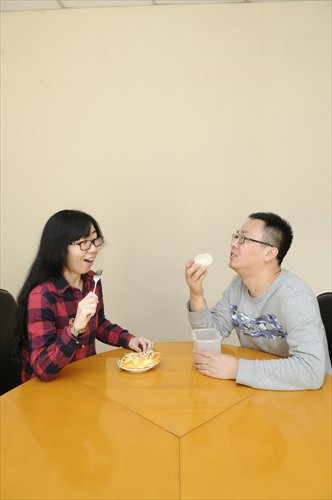
According to a survey, men who have grown up in the countryside but have subsequently found career success in the city are seen by women as the least desirable marriage partners. Photo: Li Hao/GT
A lonely hearts advertisement that went viral online earlier this month has sparked heated discussion on the Internet about the pronounced differences between China's rural and urban areas when it comes to marriage expectations and matters of the heart.
The advertisement, posted by a 30-year-old man who grew up in a poor rural village in Zhejiang Province but who now earns a good salary working for a State-owned company in a third-tier city, listed a set of requirements that has attracted the scorn of a large number of microbloggers. Any potential marriage partners, he wrote, should be willing to write his parents' names into the property deeds of any existing houses they own, or be willing to have his parents' names included in any property they buy together. Both his parents and siblings would live in the same house as them.
The woman should be from the city, an only child, and the sole inheritor of her parents' wealth. In addition, her parents should have their own apartment, their own health insurance and pensions, so as to impose no financial burdens on the young couple.
Despite explaining that his requirements were motivated by wanting to repay his parents for the hardships they had endured to put him through university, most of the comments in response to the advertisement have derided the man for being selfish, hypocritical, and money-grubbing.
Relationship complaints against fenghuangnan boil down to their unwillingness to spend money. Photo: Li Hao/GT
Phoenix men, peacock women
Men like the one who posted the lonely hearts ad are known in China as fenghuangnan, or "phoenix men." The term refers to men who have grown up in rural destitution, but have managed to move up in the world and find success in their careers in cities - like a "phoenix that has risen from the ashes."
The opposite of a fenghuangnan is a kongquenü, or "peacock women" - so-called because they have grown up in the city in relative material affluence, and are as "proud as peacocks."
Fenghuangnan and kongquenü are popularly perceived to be incompatible. An online survey conducted by Chinese news portal NetEase of 35,500 single women showed that fenghuangnan were seen as less desirable than any other type of man.
Lu Jiehua, a sociology professor from Peking University, said that the attitudes of city dwellers toward fenghuangnan was a reflection of significant social, cultural and economic gaps that still exist between rural and urban China.
"Fenghuangnan are like immigrants [to the city]," said Lu. "They face culture shock and frequently find that their views about the world differ from those who have grown up in the city."
These differences, said Lu, have been made more visible by China's massive urbanization, and especially come to the surface in intimate relationships, both personal and professional.
Case study of a failed relationship
Xu Ning (pseudonym), a 23-year-old graduate student who grew up in Changsha in Hunan Province, has experienced the difficulties of a peacock-phoenix relationship firsthand. Xu grew up in relative comfort, with both her parents bringing in decent incomes as civil servants, while her ex-boyfriend was from a small village in Shandong Province, where his parents continue to struggle economically as farmers.
"At the beginning, I was attracted by his good-looks, his charm and the fact that he had a good job at a hospital," said Xu, who met her ex-boyfriend after moving to Beijing. As their relationship developed however, Xu started to be bothered by what she felt was stinginess on his part.
"We were together for one year, and he never bought me a single present, even when there were special occasions," said Xu. "I'm a romantic person. I think presents are important, and he definitely could have afforded an occasional gift on his salary."
Not only that, said Xu, but her ex-boyfriend would always complain that she was spending too much money - even when it was her own money that she was spending. Whenever she would get her hair dyed or buy new clothes, he would nag her for days, Xu said.
"He also made it clear that I needed to give birth to a boy to carry on his family line," said Xu. "If our firstborn was a girl, I needed to continue having children until I had a boy."
Her list of grievances about things they didn't see eye-to-eye on continues.
"He said that he wouldn't buy an apartment in Beijing because property prices were too high," said Xu, who added that he wanted them to eventually move back to his hometown in the countryside.
"I can't stand the idea of living in the countryside," she said.
Finally, Xu ended the relationship after realizing that the things they wanted were too far apart. "I wouldn't say I would never date a fenghuangnan again, but I would definitely think twice about it the next time," said Xu.
A country boy's story
Yang Feng (pseudonym), a 31-year-old doctoral graduate from Tsinghua University, leads a comfortable life in Beijing with a base salary of 250,000 yuan ($40,142) per year.
However, Yang said that when he is sitting alone in his car or eating in a fancy restaurant, he can't help thinking back to his impoverished upbringing in Xiliu village, Hebei Province.
His father, a manual laborer, supported the family by carrying iron and steel weighing up to 150 kilograms from their village to the township nearby, on nothing more than a rickety bicycle, along bumpy dirt roads in the sweltering heat of summer. He remembers his mother keeping the news of her illness from him, in order not to distract him from his studies. On his 10th birthday, his older brother starved himself for two days to save enough money to buy him two tea eggs as a gift.
"I think the public's view toward fenghuangnan like me is biased," Yang said. "Fenghuangnan have a lot of virtues. We are filial, frugal and we're not afraid of hard work."
"After all, we've had to work a lot harder than people in the city just to be on the same level as them, because there's still a huge economic disparity between the city and the countryside."
However, Yang admitted that his experiences of having been poor created problems in his previous romantic relationships.
"My ex-girlfriend was from a well-off family in a city. She was used to receiving expensive gifts from her family on her birthdays, such as gold necklaces or jade bracelets," Yang said. "I decided to make her a custom birthday card which would flash with lights and sing when she opened it."
Yang's ex-girlfriend was not impressed. "I didn't have any money to buy gifts when I was growing up, so I just made my own gifts," said Yang. "I always thought it was the thought that counted."
Yang said they would also get into fights about mundane everyday matters, like where they would go to eat, or the way that he dressed.
"When we went out together, I didn't think it was important to eat at a fancy restaurant or to stay at a five- star hotel. I can eat or sleep anywhere, so long as it's clean," Yang said. "My ex was also unhappy about the way I dressed. I don't care about branded clothes. It's not that I can't afford it, but for me, the whole purpose of clothes is just to keep me warm."
Another sticking point for the couple was where they would live.
"I'm satisfied with having a home in any part of the city, and frankly speaking, I can't afford to buy an apartment downtown," Yang said. "[Whenever I spend money], I can't help but think of my parents [still] toiling on the farm and eating inexpensively and my younger sister who is still at school doing her PhD."
Yang's ex-girlfriend broke up with him last December. He said that although he has lived in Beijing for more than a decade, he was still a country boy at heart.
"My living habits and worldview are still shaped by a lack of economic means when I was growing up," Yang said.
The art of compromise
Sun Hao, a relationship counselor based in Beijing, said that every couple has differences, and that compromise and mutual understanding were the keys to a healthy relationship.
"City girls have grown up used to certain comforts, so they have higher expectations in daily life," said Sun. "Fenghuangnan might be not willing or able to provide them that kind of life, but they can meet halfway."
Sun said that in Yang's case, he could buy an apartment a little closer to downtown area to make his girlfriend happy, without having to spend as much money as buying an apartment in the center of Beijing.
"Fenghuangnan often have to shoulder a large [economic] burden for their families," Sun said. "But they shouldn't ask their spouses to shoulder the same burden with them, because it is too much pressure to put on one's partner."
As for kongquenü, said Sun, it was important that they held their tempers when conflicts arose, because often, fenghuangnan already felt a sense of inferiority from having grown up poor.
"They need to compromise more for the sake of harmony in the relationship."
Ren Xiaoyu, a kongquenü who has been happily married to a fenghuangnan for four years, is proof that phoenix-peacock relationships can work.
"My husband helps out his relatives [economically], but always within our capabilities," Ren said. "He respects me and he respects women. He doesn't have this feudal mentality of preferring boys over girls. We have a little daughter, and he loves her just as much [as he would a son]."
Ren said that they still have differences, but they have found ways of resolving them. "He is very frugal over clothes, and sometimes I get upset about it. But when those situations come up, I either talk to him openly or just let it go."