Castle romance
Discover China’s ancient fortresses and fortifications
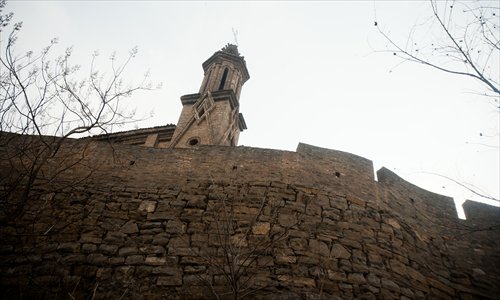
Daqi Ancient Castle and Rosary Church Photo: Li Hao/GT
The opulent fairy tale wedding of Taiwanese pop idol Jay Chou recently in Selby Abbey, an Anglican parish in a picturesque little town in North Yorkshire, England, has led hundreds of swooning social media users in China to add the medieval-era church to their "must-see" lists on their speculative Europe itineraries.
For those who cannot afford such a lavish expense, the good news is that there are ancient towers and fortresses in China every bit as stunning as the churches and castles of Europe.

The Kaiping towers in Jiangmen, Guangdong Province are among the most distinctive fortified buildings in China. Photo: Courtesy of Kaiping Diaolou Tourism Development Company
The marriage of East and West
Located in Jiangmen, Guangdong Province, the Kaiping Diaolou are a collection of fortified multistory watchtowers, constructed in the 1920s and 1930s by returning Chinese immigrants known as huaqiao who had made their fortunes abroad in places like the US, Canada, Malaysia and Australia.
Scattered across a number of villages, the 1,800-odd buildings that constitute the Kaiping Diaolou were accorded the status of a UNESCO World Heritage site in 2007.
"[They] represent a marriage of Chinese and foreign architectural forms, and stand as a historical record of the lifestyle and culture of Chinese huaqiao," said Chen Zicong, marketing director of Guangdong Kaiping Diaolou Tourism Development Company.
According to the official Website of the attraction, the best time to visit the towers is in spring, when the buildings look especially stunning framed against the blossoming of yellow canola flowers on the surrounding farms.
Unlike abbeys or cathedrals in the West, said Chen, the Kaiping towers were not intended as spaces for public communion, but rather as homes for wealthy returned Chinese immigrants. Consequently, they usually occupied a much smaller floor area.
"They served as houses, but were also strongly fortified to defend against forays by bandits, who ran rampant during the time they were built," said Chen.
Chen said that some of the buildings had been abandoned for decades, but any descendents of the original land-holders who could present evidence of ownership, such as a set of keys or a property deed, could reclaim rights to the towers under local laws in Guangdong.
The Kaiping towers have received greater attention in recent years due to being featured in big-budget movie spectacles such as Jiang Wen's Let The Bullets Fly (2010) and Wong Kar-wai's The Grandmasters (2013), but they still remain relatively unappreciated compared to many other tourist sites in the country. A 2013 CNN report noted that the city of Kaiping only receives around 600,000 visitors per year - the number that China's most-visited cities might receive in a week.
Kaiping's other attractions include its authentic Cantonese cuisine. In Chikan, one of its villages, travelers can sample traditional dishes such as baozaifan, rice that has been cooked in a clay pot by firewood, fish porridge and duck porridge.
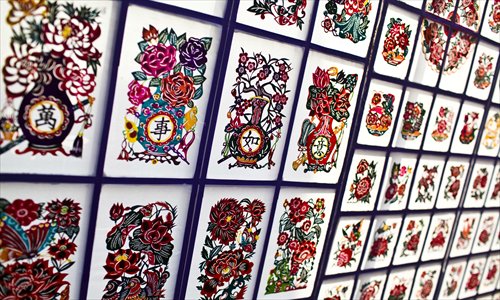
Paper cutting is a traditional folk art in Yuxian Photo: Li Hao/GT
The catacombs of China?
Underneath the Zhangbi ancient village in Shanxi Province is a labyrinthine network of tunnels reminiscent of Paris' famous catacombs. The tunnels extend as long as 5 kilometers, and are organized into three layers, with the bottom layer up to 20 meters underground.
Half an hour by car from the nearest city of Jiexiu, the fortress compound and underground tunnels were built during the Sui and Tang dynasties (581-907). The fortified complex added residential spaces and areas for social life such as a theatre in the Yuan (1279-1368), Ming and Qing dynasties (1368-1911). In addition, there are 16 temples and towers in the village as places for religious devotion.
Zhao Chen, a 28-year-old Beijing-based software engineer who visited Zhangbi last year, said it was a memorable experience.
"The three-layer underground tunnels are the most amazing and unique part of Zhangbi village," said Zhao. "We had flashlights to light our way through the tunnels, which have not been restored."
According to legend, Zhangbi's fortress was built by armed rebel forces who wished to overthrow the Emperor Taizong of Tang (626-649). The tunnels were dug for soldiers to hide in.
Touring the tunnel, Zhao said he was fascinated by the underground world. "We saw embrasures through which people could shoot their guns while remaining concealed," said Zhao. "[The tour guide told us] that the Chinese army strategically use the tunnels as shelters and for fighting during the War of Resistance against Japanese Aggression (1937-45)."
Compared to the decadent courtyards built by affluent Jin merchants during the Ming and Qing dynasties in Shanxi which have been restored, Zhangbi still bears the marks of the erosion of time.
"Strolling around the ancient village, it was also intriguing to have a closer look at the life of local people who still live in the old, sometimes pretty humble houses. You can feel other Shanxi folk customs," said Zhao.
The small village was also featured in popular director Feng Xiaogang's Back to 1942 (2012), about a famine that swept the area during the Sino-Japanese conflict.
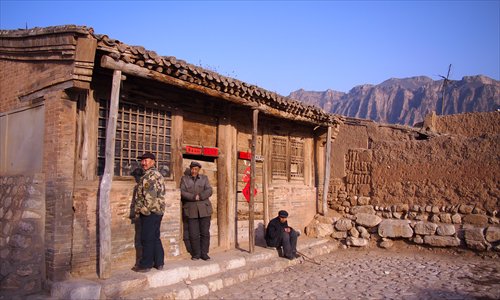
Villagers in Yuxian Photo: Li Hao/GT
Yuxian Castle
For those planning to spend Spring Festival in Beijing, the ancient township of Yuxian in Zhangjiakou, Hebei Province, is a short three to four hours drive away.
Yuxian, built between the Liao and Qing dynasties (916-1911), boasts plenty of ancient architecture, from palaces to temples to theatres to courtyards. Located 280 kilometers north of Beijing, the town was a place of geographical and strategic significance during the Ming Dynasty as it lay on the border between Huabei and Zhangbei, separating the Zhongyuan people from the nomadic people. Zhongyuan people mainly refer to people who live in the middle and lower basin of Yellow River and upper basin of Huaihe River. Nomadic people refer to Mongolian and Manchu people.
From the Ming Dynasty onwards, fortresses and other military fortifications were built to bolster the town's defenses.
During the day, the town's inhabitants would work on farms outside the gates, and return before the gates were shut at night.
"Yuxian provides a fascinating subject for photography enthusiasts who are interested in architecture and ancient villages," said Hou Jiajing, a Beijing local who visited the ancient town during 2013 Spring Festival holidays.
"Compared with the well-preserved and restored cultural relics in Beijing, Yuxian's buildings are rough and kind of damaged, a testament to history," said Hou.
Apart from ancient architecture, visitors can also observe the traditional custom of Da Shuhua in the nearby town of Nuanquan over the Spring Festival period. The 300-year-old tradition involves throwing hot molten iron against a cold stone wall to create sparks resembling fireworks. The practice has been designated as an "intangible cultural heritage" by the local government, in acknowledgement of its distinctiveness.
Not too far away is the Jimingyi Ancient Post Station, dating back to the Yuan Dynasty (1206-1368) and the only extant post station office of its kind. Zhangjiakou is also the site of a joint bid with Beijing to host the 2022 Winter Olympic Games.
Six Chinese castles
1 Kaiping Diaolou in Jiangmen, Guangdong Province
2 Zhangbi ancient village in Jiexiu, Shanxi Province
3 Yuxian Ancient Castle in Zhangjiakou, Hebei Province
4 Fujian Tulou in Zhangzhou, Fujian Province
Ancient rural farmhouses built by the Hakka people between the 12th and 20th centuries as strongholds against attack.
5 Daqi Ancient Castle and Rosary Church in Zezhou, Shanxi Province
Built in 1914, the castle features Chinese style of fortress, and the church features Gothic architecture style.
6 Xiangyu Ancient Castle in Jingcheng, Shanxi Province
Built in 1634 during the Ming Dynasty, this castle is perhaps the most famous among all the fortresses in the north of China.