Faltering EU breeds youthful euroscepticism
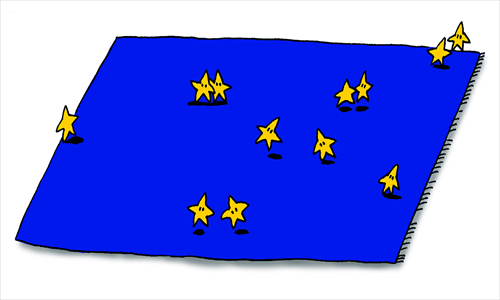
Illustration: Liu Rui/GT
Eurosceptics are no longer crabby old men ranting about pounds and ounces or pounds sterling. Increasingly, it is young voters who are turning against the European project, argued a recent article in The Economist.
The article examined how right-wing eurosceptic political parties of major European countries are successful in attracting young people, citing economic factors as the main reasons. In Germany, this conservative trend has been frighteningly apparent. The anti-EU party Alternative for Germany (AfD) receives a large proportion of its votes from the under 30s. Young people are also heavily involved in PEGIDA, a movement which has grown rapidly since last October, organizing massive xenophobic uprisings against what it calls "the Islamization of the Occident."
Euroscepticism is increasing across the board. Both creditors and debtors, eurozone and non-eurozone countries, left and right, and young and old people are becoming wary of the EU. Prior to the crisis in 2007, 57 percent of European citizens trusted in the EU, dropping to 31 percent just five years later, where it has roughly remained until a more recent upturn. The bottom line is that euroscepticism is no longer a British "disease" - the virus has spread across the continent, and is not only taking the old and weak. As The Economist article observes, ultra-right parties across many European countries are experiencing their greatest success with people aged 18 to 30, including AfD, the Greek Golden Dawn, Hungary's Jobbik party and the Dutch Eurosceptic Freedom.
Economic factors have certainly had an impact on this, with unemployment hitting hard in many countries across Europe. This has resulted in an EU-wide youth unemployment rate of 21.7 percent, more than twice as high as the adult unemployment rate of 9 percent, as well as 7.5 million Europeans aged 15 to 24 who are neither in employment, nor in education or training.
But the economic reasons leading to euroscepticism are not the same across Europe, and it is misleading to claim that they have consistently led to specifically right-wing, anti-EU parties.
While unemployment is certainly an issue in countries like Spain and Greece, Germany's unemployment rate hit a record low in March. A 2014 Eurobarometer poll found that while 23 countries saw unemployment as their nation's biggest challenge, immigration was at the top of German and UK agendas, while the Netherlands' greatest issues were health and social security.
These different economic issues have led to proportionally varying combinations of conservatism and euroscepticism, and sometimes no combination at all. Greece is the best example of a country in which economic issues have led voters down a radically xenophobic path, but also recently caused the election of a left-wing party that is not willing to stay in the EU at all costs.
Spain is another example of a country in which the eurocritical Podemos party swings far to the left, and appeals greatly to young people by addressing problems of anti-austerity, unemployment and corruption.
Young people are becoming increasingly eurosceptic, but also becoming increasingly radical, both left and right. If the trend continues, this may significantly change the future of European integration, a destination the previous generations having worked hard to reach.
The hope by pro-EU advocates is that as growth picks up, euroscepticism will weaken and eventually diminish. However, the collapse of trust in the EU runs deeper. Enthusiasm for the EU will not keep growing unless the EU profoundly changes the way member states and citizens relate to one another.
Since the crisis began, citizens in creditor countries have become resistant to taking responsibility for the debts of others without having mechanisms for controlling their spending. On the flip side, with fiscal coordination by the European Central Bank for comprehensive domestic reforms, Eurocrats have crossed many red lines of national sovereignty, extending their reach to areas that go to the heart of welfare states and national identities.
Few in either the north or the south feel that they are able to direct their country's own path. It is critical for EU policymakers to consider how to quell excessive nationalism, while recreating at the European level the substantial portion of democracy that has vanished across most national levels.
The author is a freelance writer from Germany, who divides her time between London and Berlin. opinion@globaltimes.com.cn