HOME >> WORLD
Cameron's unexpected triumph leaves UK's future in Europe unclear
Source:Reuters Published: 2015-5-9 9:35:29
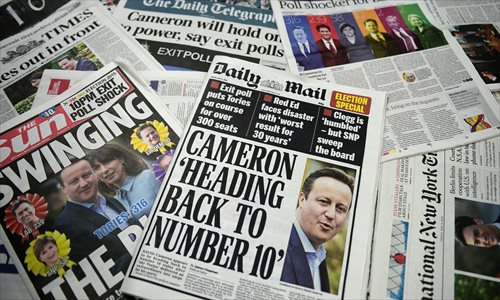
A picture of an arrangement of British newspapers carrying headlines dominated by exit poll forecasts in favor of the Conservative Party in the British general election taken in London Friday. Prime Minister David Cameron’s Conservatives are on course to be the biggest party in the next British parliament. Photo: AFP
Prime Minister David Cam¬eron won an emphatic election victory in Britain, overturning predictions that the vote would be the closest in decades to sweep into office for another five years, with his Labour opponents in tatters.
The sterling currency and share prices soared on a result that reversed expectations of an inconclusive "hung parliament" with Cameron jockeying for power with Labour rival Ed Miliband. Instead, Cam¬eron was due to meet Queen Elizabeth before noon to accept a swift mandate to form a government.
But despite the unexpectedly decisive outcome, more uncertainty looms over whether Britain will stay in the EU, and even hold together as a country.
Scottish nationalists swept aside Labour, meaning that Scotland, which voted just a year ago to stay in the UK, will send just three representatives of major British parties to parliament and be all but shut out of the cabinet. That could revive calls for it to leave the UK.
Cameron's victory also means Britain will face a vote which he has promised on continued membership in the EU. He says he wants to stay in the bloc, but only if he secures changes to its rules in negotia¬tions that have not yet begun.
Cameron returned, smiling, to the prime minister's office in Downing Street early on Friday.
With almost all seats declared, the Conservatives won an overall majority to govern alone for the first time since 1992. Miliband announced his resignation as Labour Party leader on Friday.
"Britain needs a strong Labour party. Britain needs a Labour party that can rebuild after this defeat so we can have a government that stands up for working people again," Miliband told a party meeting.
Cameron no longer needs the Liberal Democrats, with which he has governed since 2010. The centre-left party was crushed, perhaps reduced to single digits after winning 57 seats five years ago.
Among the stunning results, Ed Balls, in line to be chancellor of the exchequer if Labour had won, lost his seat.
Cameron sounded a conciliatory note, especially towards Scotland, likely to be his first immediate headache.
"I want my party - and, I hope, a government I would like to lead - to reclaim a mantle we should never have lost, the mantle of one nation, one United Kingdom," Cameron said. Sterling gained more than 2 cents against the dollar to rise above $1.55 for the first time since late February, and looked on track to enjoy its biggest one-day gain against the euro since January 2009.
The FTSE 100 stock index was up 1.45 percent at 6985, approaching a record high set last month.With almost all of Scotland's 59 parliamentary seats counted, the Scottish National Party (SNP) had won 56 of them, up from just six five years ago, all but obliterating Labour in one of its historic strongholds.
"We're seeing an electoral tsunami on a gigantic scale," said Alex Salmond, the party's former leader, now elected to represent it in parliament in London.
"The SNP are going to be impossible to ignore and very difficult to stop," he said, saying such a result would strip Cameron of any legitimacy in Scotland where his Conservative Party would have only one lawmaker.
The UK includes England, Scotland, Northern Ireland and Wales. England makes up 85 percent of the population but Scottish politicians elected to parliament in London have historically held important government posts.
That will now be impossible with the SNP holding nearly all Scottish seats.
In a body blow to Labour, Douglas Alexander, the party's campaign chief and foreign policy spokesman, lost his seat to a 20-year-old Scottish nationalist student. Scottish Labour leader Jim Murphy was also toppled.
Labour's Miliband is widely expected to resign in the wake of his defeat. A North London socialist and self-described "geek" who never quite connected with working-class voters, he ran a campaign that was widely seen as better than expected, but was always far behind Cameron in polls that asked voters who they saw as a more credible leader.
Posted in: Europe