Staying chaste
Premarital sex still a contentious topic in China
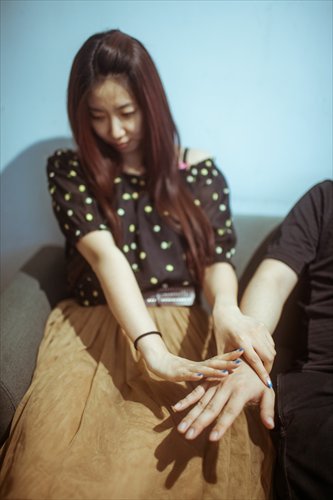
Many people in China still believe that women should remain chaste before marriage. Photo: Li Hao/GT
"Are you also a virgin? Do you value chastity? Have you a sense of morality?" An Ran, a vocal member of a popular QQ online chastity group, asks at the beginning of her interview with Metropolitan, expressing that she does not speak to people who don't share the same belief as she does. "Whether you're a man or a woman, I believe it's a person's responsibility to not be involved in any sexual relationships before marriage."
The 28-year-old civil servant from Xi'an, Shaanxi Province has had a number of suitors, and ended a two-year-long relationship in April. But before agreeing to date a man, she is adamant that he must also be a virgin.
"[Staying chaste] is the right thing to do for your future husband or wife so they won't feel uncomfortable about your romantic past," she said, adding that it would mean that one's body was "clean" and that it would ensure one's eventual marriage partner would "be loyal forever."
"It's also the right thing to do for society," she continued. "Sex before marriage is a sin. It leads to abortion, which is a form of violence, as well as the risk of sexually transmitted diseases."
According to a recent study cited in a Xinhua News Agency report last month, 71 percent of women between the ages of 20 and 39 in China's urban areas have had premarital sex. Another survey last month, of 10,000 women in 10 of China's cities conducted by women's social media community hub Her Style, found that nearly one in four were willing to propose casual sex with a stranger through online platforms.
Against these increasingly liberal attitudes toward sex however, there has also been a backlash, with a number of media reports in recent times indicating that many in the country continue to hold more traditional values toward sex and marriage.
Speaking out against premarital sex
Last week, the Guangzhou Daily reported that a 22-year-old woman surnamed Wang filed a complaint with police after her hymen was accidentally broken by a doctor during a premarital check-up, sparking heated discussion on the Internet about the value of premarital chastity.
Wang is quoted as saying in the report that the reason she was so upset was because she had hoped to leave her hymen intact for her future husband, so she could prove that she had not engaged in premarital sex.
The article has been read more than 2.7 million times online, with a large number of Net users leaving comments praising Wang for her traditional values.
Other examples abound. In 2012, Tu Shiyou, 41, founded her own website advocating premarital chastity, on which she declared herself a "Chastity Goddess" and published a medical certificate verifying that she was still a virgin. According to a Modern Express report in February that year, her website received more than 100,000 views on Sina Weibo in the first week.
In 2010, the Nanfang Daily reported that Zhejiang University had started running a course advocating marital chastity, and in 2008, the Spring City Evening News reported that local education authorities in Yunnan Province had introduced a textbook to be used in middle schools and high schools in the region that preached the values of staying chaste before marriage.
While Zhejiang University shut down its course after one month, amid astringent criticisms from well-known sociologist Li Yinhe, from the Chinese Academy of Social Sciences, and prominent sexologist Fang Gang, from Beijing Forestry University.
The textbook, titled Jinsheng wuhui ("Don't have any regrets in this life"), remains in use two years before being cast aside in August 2010 in Yunnan.
Online as well, there remains a small but committed undercurrent of those against liberal sexual practices. A Baidu forum for people committed to remaining chaste before marriage has nearly 16,000 members, and on QQ, there are more than 50 chastity support groups, each with around 100 members.
An belongs to one such group.

While many still succumb to social pressures of remaining chaste before marriage, some experts say the choice should remain up to the individual. Photo: Li Hao/GT
Committed to chastity
"I refuse to date or marry someone who is not a virgin. I'm compulsive about this when it comes to my relationships," said An. "I can't stand the idea that my future husband has had other women before me."
In her last relationship, her ex-boyfriend asked to have sex with her after they had been going out for two years, she said. An turned him down, and then broke up with him for asking.
"If he wanted to have sex with me, he should have proposed to marry me first, or else he's just a fraud," An said. "I want to find someone who shares the same beliefs as me."
An said she had seen too many examples of women around her who slept with their boyfriends, only for the man to dump them afterward.
"Once a woman has sex with a man, he will no longer be attracted to or intrigued by her, so he won't marry her," she said. "Such women will end up as spinsters or be forced to marry down, because no decent man would want to marry a 'second-hand' woman."
Chen Xi, a 22-year-old male college student from Guangzhou, Guangdong Province, is of the same mind as An. "I want to find a virgin to be my wife in the future. If I demand that the woman remain chaste, I have to remain that way too. It's only fair."
Chen said when he broke up with his ex-girlfriend, she had offered to sleep with him in order to save their relationship, but he refused. "She should save her virginity for someone who wants to marry her."
Chen admitted that his friends frequently taunted him for his stance on premarital sex, saying that the only reason he remained a virgin was because he wasn't attractive enough to find a girl who was willing to sleep with him.
He refuted the fact, and insisted that it was because he was determined to stick to his values - even if it meant he wouldn't be having sex for a while yet. "I might get married after 30, since people tend to marry late nowadays," he said.
Hangover from 'patriarchal society'
Peng Xiaohui, a sexology professor at Central China Normal University, said that it was a personal choice as to whether someone has sex before marriage, but people who possessed a "virgin complex" - those who see their virginity as the sole or most important trait defining their identity - were clinging to the vestiges of patriarchal society.
"The virgin complex comes from past patriarchal society, when women didn't have any means of earning their own income, and their livelihood was entirely dependent on their husbands," said Peng. "Virgin complex belongs to a logic that views women as products [to be bought and sold]. A woman's value [in those times] was based on her virginity and fertility, which could be exchanged for [economic] security."
In undeveloped economies, there was a tendency for people to value premarital chastity, said Peng, because people could not afford to raise a child alone. In such places, consummating a relationship through sex is a way of creating a binding economic contract.
"The reason why in many Western countries there is now little regard for staying chaste before marriage or having children out of wedlock is because their economies are more developed than China's, and their social welfare systems allow people to raise a child out of wedlock," Peng said. According to a 2013 CBS News report, 48 percent of first births in the US occur out of wedlock. The exception to such liberal attitudes toward premarital sex in Western countries, said Peng, was people who held religious beliefs that preached chastity before marriage.
He said that personally, he thought that people who still had a virgin complex - tied to the idea of bleeding on marriage night - were "ridiculous."
"Thirty percent of women [who haven't had sex] won't bleed on their first night," Peng said, citing a report from the British Medical Journal in August 1998.
"They might have been born without a hymen, or their hymen may have broken already due to strenuous physical activity," said Peng.
"Does that mean they're still chaste?" he asked quizzically. "I support staying chaste if a person is just making that choice for himself or herself, but it's not right if he or she imposes that belief on other people."
Chastity: Better sex after marriage?
To Peng's chagrin, there remains a vocal contingent of those who preach the benefits of not having sex before marriage.
Yang Bingyang, a columnist and author of relationship books, repeated a familiar refrain about the two sexes wanting different things from a relationship.
A man, said Yang, simply wants to have sex, whereas a woman wants marriage. "If a woman is reticent when it comes to sex before marriage, then a man is more willing to marry her because the man will believe that there is a lower chance of her being unfaithful after marriage," Yang said. "The man will also tend to invest more in her after they are married, since he is convinced she is faithful."
A Huffington Post report last August cited a study carried out by two professors from the University of Denver that found the more sexual partners a woman had before marriage, the less happy a woman reported her marriage to be.
But Jim McNulty, a social psychology professor from Florida State University who has also published a significant amount of research on the topic, told the Huffington Post that people should not interpret the correlation as meaning that having more sexual partners before marriage causes one to be unhappy in marriage.
"For example, people who tend to avoid commitment in general may have more sexual partners and be less happy when they settle down. It's not the fact that they have more sexual partners that leads them to be less happy, it's the fact that they don't really like commitment," wrote McNulty. "I would be very surprised if having multiple sexual partners before marriage, independent of any other factor, has a direct causal influence."
Peng said that different people had different attitudes toward sex, but the important thing was that people were free to make their own choices. "We need to make sure that people have the freedom to make the choice [about premarital sex] on their own, instead of being forced into a particular choice because of social pressure."