The art of doujinshi
The creation of ACG fandom works, giving rise to a new subculture
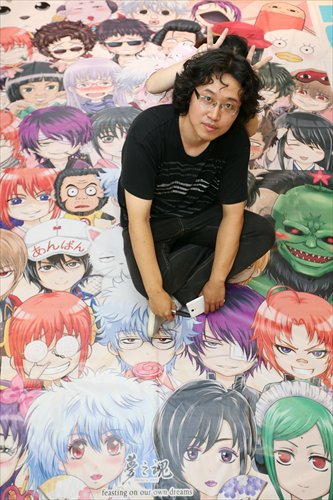
Doujinshi comic artist Lu Yingnan, well-known in the circle as Ming Wang, is surrounded by his artworks based on the Japanese comic and animation series, Gintama. Photo: Cui Meng/GT
Fan Junyi, a 16-year-old high school freshman wearing a purple wig, took a deep breath, wanting to take in everything at the "doujinshi" fair on Saturday.
With artists signing their works for fans, and products such as books, posters, and cartoon printed pillows, stationery and more on display at the Shenyu Art Museum in Xicheng district, a layman would not be able to tell the difference between this fair and a traditional comic con.
However, this one is a doujinshi convention exclusively for recreational fandom works of Japanese comic and animation series Gintama, or Silver Soul.
While doujin refers to people with a shared interest in the animation, comic and game (ACG) community, doujinshi is a Japanese word that describes amateur works, including novels, music, videos and games, which are created by fans based on certain original works. It can be loosely translated as "fandom works."
"Takasugi and Katsura engage in a lot of affectionate flirting in some doujinshi stories, which is one of my favorites," said Fan.
The two male characters from Gintama were actually enemies in the original story.
It's beautiful that two people care for each other despite their different pursuits in life, and this kind of love story between two lovable supporting characters can only be found in doujinshi novels rather than in the original comic, said Fan.
"Doujinshi works can reveal and interpret some elements which are not shown in the original works in an elaborate way," she said.
According to Lu Yingnan, organizer of Saturday's convention, the event attracted about 800 fans. More than 100 original doujinshi illustrations by young authors, mostly in their 10s and 20s, were submitted for exhibition.
Domestic doujinshi authors and their readers have their eye not only on original works from Japan and the West, but also on original domestic works along with the growth in the ACG industry in China.
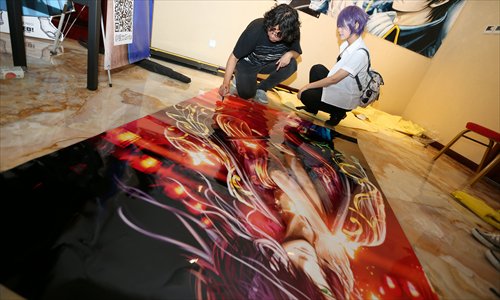
Fan Junyi gets the poster she bought at Saturday's doujinshi fair autographed by the author. Photo: Cui Meng/GT
Doujinshi fans
"As a student with not much money, I am still willing to pay up to 500 yuan ($80) for Gintama doujinshi products," said Fan.
Gintama, known as one of the most popular comic and animation series in Japan since its first appearance in 2003, sees a large amount of doujinshi creations among Chinese fans, too.
"It satisfies my fantasies in many ways, such as all sorts of different CP (character pairing) lines," said Fan.
Fans turn to doujinshi works to satisfy their need to see their beloved characters, especially the male ones, falling in love with each other, Fan said.
On top of many fans' preference for male-male romance, doujinshi works also range from comedy and tragedy, to drama and sexually explicit stories, dividing readers into many sub-groups.
Among Fan's friends, there's quite a big doujinshi fan circle, where they share their views. Fan also plans to write doujinshi novels in future and to organize a small doujinshi fair with the help of her cosplay club in October.
Alternative creators
Lu, 33, started drawing doujinshi comics in 2009. According to him, that is when doujinshi creation started to take off in Beijing.
Among the 80 and 100 comic cons annually held in Beijing, what Lu is really interested in are the handful of doujinshi-exclusive conventions, where he finds "creativity or vitality."
"We lost interest in traditional comic cons because they all follow the same pattern. You can only find the exact same products, most of which are knock-offs," he said.
"Doujinshi is what I really want and how I meet like-minded people."
To better develop the community, Lu co-founded a doujinshi authors' league a few months ago, which already comprises more than 100 comic artists in the country.
Doujinshi communities serve as a talent bank, according to Lu, estimating that there are about 50 doujinshi societies in Beijing, mostly in college and high schools. "Those societies serve as simulation practice for what it really means to become original comic artists or game designers and marketing personnel in the industry."
Many professional artists started off doing doujinshi and still create doujinshi works even after going professional, said Lu.
Recreation encouraged
"It's a way for original authors to interact and converse, for fans to express and use their imagination," said Lea Liu, a writer on ACG-related topics on zhihu.com (a popular question-and-answer website).
Liu, who graduated from the Animation School of the Beijing Film Academy, wrote her graduation dissertation on doujinshi culture.
It explores the pros and cons of doujinshi works to original creators. It recommends that doujinshi works be encouraged to raise exposure and influence.
"I hope creators of the original works will attach more importance to and make good use of these creations, instead of suppressing it," said Liu.
One of the domestic ACG products that has generated a lot of doujinshi works is The World III, an online game that is run by game.163.com under China's Internet giant, NetEase. A search on baidu.com for "The World III" and "doujinshi," yields more than 5 million results.
Zhang Haixing, marketing director of The World III, told Metropolitan that after researching the likes and behaviors of its players in the past seven years, they aim to build the game as a signature model in the domestic sector, that celebrates the flourishing doujinshi culture.
"Positive encouragement and guidance of the development of doujinshi creations are very important to creators of the original works," he said.
"Doujinshi creation is not only about players expressing their love for the game, but also goes a step further recommending and publicizing it to the rest of the world."
Furthermore, some original creators like The World III would do market research to determine what fans' needs and wishes are, and then they extend the plots accordingly.
For example, the new plots of the game might reveal a happy ending for the non-player characters (NPCs) who the fans wish to see as a couple, said Zhang. They also hold carnivals regularly where fans can dress in cosplay and give their own interpretations of the game.
Copyright clash
Copyright is usually a complicated issue in doujinshi creation, said Zhang.
He said whether an individual profits from doujinshi or not determines whether it's legal, and whether they have respected the originals' copyrights or not, determines whether it's moral.
"Our game encourages and supports players to recreate works based on intellectual property, only on the premise of not profiting and not violating others' copyrights," he said.
Since doujinshi works are not printed in large quantities and are not profitable, most companies tolerate this kind of recreation, said Liu.
"For the copyright holder, doujinshi can be a double-edged sword. It can help expand influence, or it can hurt the originals' image and diminish profits," said Liu, citing the situation in Japan as example, where the culture is more mature and has been flourishing since the 1970s.
In Japan, most original creators accept recreation, but they still might go to court if doujinshi works seriously violate their rights.
According to Lu, copyright is a problem for doujinshi authors, too. Many like himself share the trouble of piracy.
"You can see imitation products on the market soon after I release my works online," he said. "In the past few years, the enthusiasm of doujinshi has attracted many companies. The piracy business also eyes the market, and many doujinshi authors' works are being copied."
Flourishing subculture
Since its premiere on July 10, King of Heroes, a 3D cartoon movie, has sparked the recreation of lots of doujinshi illustrations, short comic stories, video clips, and fiction.
The film tells the story of the Monkey King, a well-known fictional hero originally from the Chinese classic, Journey to the West.
Its director Tian Xiaopeng told Metropolitan that the rising number of good quality doujinshi works of the film has been surprising and encouraging for him.
"Many [doujinshi authors] have done a very good job. Not only the techniques used, but also the stories they have come up with are impressive," he said.
"They have wonderful extensions and interpretations of the story."
Tian said doujinshi works inspire him a lot.
"To the original creators, it shows that there's a good audience base," he said. "Original creators' passion comes from the audience, and doujinshi works can greatly encourage us."
"I hope there will be more works co-created by creators of the original works and the fans, which might open the door to a new form of creation," said Liu.