Ugly school uniform dents students’ confidence
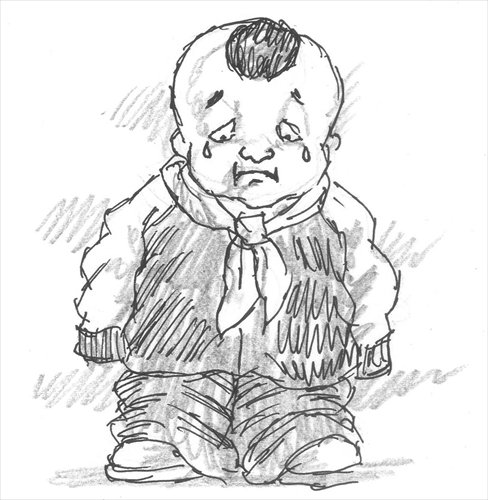
Illustration: Peter C. Espina/GT
Chinese school uniforms have been criticized for years, usually for being ugly, unfashionable, and outdated.
For most students, the school uniform in their memory is just a synonym for sportswear, awfully designed with long and slack sleeves and pants legs, and ordered by school authorities from some unknown and unqualified small workshops.
A survey by the Bureau of Quality and Technical Supervision in Shanghai in 2013 found that 16 out of 22 batches of school uniforms were "poor-quality," and one of them was even made from carcinogenic material.
After grabbing headlines for years, school uniforms have finally been given due attention by top government authorities. The Standardization Administration of China recently released a set of national standards to regulate the production of school uniforms, which is purchased voluntarily, and school authorities must encourage their students to join in the design process.
The new policy not only aims at offering more protection to students, but also hopes to relax the tight rope around their necks and remove the backwater nature of school life.
The rigid atmosphere that looms over Chinese elementary and middle schools has drawn an increasing number of criticisms than before. Many school authorities still stick to a hard-line approach in dealing with the demands of students. There have been several instances across the country of students committing suicide after their teachers humiliated them for having "unacceptable" hairstyles.
Since results of studies are usually different and even contradictory, there is still no convincing empirical research that can assert school uniform is good or bad for the growth of young students.
But in China, one widely accepted school uniform has been proven beneficial to the students. In 2002, Shenzhen, the pioneer city of China's reform and opening-up, adopted a policy to standardize and unify all middle and high school uniforms, which is a good way to guarantee quality. Besides, it seems that the design is also pleasant to the majority of students.
Fans of the uniform have even created social media accounts on Sina Weibo and Instagram that call Shenzhen students to post photos with the uniform on. More interestingly, the popular and mass-produced uniform was added this April to an exhibition at the Victoria and Albert Museum in the UK. Kristian Volsing, curator of the museum, said, "The uniform has created an identity for the citizens of a city that didn't exist 40 years ago."
Shenzhen, a young migrant city, has found cohesion through a school uniform, the power of which shouldn't be underestimated. However, Shenzhen's success is not typical of most Chinese schools, which have barely paid attention to the issue. Most students across the country are still forced to dress in poorly made, ugly, and badly fitting clothes that weakens their sense of confidence and school identity.
Although school authorities and students now have more autonomy to decide on their uniforms, we must remain cautious about the implementation. Cases of school personnel embezzling funds for school uniform or receiving kickbacks from unqualified factories are not unheard of.
Parent's associations must assume a bigger role in cases like this, as a supervisory body that plays a role in the school's financial business. Although many schools do not have a parent's association, it is high time that the educational authorities demand the establishment of such organizations for every school. The outdated school-students-parents relationship which was established on information asymmetry should be changed as soon as possible.
The reform of school uniform is actually a reflection of a lot of maladies in Chinese education. Only when students are proud of their school uniforms can we say the country's education is finally on the right track.
The author is a Global Times reporter. liuzhun@globaltimes.com.cn