Baijiu goes global
International day launched to boost China’s traditional ‘firewater’
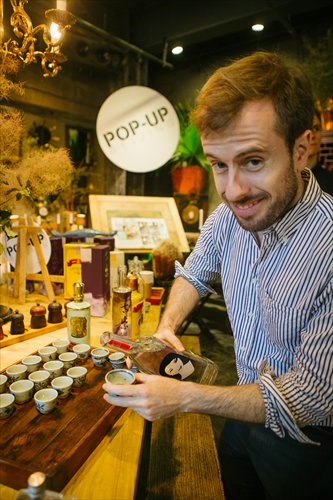
Foreigners taste all kinds of baijiu from China and abroad at a warm-up baijiu tasting event on Tuesday ahead of World Baijiu Day on August 8. Photo: Li Hao/GT
When Brian Hewson from New Zealand first tasted baijiu (white liquor) at a gathering with his colleagues in Shanghai almost four years ago, it was not a pleasant experience.
Hewson was shocked at how his Chinese colleagues could down the shots so quickly. After taking just one shot, the sharp, pungent odor brought tears to his eyes. "It was like firewater. A fire pouring out of my mouth which burned my throat and taste buds," said Hewson, 50, who cannot remember how many shots he had. His only memory of baijiu that night is its pungent taste and its high alcohol volume.
The New Yorker reported on July 28 that the production of baijiu accounted for a third of all alcohol produced around the world in 2012, according to a report released by the International Wine & Spirit Group. However, like Hewson, the baijiu experiences of many foreigners in China are the painful ganbei (bottoms up). Many have taken to Twitter, Facebook and Weibo to express how awful it tasted. As for foreigners outside of China, many have even never heard of baijiu.
Jim Boyce, a Canadian wine expert and wine blogger in Beijing, wants to change that with a World Baijiu Day planned this Saturday.
Launched by Boyce, a total of 18 cities including Beijing, Shanghai, London, Los Angeles and Sydney will participate. Both Chinese and foreigners are expected to see baijiu-related events such as baijiu cocktail competitions and using baijiu in food on that day.
"Baijiu is the most consumed alcohol in China, outselling vodka, gin and whisky, but almost no one outside China has tried it. The goal [of launching the World Baijiu Day] is to get people to try it," said Boyce.
Like Boyce, many other owners of bars and new baijiu brand companies in other countries are trying to promote baijiu culture around the world by changing the formula slightly, lowering the alcohol level, changing the ingredients and brewing methods as well as holding promotional activities, in order to give foreigners the opportunity to try the variations of baijiu.
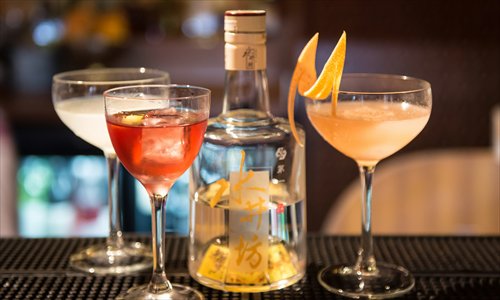
Baijiu cocktail made with a famous Chinese baijiu at the first master class of WSET. Photo: Courtesy of Paul Mathew
Catering for foreign tastes
Though Hewson's first experience with baijiu was not a pleasant one, four years on and he has gradually developed a taste for it by sipping rather than downing it.
After tasting baijiu at the warm-up tasting event Tuesday for World Baijiu Day, Hewson said most foreigners' first experience is ganbei.
"Inevitably one ends up drinking too much and will say, 'Oh, I will never drink it again.' They don't like it because they do not get the time to be familiar with the taste," he said. "Instead of ganbei, the tasting event taught me to take my time to appreciate the aftertaste and understand it."
"Taizi [a kind of baijiu produced in New Zealand] is great. When you first smell it, there is no smell. But after you take a sip, all kinds of flavors spread in your mouth. I can even taste some spices such as anise. It is complex in flavor," he said.
Hewson has found that internationally, people now take baijiu more seriously since not only Chinese but also foreigners are producing baijiu.
"I have got to know two brands of baijiu [produced] overseas from the tasting event, which is very interesting," he said.
Matt Trusch, founder of Bye Joe USA which produces a baijiu variant with two infused flavors - dragon fire and tiger eyes - told Metropolitan that more and more baijiu brands are being produced and sold overseas to attract a foreign following.
Trusch, who became a fan of baijiu when he studied in China 23 years ago, imported 100 percent red sorghum spirit from China and used an American filtration system to improve the spirit. With many foreigners finding traditional baijiu too potent with an average of 55 percent alcohol and unsuitable for mixing cocktails, he lowered the level to around 40 percent, which is more palatable for Americans.
Baijiu bar culture
Luke Hambleton, a marketing manager from the UK, is planning to attend a baijiu cocktail tasting event at The Hide Bar for World Baijiu Day in London.
As a regular at The Hide Bar, a bar that offers five brands of baijiu and baijiu cocktail in London, the sight of a baijiu bottle and its distinctive aroma in a bar brings back his memories of living in Beijing several years ago.
In China, Hambleton had drunk many brands of baijiu including Hongxing and Niulanshan Erguotou. "They kept me warm through the Beijing winters and kept the conversation flowing on a summer's evening over lamb BBQ," he said.
For Hambleton, baijiu has a very distinct and over-powering flavor and aftertaste, which makes the drink stand out from other strong spirits like vodka, sake or soju, but he has to admit that his friends and relatives are generally not fans of baijiu.
Changing people's perceptions are very important, said Hambleton. He hopes to see baijiu used in pre-mixed drinks, which he thinks can help change perceptions.
Some bar owners and bartenders in London are already trying to popularize the spirit by changing the ingredients and brewing methods, and organizing baijiu sessions.
"The flavors of baijiu are quite unusual. I don't know of anything quite like it, so I think it takes a few tastes and a bit of education to get people interested in the spirit," said Paul Mathew, co-owner of The Hide Bar.
He said the first time someone tries a whisky or a tequila, it might not be love at first taste, but once people are accustomed to what to expect, they can start to appreciate the spirit.
"Similarly with baijiu, once you have an image of the grains being fermented in historical baijiu pits or in rows of ceramic pots, or once you've seen traditional baijiu stills and wicker maturation vessels, then some of the flavors become more familiar or make more sense," Mathew added.
Mathew was fascinated by baijiu when he first worked in Beijing in 2009.
He became keen to encourage other people to try the spirit outside China and experimented with baijiu cocktails, infusions, or using it as a substitute for vodka, gin, whisky and tequila in classic recipes in his bar. He likes mixing baijiu with citrus to accentuate some of the fruity flavors. Sour and salty flavors also work well, and he has even infused it with preserved Chinese plums.
On July 27, Mathew also led the first baijiu master class, which was the first of its kind in the world launched by the Wine & Spirit Education Trust (WSET), a spirit training organization in the UK.
"WSET offers training in all sorts of wines and spirits. Baijiu was a big omission," said Mathew, who has found a growing interest in baijiu among foreigners.
With 16 people, most of whom were foreigners, he taught them to recognize different types of baijiu, their ingredients and other background along with holding some tasting events.
Improving baijiu's image
Among the bars taking part in this weekend's World Baijiu Day is Peking Tavern in Los Angeles, at which a baijiu cocktail making contest will be held.
At the Golden Monkey, a cocktail bar in Melbourne which cold-brews Chinese tea, they will blend those with baijiu, rice malt syrup and citrus to create a baijiu iced tea, according to Boyce.
"People in the industry have often told me baijiu has an image problem overseas that makes sales difficult, whether we are talking about baijiu itself or events, books or other things associated with it," said Boyce.
He further explained that this could be because people just don't know very much about it and it does not really have a very big profile.
Another reason could be that people outside China are always thinking about food safety issues when it comes to Chinese products.
"[Once] I gave people some amazing local wines. Their first reaction is that they do not want to drink it because they do not trust it," he said.
"I figured putting a spotlight on this spirit through an event like World Baijiu Day would help. One of the best parts of this project has been seeing people get excited about how to use baijiu for something other than shots."
The Xinhua News Agency reported on August 2 that two distillers in Guangxi Zhuang Autonomous Region allegedly added Viagra, a drug used to treat erectile dysfunction, to three of their baijiu products, according to a statement released by the local food and drug administration.
The report has raised much public concern about the safety of drinking baijiu.
But Hewson doesn't think an incident like this will affect his impression of baijiu. "It is quite an isolated incident."
Boyce also doesn't think the incident will tarnish baijiu's image.
"I do not think it will have a big effect on World Baijiu Day. People might talk about it, but the number of bottles that were involved are very small compared with the whole market for baijiu. And I also do not think that it will have a big effect on foreigners' trust of baijiu. Over the past several years, they have a greater acceptance of baijiu," said Boyce.