Japan’s manga teaches horrors of war
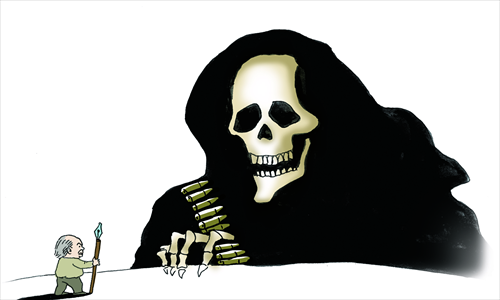
Illustration: Liu Rui/GT
Shigeru Mizuki, who died on November 30, was one of Japan's most popular manga (comic strip) creators, famous for his stories of ghosts and magical creatures for children. But Mizuki capped his career with Showa: A History of Japan, a bleak examination of Japan's 20th century. Beginning with the famines and depression of the late 1920s and 1930s, it unblinkingly depicts Japan's oppression of Korea and China, including the massacres at Nanjing and elsewhere. But this bleak story is aimed at children, looking to instruct a generation in the horrors of war and their grandparents' suffering and crimes, in the spirit of "Never again."
Mizuki's favorite character, Nezumi-Oto, a cuddly rat-man, appears throughout the text to highlight particular points, again pointing to the book's childish audience. Mizuki's beliefs, however, were not forged by helpful imaginary critters but by harsh personal experience; he lost an arm as a Japanese soldier, struggled with PTSD after the war, and his brother was imprisoned as a Class B war criminal for killing a POW. His angry reflections are drawn into Showa, in which he eventually confronts the reader to tell them "The 'military' was like a cancer that had to be surgically removed."
Onward Toward Our Noble Deaths, a 1973 book by Mizuki, was his first work on the war. Based on his own experiences, it depicts a small unit doomed by its commanders and the mad ideology of wartime imperialism, brilliantly using Herge's Tintin technique of simply drawn characters against detailed backgrounds in order to emphasize the everyman character of the soldiers.
Mizuki was hardly alone. In fact, Mizuki's pacifist approach and harsh examination of Japan's war crimes is the norm for much historical manga, and in other forms of Japanese children's literature. The vast bulk of popular works for children are harshly critical of war. Mizuki is just one of the popular artists who has used children's characters in wartime histories; elementary school readers can be guided through Japanese history by Doraemon. Other writers, such as Ishinomori Shotaro, creator of Kamen Rider, use ordinary people as witnesses to war.
There are also numerous narrative works on the war itself, both manga and regular books. Some of these focus on Japanese domestic suffering, such as Barefoot Gen, A Thousand Paper Cranes, and the heartrending animated film Grave of the Fireflies. But these narratives, which, while they show the suffering of war, can sometimes fuel belief that Japan was primarily a victim rather than a perpetrator of atrocities, are also balanced by tougher books that examine Japan's war crimes in China.
Educational manga series on Japanese history, which are often supervised by Japanese historians, have a consistently pacifist moral framework, according to sociologist Akiko Hashimoto. Popular in Japan since the 1970s, they include notes to parents reading to children that remind them to "please make sure to let the readers pay attention to Japanese acts of perpetration in China." Two out of three of the biggest series include explicit depictions of Japanese atrocities ranging from Nanjing to Unit 731 and the "Three-Alls Campaign."
There are, of course, also ultra-nationalist manga, some of them very popular, such as the rants of Yoshinori Kobayashi, whose infamous mid-1990s On War gave a frothing right-wing account of the war, praising Japan's army for "resisting colonialism" and denying war crimes. But On War was slated by most critics, and Kobayashi's works - which are strikingly uncreative, consisting largely of large blocks of ranting text - are mostly aimed at young men, rather than children, who already share his beliefs.
Apologetic tendencies are also present in other fantasy or science-fiction manga and anime. The Japanese military often acts as defender against foreign aggression, and takes an essentially heroic role. But these are often de-emphasized as series continue, and a more complex approach taken to war.
And manga is only a part of pacifist education in Japan. It's routine for children to go on tours of Hiroshima and Nagasaki, where older guides tell them of the horrors that happened to them and their relatives - not only in the bombings, but in the wars in China and elsewhere. Over a third of the world's peace museums are located in Japan, a powerful contrast to the war museum at the Yasukuni Shrine that infamously glorifies Japan's aggression.
The loud minority of Japanese nationalists, especially when pandered to by conservative politicians such as Prime Minister Shinzo Abe, can sometimes make it seem as though their ideas are the norm, or go unchallenged in Japan. Mizuki and others remind us that many Japanese oppose militarism and are willing to take a cool look at history - and to teach their children those same values.
The author is an editor of the Global Times. jamespalmer@globaltimes.com.cn