Childhood sweets
China’s post-80s generation crave the treats of their youth, create new trend
This Spring Festival, 29-year-old Li Xi returned to her hometown in Beijing from Milan, Italy. Having left the country for study at 15, and later remained for work and graduate study, Li's memories of her hometown and childhood are rather vague. However, there's one thing she never forgot - xiaoshipin (old Chinese snacks). She has been missing them for what seems like ages.
"On winter holidays, I did homework on an old wooden table, and my parents would sit next to me. They would give me guidance when I ran into difficult problems and rewarded me with snacks when I solved them," said Li.
She said although the snacks weren't very nutritious, she and her cousins would beg her uncles and aunts for pocket money to buy them.
"[We would go] to the only supermarket in the community to buy snacks when we had some money, which was most exciting," she said. "Puffed crackers, jelly and gum of different flavors, they were the best treasures and delicious things to me."
This Spring Festival, Li went back to the hutong where her family used to live and found the old supermarket was miraculously still in business.
"When I took the first bite of the puffed shrimp crackers, which used to be my favorite and was often bought for me by my grandmother, I almost burst into tears," said Li. "I just felt all the memories flooding back to me, the reminiscence of old times."
Despite her best efforts, Li has been unable to find an Italian snack that captures even a modicum of that "old" feeling.
Li is not alone in missing old childhood snacks. Many people, most of whom belong to the post-80s generation have started to purchase "old snacks" for a taste of yesteryears. According to a 2015 Xinhua News Agency report, data from Taobao, China's largest online shopping website, showed a 102.1 percent increase in "post-80s snacks" sales compared with 2014. And Guangdong Province and Beijing consumers in their 20s and 30s purchase more "old snacks" than other places.
"It's not only snacks, but a social phenomenon of young people missing the old times more than before, and seeking a way of releasing their pressures," said Xia Xueluan, a sociology professor at Peking University.
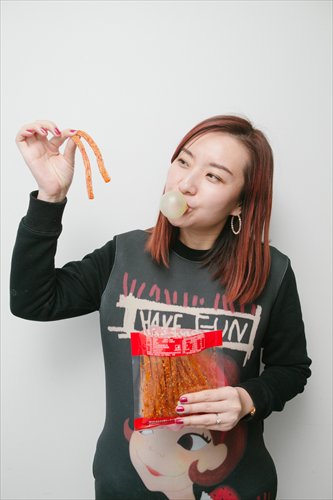
A young woman holds some latiao and chews a bubble gum, two kinds of snacks favored by pupils in the 1980s and 90s. Photo: Li Hao/GT
Returning to happier times
Li studies art in Milan and is on course to get her PhD this year. She said graduate design can be torturous, and she often finds solace and release through eating.
She mostly misses snacks like mailisu, Mylikes in English, a circular cocoa butter snack that has maltodextrin filling. It was one of the most popular snacks among children in the 1980s and sold for less than 1 yuan per pack back then.
"When I was a little girl and would fall ill or encounter unhappy things, I would eat one ball. I believed it would cure all the diseases and drive away unhappiness," said Li. "I miss it very much when I am unhappy and depressed. The sweet flavor and reassurance brought by Mylikes is healing."
According to Xia, it is natural for young people in China to miss their youth, a time when they were carefree.
"Many individuals who were born in the 1980s now have to shoulder social and family responsibilities and fight for a living, which has brought them more and more pressure," said Xia.
He said not everyone is able to deal with the daily stresses of life, and eating "old snacks" and reminiscing about their untroubled youth is an effective coping mechanism for many of them.
Han Meiling, a Beijing-based psychologist, agrees with Xia.
She said the 1980s generation was born into a society undergoing a lot of changes in politics, economy and culture, and so many of them "refuse to grow up".
"It is very natural for them to miss the past and temporarily escape from the present," said Han. "Things that belong to the past, such as 'old snacks,' toys, and old photos are some of the typical medias to reflect the past to their present life," said Han.
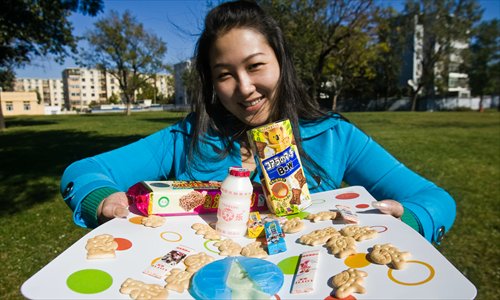
The "old snacks" of the 1980s and 90s are becoming popular among people in their 20s and 30s. Photo: Li Hao/GT
New trend of 'old snacks'
A search for "old snacks" on Taobao reveals more than 35,000 results. Tang Ming, a 30-year-old Taobao snack vendor, said "old snacks" started to get trendy in recent years after producers realized the business opportunity brought by the young generations' reminiscence.
For example, latiao (spicy strip made of oil dried bean curd and wheat gluten), which was favored by pupils in the 1980s and 90s, has regained popularity largely due to the efforts of a domestic snack producer in Luohe, Henan Province.
Last year, a photographer posted photos of his trip to the factory on Sina Weibo. The photos showed that the factory upgraded its production standards, sanitation and repackaged its product, and attracted over 5 million views and thousands of comments and likes. The comments were mostly from people in their 20s and 30s, saying that they were glad that their favorite snack could regain popularity, and they would continue to eat it.
Tang said foreign "old snacks" will also get more popular in the future due to the influence of a new Japanese animation called Dagashi Kashi. Since the first episode was released on January 8, the animation has gained more than 3.6 million views on bilibili.com, a Chinese video website famous for real-time commenting.
The animation is about the funny stories between a young supermarket owner who is very good at making and selling "old snacks" and a young rich girl who loves snacks and wants to try all the snacks in the world. In the animation, many "old snacks" are described in rich detail and quite resemble their Chinese counterparts. As a result, the animation has sparked a trend of buying "old snacks"and triggered curiosity about foreign snacks among Chinese Net users. Responding to the trend, Tang recently began to sell different kinds of "old" Japanese snacks, which are becoming popular in China. She sold more than 900 "old" Japanese snacks in roughly a month.
Tang said that there were imported snacks in the 1980s, but they were expensive, and their sale was limited.
"I remember the most expensive ice cream I had when I was a child was Magnum, which was sold for 12 yuan in 1989," said Tang.
"And there were other imported snacks such as Russian and European chocolate and candies, and Coca-Cola, all too expensive for ordinary families to consume frequently."
She said imported snacks were only available in State-owned stores and could only be purchased using limited coupons during festivals such as Spring Festival.
But today, the advent of the Internet has made it easier for people in China to purchase imported snacks. Expecting the numbers to rise, Tang is already putting together a strategy to capitalize on the trend.
"Next, I will pack the Japanese items with Chinese ones and make special snack packages with different old animation themes," she said. "Nowadays young people need creative but classic products like these 'old snacks' which can remind them of their childhood."
Food, culture and reminiscence
Chen Shuo, director of the famous documentary A bite of China, told the China Youth Daily in June that people miss certain foods and their flavors because they convey the unique spiritual essence of a period, history or culture in different places in the world.
"The foods people eat in their childhood can make a rather profound impression, and they will naturally miss the flavors they used to be emerged in when grown up, especially for those who leave their hometown," said Chen.
"And people choose different foods and snacks due to their cultural and social identities and backgrounds. So foods are not just foods, they are symbols and medias for people to learn and accept certain culture and customs, and always have profound historical significance."
Children can enjoy snacks all over the world today, but some snacks always remind one of home. Knowing that she's going to miss her favorite childhood snacks when she returns to Italy, Li spent Spring Festival eating all her favorites.
"I ate Mylikes, shrimp flavored puffed cheese sticks, jelly, snack noodles (instant noodles that are eaten dry with seasonings) as well as the old-style ice cream," she said.
"I am also taking 10 packs of Mylikes back with me."