Local transplants divulge the best places in Beijing for authentic Korean eats
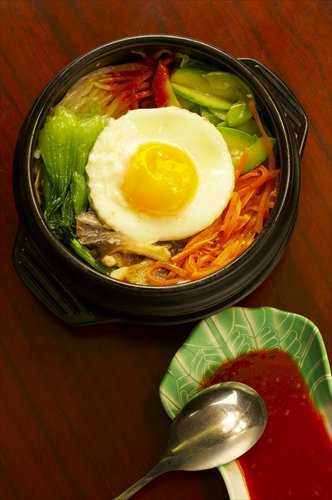
Bibimbap, which includes rice, cooked vegetables and often egg or meat, is a popular South Korean dish. Photo: IC
When Park Ji-hyeon took her first sip of the potato soup at Lalajigu Hotpot Restaurant in Beijing's Wangjing area, she was amazed by how good it tasted.
The soup, which is called gamjatang, is a South Korean classic made by slow-cooking pork bones to create a hearty broth, and then adding potatoes, meat, cabbage and more. To her amazement, she said, it was even better than the gamjatang she'd had back home in South Korea.
"I almost cried when I tasted the soup, it was so delicious," Park, 26, said in her broken Chinese. Since moving to Beijing eight months ago to study at Beijing Forestry University, Park reckons she has visited almost every South Korean restaurant in Wudaokou and Wangjing, the two neighborhoods that boast the highest concentration of South Koreans in Beijing.
According to Park, her experience at Lalajigu is not the norm. "Around 80 percent of the South Korean restaurants that I've tried in Beijing are not that good," Park told Metropolitan. "The flavors are so different from the original flavors in South Korea."
That may be surprising, considering the demand. According to a Financial Times report in 2015, China is home to more South Koreans - over 100,000 - than people from any other country. A majority of those, around 80,000, according to a 2014 Xinhua report, live in Beijing, with many concentrated in Wangjing, which has come to be known as the city's "Koreatown."
South Korean transplants aren't the only ones chowing down on the country's cuisine, however. The popularity of South Korean soap operas in China means that many Beijingers have been joining in on the dining trend. In 2014, for example, when the popular soap opera You Who Come From the Stars showed characters munching on fried chicken and beer, hundreds of articles erupted in the Chinese media recommending the best places to find the classic South Korean pairing.
"Due to differences in ingredients and cooking methods, it's hard to find exactly the same thing as what they were eating in the soap opera," said Park. "But there are still some good options you can find here."

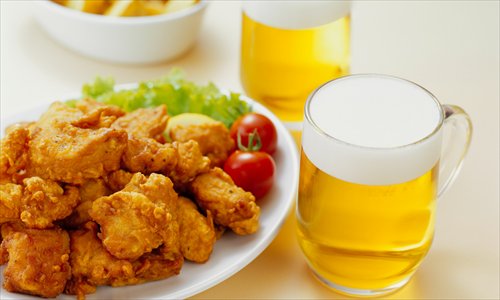
Barbecued meat and fried chicken and beer, two of the most popular South Korean foods among Chinese. Photos: IC
Searching for a taste of home
There's no shortage of options in Beijing. A search of the keywords "South Korean" and "dining" on the popular restaurant rating app Dazhongdianping yields more than 1,000 results in Beijing alone.
The harder part is finding restaurants that are able to replicate the taste of home.
Park has found her own favorites: "The potato soup at Lalajigu Hotpot Restaurant, the niangao (rice cakes) at Huoluhuo restaurant and every dish at Sarangbang are all great," she says.
Though chain restaurants have a bad reputation in the West, the same isn't necessarily true in China, where they guarantee a certain level of quality. A case in point is Huoluhuo, a Chinese chain dedicated to South Korean food with more than a dozen locations in Beijing. Sarangbang, meanwhile, is a stand-alone restaurant located in Wudaokou.
Unlike Park who likes to try different restaurants to find the best, Song Tae-hee (pseudonym), a journalist who's lived in Beijing for seven years, has long stuck to three restaurants that she says serve original South Korean dishes: Zixiamen, Bibigo and Barsak.
"I've been to some South Korean restaurants in Beijing with bad service and bad food," she says. "But these three are authentic."
For Koreans, she says, it's an easy matter separating the wheat from the chaff. "As soon as I take a bite of the food, I can tell immediately whether or not it's authentic," Song said. "It's just natural; it's the taste of home."
Zixiamen and Bibigo are both chain restaurants imported from South Korea that serve BBQ and traditional dishes, while Barsak is an independent eatery in Wangjing that, according to Song, serves good Korean fried chicken. "It's better than what you can find in Wudaokou," she says.
As for Zixiamen, Song recommends their lunch box, which she calls "delicious and the best bargain." With a diversity of choices that include meat, soup and rice, she says it's hearty and varied enough to keep your taste buds interested. "Many South Koreans go there to eat."
Kim Suk-hui, who runs TCoffee, a Korean cafe in Chaoyang district, agrees that Zixiamen is a good choice, and adds two more chains to the list. "Benjia is a good place to eat Korean BBQ," she said. "If you want to treat friends to a higher-end place, you can go to Aijiangshan."
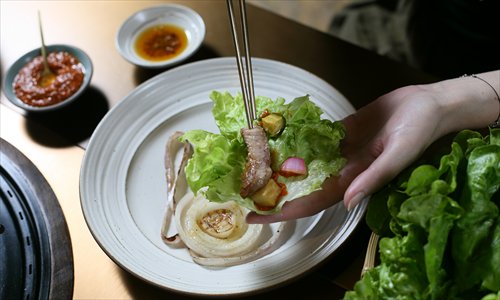
According to the conventions of Korean cuisine, barbecued meat should be eaten wrapped in lettuce. Photo: CFP
When Korean dishes meet Chinese cooking
Over her six years living in Beijing, Kim tells Metropolitan that she has seen a number of strange adaptations of South Korean cuisine in Beijing.
Though South Korean and Chinese cooking share a number of similarities in terms of method, their flavors and ingredients are distinct - which is why, when they mix, it can produce an unwelcome, or at the very least jarring, fusion.
"It makes me feel awkward," says Kim of Chinese-style Korean food. "Why can't they just make either Chinese food or South Korean food?"
A case in point is gimbap, a traditional dish similar to Japanese norimaki that features steamed white rice and fillings that include egg, cucumber, ham, spinach and so on rolled up in sheets of dried seaweed and sliced into pieces. It's a relatively basic dish, but Kim says since coming to China, she's seen variations that she never expected. "While in Beijing, I've seen many restaurants putting dried meat floss in the gimbap and they often forget spinach. It smells terrible."
Both Kim and Park have also noticed that most South Korean food in Beijing has a "lighter" taste than what they'd find at home. "We like our food to be spicy and salty, but in Beijing, the flavor in most restaurants is less strong," Park says. "Many so-called South Korean chili sauces also are not spicy enough."
According to Kim, sauces are of paramount importance in South Korean cuisine. In China, though, many chefs just use Chinese sauces as a replacement in dishes like Korean soybean paste soup. "Even if they use imported sauces, they tend to put less in the soup than we do."
But even when restaurants import original sauces and follow traditional recipes, both women point out that it's often difficult for Korean restaurants in China to achieve the same flavor, because they generally don't import other ingredients like chicken and other meat.
"For instance, Beijing's chicken is different from what we eat in South Korea," Kim says. "The chicken here tastes dull and doesn't have the same sweet flavor. So the fried chicken isn't the same."
Song takes a more relaxed attitude to fusion versions of Korean food, saying, "Adapting cuisines to local tastes is just a normal phenomenon."
Park, though, thinks that whatever changes are made should be carefully considered. "If they can improve on South Korean dishes, I would like to try them. But so far, I haven't seen that happen."
Eating like the stars
Ever since South Korean soaps began to take China by storm more than a decade ago, the foods featured on these shows - and by extension, Korean cuisine - have been gaining increasing popularity.
These days, every other street corner in Beijing seems to have restaurants offering niangao, gimbap, bibimbap (a stone bowl of rice mixed with vegetables, egg and chili pepper paste) and Korean BBQ. Debates over the best South Korean restaurants in the capital are also hot on Chinese social media. Korean-food fever hit its peak in 2014 when the episode of You Who Come From the Stars featuring characters eating fried chicken aired.
Because of the fever, iQiyi Café in Chaoyang district even redecorated its interior based on the show and began serving dishes eaten by the characters.
"After changing our decor to replicate the living room on the show, we saw a surge in customers," Lu Bin, iQiyi's manager, told Metropolitan in a previous interview.
Linda Li, 27, a Beijinger who counts herself as one of China's many fans of South Korean soaps, says, "I like finding the foods eaten by my favorite characters, because it makes me feel like I have a connection with them."
Of course, television isn't necessarily a realistic depiction of Korean eating habits. According to Kim, fried chicken is rarely eaten as a meal. "It's just a snack that people eat while watching TV or after dinner," she says.
Instead, she added, South Korean meals often feature some combination of soup, rice and pickles.
And then there are seasonal dishes. According to Park, cold noodles are common in the summer. In other seasons, South Koreans often eat barbecued meat, niangao, soybean paste soup, pickle soup, bibimbap, gamjatang and gimbap.
Another thing Chinese diners may be missing out on are the traditions that surround South Korean eating culture.
For instance, it's traditional to wait for the most senior members to pick up their chopsticks before starting to eat, and not to finish until they lay the chopsticks down. And here's one more inside tip from Park for foreigners eating Korean food for the first time.
"First, when we eat bibimbap, we eat it with soybean paste soup," she said. "Second, when we eat barbecued meat, we wrap it in lettuce."
Newspaper headline: Seoul food