Obama apology for Libya comes at inconvenient time for Clinton
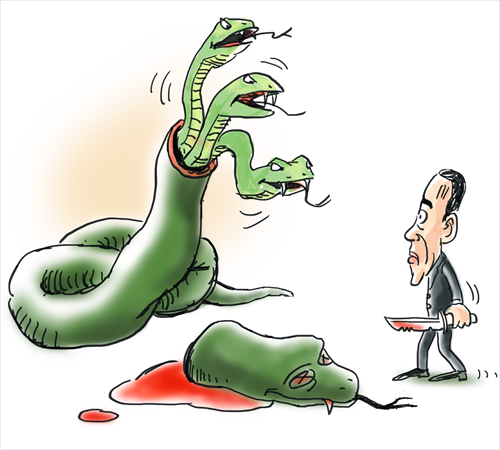
Illustration: Liu Rui/GT
Better late than never. Unfortunately, this saying could not be applied to Obama's recent confession of the biggest mistake during his presidency.
In his words, "failing to plan for the day after what I think was the right thing to do in intervening in Libya" is the worst failure. The failure reflects the problem of the so called "Obama Doctrine," if the president really has one. Generally speaking, the Obama Doctrine includes the following elements: prudent use of forces, the combination of intervention and retrenchment, smart power, reallocation of limited resources, shared burdens for allies and partners, and so on.
The Obama Doctrine is more a short term solution or tactic to numerous crises rather than a grand strategy to guide the country. The aims and means of US foreign policy during Obama's tenure have been disconnected. The US is destined to send ambiguous signals to its allies, partners and enemies if it claims a clear strategic goal but still uses conflicting means at the same time.
The same problem took place in Libya. The goal was simple - end the regime. The US had no strategic planning for the country and has no idea about how to deal with the ensuing power vacuum. The means are conflicting. The administration's approach to Libya, "leading from behind," is ridiculous enough. How can a leader play this role when hiding behind the others? The contradiction of roles and duties finally led to many unintended consequences like the rise of the Islamic State (IS), and even the European migrant crisis.
However, Obama apparently believes he is not the only one to blame for the Libya mess. In an interview with The Atlantic last month, he made clear he felt Europe had not been sufficiently committed to helping sort out the country. He expected "given Libya's proximity," the Europeans would be invested in the follow-up. He even explicitly singled out the UK by saying Prime Minister David Cameron was distracted during the Libyan crisis.
It is hardly convincing that Obama honestly believes Europe is the force that can be counted on for security matters. Europe doesn't have the willingness or the capability to make itself a heavy-weight security actor or to build a European "wing" of NATO. Numerous crises before and after Libya has shown that Europe isn't able to sort out the mess in its own backyard, and how Obama was naive to expect Europe to follow up the chaos after a regime change across the Mediterranean.
In fact, as the first US Pacific-born president, Obama hasn't accrued many supporters in Europe over his foreign policies. His rebalancing to Asia was interpreted as pivoting away from Europe, and his "lack of leadership" in the Middle East has disappointed many Europeans. After all, it is Europe that is now suffering greatly from the chaos in the Middle East, from the IS-inspired terrorist attacks to the surge of migrants.
Obama's remarks further aroused unease of the transatlantic relationship and in particular the "special relationship" between the US and the UK. In an attempt to qualify Obama's remarks, an NSC spokesperson said, "we deeply value the UK's contributions on our shared national security and foreign policy objectives which reflect our special and essential relationship." Despite that, the schism between Europe and the US over the Middle East is already there, and Obama's confession over Libya wouldn't do anything to mend it.
The timing of Obama's confession is a bit bizarre. In the ongoing primaries nowadays, the Democratic candidate and former secretary of state Hillary Clinton has been criticized as a strong supporter of the Libya intervention who failed to plan for the aftermath of the regime change and sat idle when extremists gained power. In one primary debate last year, Clinton had to defend her role in the 2011 war by branding the US response as "smart power" which gave rise to "a free election the first time since 1951" in the country. Obama's reflection on his policy toward Libya might not help Clinton.
Sun Chenghao is an assistant research fellow, Institute of American Studies at China Institutes of Contemporary International Relations; Zhang Bei is an assistant research fellow, Department for European Studies, China Institute of International Studies. opinion@globaltimes.com.cn Follow us on Twitter @GTopinion