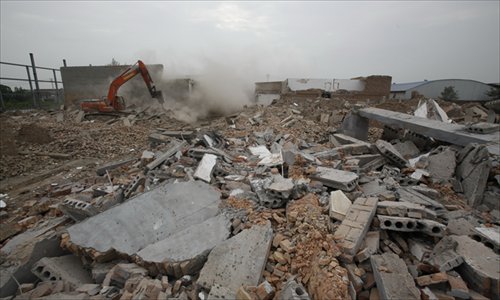
Authorities in Xi'an, Shaanxi Province forcibly demolished a number of buildings on July 2. The buildings are believed to have been illegally built and no compensation was offered for their destruction. Photo: CFP
One Wednesday morning, Ma Yongtian packed up banners and campaign materials before going to her usual spot, namely the small garden opposite the Chinese embassy in Washington DC. She then began her routine of protesting against being evicted from her property in Changchun, Northeast China's Jilin Province.
But that particular day, to her surprise, she saw people removing a spray-painted Chinese character from the embassy gate. The Chinese word chai (拆), meaning to demolish or dismantle, had been painted in a familiar way on the embassy.
Over the past decade, that character daubed in red paint on walls in China meant a property was to be destroyed due to a governmental demolition order.
"For a moment I thought the embassy was really about to be torn down," said Ma, 49. "Then I realized it was some people showing support for petitioners like me, who are protesting forced demolitions on the mainland and who have come to foreign countries to seek a solution."
Four days after the characters were found outside the embassy in Washington DC on July 10, the Chinese embassy in Canada became a second target as chai, written in red paint with a circle around it, was found on a white board hanging outside the embassy gate in Ottawa.
The news soon drew widespread attention across Chinese cyberspace. While some were amused by the stunt concerning the thorny issues plaguing China's continuing urbanization, others questioned the meaning behind the acts, saying such staged shows could be simply for the purpose of securing "political asylum" in foreign countries.
The Sparrow Initiative
A Washington-based land rights group named Sparrow Initiative is widely believed to be responsible for the graffiti, but Ma said she has no idea who tagged the embassies although she also belongs to the organization.
Yang Jianli, one of the organizers of Sparrow Initiative who now lives in the US, told the Global Times that the organization started in March 2010 with the idea of helping forced demolition victims get international attention by protesting overseas, beginning with the United Nations headquarters in New York.
Hu Yan, a petitioner from Shanghai who believed she was not properly compensated for the demolition of her house to make way for the World Expo, approached Yang and his group Citizen Power for China in 2010 for help.
Thanks to him, Hu Yan was among the first Chinese petitioners protesting across the UN building gate, spreading materials and telling her stories to passers-by.
"I decided to name the campaign Sparrow Initiative, to symbolize creatures as little as sparrows that are brave enough to protect their nests," said Yang.
Later people from Wuhan and Guangdong came to the UN headquarters to protest alongside Hu Yan, and soon attracting attention from foreign media.
By 2011 most petitioners had reached settlements with their local governments in China. However, the campaign was revived this year when more petitioners sought help. This time, they focused on the Chinese embassy in Washington.
Ma is currently the only Sparrow Initiative member protesting at the embassy in Washington, she said.
She told the Global Times that her privately-owned 200-square meter factory was illegally torn down in 2001 with the government offering her compensation that was lower than the standard levels.
She came to the US in March after running out of options at home. She had filed legal procedures and petitions at local and national offices for a decade, but had been detained for her troubles for several times, she explained.
After protesting at the UN headquarters for three months, Ma came to the embassy in Washington with her 30-year-old son. Every day she walks from her rented house and arrives at the embassy around 8 am to put up banners reading "Against violent demolition, return the citizen's property" in both Chinese and English.
She then uses a loud-speaker to read out loud to passers-by a letter she wrote to the Chinese ambassador.
Seeking asylum
Most protesters go to the US with a tourist visa and then apply for political asylum to obtain a work visa.
Ai Furong, a petitioner from Shanghai, has been protesting outside the UN headquarters for two years. His hardware store and small pub in downtown Shanghai were forcibly demolished in 2001 and 2004 during a makeover of an old district, he said, and the government offered him a discounted compensation package.
Due to frequent petitions, Ai's wife was blacklisted and stopped from going abroad, he said. He flew to the US alone for a 14-day group tour and obtained a work visa after applying for asylum at the New York immigration department in August 2011.
Ai, who joined several Shanghai petitioners as part of a group called the Petitioners Association of China Forced Evictions (PACFE), protests every work day across the street from the UN building, lobbying passers-by with a speaker, targeting UN officials or delegates on their way to work.
The 53-year-old man said he would not give up "even though some people might say we're being ridiculous and disgracing our own country."
But there are some protesters, less dedicated to any real cause, who insist on staying simply to seek a US visa rather than a settlement to their case, Ai said.
Some are not sincere and have other intentions, he said. For example many choose to stay after their petitions secured them a compensation agreement with the local government in China, so that they can enjoy health insurance and an easier life away from home.
The PACFE, an NGO registered with the New York government, currently has some 10 members in the US and branches in Japan, Australia and Canada.
According to its director Hang Haodong, now a US citizen but originally from Shanghai, the organization's major goal is to "safeguard the rights to life and property of its members and Chinese forced demolition petitioners."
The PACFE also demands that the government return illegally seized properties to their owners or fully compensate them for demolished residences.
Hang said he prefers a softer approach to protests, with his banner highlighting appeals to get his house back without denouncing the Chinese government or the Communist Party of China.
"I used to petition at the consulate in Chicago where staff would greet me or take photos as they passed by. But still, nobody there was willing to talk about my appeals," Hang said.
Compared to Hang, Ai tends to use more dramatic methods of protest. For example he joined another female PACFE member for a topless protest in early June.
Although he is financially secure from working part-time jobs and doesn't have to worry about medical bills, Ai say his petitions have cost his family in excess of one million yuan.
Xie Jingyuan, a petitioner from Beijing, is lucky enough to have settled his case but still shares similar concerns about not being able to return home.
Xie petitioned in China for almost three years after his house in Beijing's old Xuanwu district was demolished to make room for a governmental research institution. After reading articles online about petitioners in New York, he decided to go to the US alone. To his surprise, the Beijing government quickly agreed to a fairly good compensation plan providing his family with seven apartments and money to make up for the properties he had lost.
"We've signed a contract, but the houses they promised haven't been given to us yet," said Xie, explaining that this is why he is hesitant to return home.
To chai or to protect
Wang Xixin, a law professor with Peking University who specializes in constitutional and administrative law, told the Global Times that the chai graffiti and increasing number of demolition victims have come as a result of Chinese local governments' passion for land sales, a source of great profit and great discord.
"A new compensation guideline for expropriation of land and houses has just been established, but there's always a difference between people's expectations and the compensation government offers. This is because we are still without a transparent system for the evaluation of house prices as well as a legal and fair compensation procedure," Wang told the Global Times.
Speaking of protesters overseas, Wang said he respects people who seek every legal means to express appeals, but cautions that petitioners should not be depicted as "heroes" when they go to extremes.
"When this happens, it loads a case with political meaning, far exceeding its original nature as a financial dispute," Wang said. He added that this could force the government into a dilemma and disrupt potentially effective ways of settling disputes.
Some overseas Chinese who witnessed the protests said that the protesters were seen mingled with "anti-China forces" such as cult practitioners and some self-proclaimed democratic activists.
Most demolition activists denied having received any financial support from them.
"I love my country and want to return to a peaceful life," said Ai.
Xie, from Beijing, said some democratic activists tried to talk him into joining them, but he refused.
"I'm not a CPC member but it doesn't mean I would join with anti-Party activists. I understand democracy is not built in a day, and China is already carrying out reforms," Xie said.
"It's better to have peaceful protests than violent cases like the explosion at Beijing Capital International Airport or people who self-immolate," said Wang Cailiang, a Beijing-based lawyer who handled a large number of cases concerning forced demolitions.
For protesters like Ai Furong, it might not be easy to wait another two years and keep protesting in a "peaceful way."
Ai told the Global Times he is planning something big in September. But he refused to disclose details.
