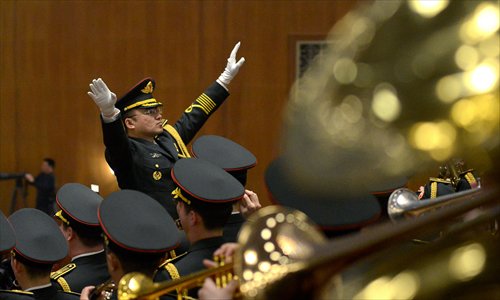
A Chinese People's Liberation Army military band performs during the opening meeting of the fourth session of the 12th Chinese People's Political Consultative Conference National Committee at the Great Hall of the People in Beijing on Thursday. Photo: AFP
China's top political advisory body kicked off its annual session on Thursday as members from diverse backgrounds were urged to make recommendations on the country's development in the next five years.
At the opening meeting held in the Great Hall of the People in Beijing, Yu Zhengsheng, chairman of the Chinese People's Political Consultative Conference (CPPCC) National Committee, delivered a report on the work of the Standing Committee of the CPPCC National Committee in 2015.
He also announced the CPPCC's key emphasis in its 2016 work.
Top Party and government leaders, including President Xi Jinping and Premier Li Keqiang, also attended the meeting.
Yu said that 2016 is the first year of the final stage of completing the building of a moderately prosperous society in all aspects and a crucial year for structural reform.
He asked members to "devote their main efforts this year to making suggestions and proposals related to the implementation of the 13th Five-Year Plan," referring to a draft road map for the national economy and social development from 2016 to 2020.
The 13th Five-Year-Plan is set to be a key period for China's goal of building a "comprehensively well-off society," which involves difficult tasks such as political, economic and cultural constructions. Many members of the CPPCC are experts in different fields, and they can offer professional suggestions to the country's policymakers, said Fu Siming, a professor with the Party School of the Central Committee of the Communist Party of China.
"China will face a wide range of reforms during the next five years, many of which are related to grass-roots organizations and the public. The CPPCC's active participation is important to involve various members to assist in policymaking," Su Wei, a professor at the Party School of the Chongqing Municipal Committee, told the Global Times.
China's GDP grew by 6.9 percent in 2015. Xi said in November last year that annual growth of at least 6.5 percent would be required to reach China's goal to double its 2010 GDP and per capita income by 2020.
Yu also noted that the CPPCC will work harder to exercise supervision as well as to improve and strengthen its investigation and research into problems that hinder the construction of a comprehensively well-off society.
"Supervision is a main CPPCC function. Due to corruption within the organization as well as weak implementation in recent years, the CPPCC did not fully pull its job off," Su said.
Meanwhile, much of the research undertaken by some CPPCC members is formalistic, which can hardly pinpoint the real problems that hinder China's development, Sun noted.
"The emphasis in work in 2016 requires the CPPCC to overcome such problems and bolster its function as an important organ for multi-party cooperation and political consultation under the leadership of the CPC," Fu said.
Increased participation
More than 2,000 members attended Thursday's opening session.
About 5,027 out of 6,012 proposals raised since the third session of the 12th National Committee of the CPPCC held in March 2015 were endorsed by authorities, news site chinanews.com reported in February.
Su said that the members of the CPPCC are becoming more active in drafting proposals and take part in political and social affairs.
"The CPPCC is a key part of the system of multi-party cooperation and political consultation under the Party's leadership. China is now entering a crucial period of reforms. The CPPCC's supervision and suggestions will boost the country's development, as well as the Communist Party of China's governing capabilities," Su said.
During the meeting, Yu noted that the advisory body's political consultations were made more fruitful in 2015 while supervision was strengthened.
In particular, members of CPPCC National Committee improved supervision over issues of wide public concerns, such as investment approval system reforms and pollution control in Northwest China's Tengger Desert.
