
A breeder feeds giant panda triplets at Changlong Wildlife Park in Guangzhou, South China's Guangdong Province, July 14. Photo: CFP
Bears bounce backLast week, the International Union for Conservation of Nature (IUCN) published its Red List of Threatened Species in which it declared the giant panda has been downgraded from "endangered" to "vulnerable."
Experts say this is acknowledgement of Chinese efforts to protect the giant panda, which have involved both launching projects to maintain its habitat and breeding the animals in captivity. However, there are still some issues that need to be addressed in the future.
The IUCN puts all species in seven categories from high to low risk, from "extinct" to "least concern." The organization analyzes data such as population size and the status of a species' habitat, in order to assess their risk level.
The IUCN's list said the giant panda was an at risk species in investigations from 1965 to 1988. The giant panda officially became an endangered species in 1990.
This time, using data collected by the Chinese authorities in 2014's fourth nationwide panda census which reported that there were 1,864 wild pandas, an increase of 17 percent over 2005, the IUCN downgraded the giant panda's risk status.
However, China's top forestry authority claimed Monday last week that the giant panda is still "endangered."
"It is premature to downgrade the panda's conservation status," the State Forestry Administration said in a statement.
The statement also pointed out that pandas are still facing a survival crisis in some regions. The authorities have emphasized that panda conservation efforts must continue to resolve issues related to the animal's shrinking habitats, narrow gene pool and vulnerability to climate change and poor human management.
Wan Hui, director of the World Wildlife Federation (WWF)'s Xi'an Office, said the downgrade is an acknowledgement of work in panda protection by the government and organizations involved, but it doesn't mean that efforts will be lessened, because the giant panda is still "vulnerable."
In the past decades, the Chinese government, along with organizations such as the WWF and local groups, has invested a lot of effort in both protecting giant panda habitats, as well as increasing its population through breeding in captivity.
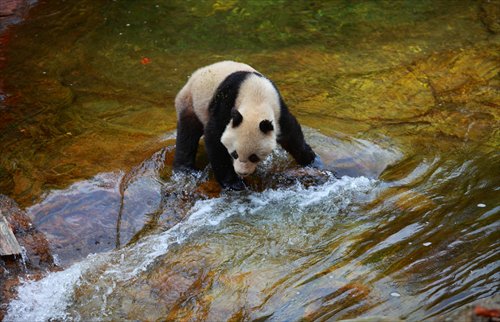
A wild giant panda is spotted in a creek in the mountains of Taibai county, Shaanxi Province, October 19, 2014. Photo: CFP
In the past decades, the Chinese government has invested a lot of effort into saving the giant panda, both in protecting its natural habitat and in raising the species in breeding centers.
When people talk about giant panda protection, most think about pandas bred in confinement in zoos or breeding centers.
Every year, hundreds of thousands of tourists visit Chengdu to see the animals, and the giant panda is an important publicity and diplomacy tool of the Chinese government.
The pandas are bred by scientists and some of the bears later go through a course that tries to prepare them for life in the wild - but only a few of the pampered animals ever get tough enough to be set free.
Few people think about the fact that the most important thing about protecting the species is to also protect its natural habitat.
In the past few decades, the Chinese government, along with organizations such as the WWF and local groups, have put a lot of emphasis on protecting the giant panda's habitat.
In the 1970s, the government designated several areas, including vast tracts of mountainous regions in West China's Shaanxi and Sichuan provinces as protection zones and national parks. The aim was to protect the natural habitat in these areas, not only for the giant pandas, but also for other wild species that reside there.
Foping National Protection Zone, situated in Hanzhong, Shaanxi Province, was established in 1978 and through more than 30 years of careful conservation work, the zone has seen an increase in its panda population from 45 to 70. The workers and even nearby villagers occasionally spot wild giant pandas in the area, sometimes just grazing, sometimes drinking water or climbing trees.
The protection zone spans 35,000 square kilometers, has 1,580 types of plants and 265 types of wild animals. Out of these, four are national Class I protected animals and 33 are Class II.
He Xiangbo, office director of the Protection Zone Bureau, said Shaanxi has a high density of wild giant pandas. They regularly send workers to patrol the mountains to find poachers or any destruction of the environment.
"We have six stations in the zone and more than 30 workers each, and we have a schedule where each has to patrol at least five days per month," he said. Every winter, all the stations do a complete checkup of the whole area to find out if any wild animals have been injured or if any part of the zone has been sabotaged by humans.
The WWF's Wan said an issue facing giant pandas in China is that different panda communities have lost contact with each other due to the destruction of forests, and long years of separation have led to inbreeding, which poses a problem for the entire species' survival.
"The WWF is cooperating with local protection zones and governments in China to create six 'environmental walkways,' connecting different zones with high densities of giant pandas," Wan said.
The project was launched in 2003 in Sichuan and Shaanxi and workers have been planting bamboo and trees in the hope to restore giant panda habitats.
But even though there are theories on how the recovery should be implemented, in practice there are difficulties. Scientists have had to fumble and experiment before finding methods that work in each particular region. Furthermore, in practical protection work, often results are visible only in the long term.
"For example, when we were planting a certain type of bamboo, local protection zone workers found that it was hopeless and dying rapidly. But the second year we tried planting the bamboo, they grew well," she said. "When you are doing detailed, practical work, it's impossible to see immediate returns."
Sustainable economy
Another important measure taken to protect pandas and their habitats is to involve the residents living in that area in the work of conservation, to avoid the deliberate destruction of the environment.
Foping natural zone's He said that in the past, there used to be a problem with poaching in the area. Most people who live near natural protection zones are farmers, often living in poverty. When harvest season is over, sometimes they sneak into the mountains to poach wild animals or illegally cut down trees.
Foping wildlife bureau developed a few projects with the surrounding residents, helping them to make money in lean times by raising bees or growing medicinal herbs.
"Gradually, they stopped going hunting in the forest because it's hard work and doesn't earn them as much," he said.
People are carrying out this idea on the grass-roots level as well. Zhao Huawen founded an NGO called the Happiness Bank in 2009 and launched the project of protecting the panda's habitat through establishing sustainable businesses run by people who live near these areas.
When he first started executing the program, through onsite investigations and polls he found out the people who live near panda habitats, which are usually in the mountains, are often poverty-stricken and lack a way to earn a living sustainably. In fact, in the past, many of these residents lived by the mountains also earned a living by cutting down trees or selling poached animals on the black market.
In the last couple of years, he and his team helped villagers plant and advertise local products, such as kiwis and other local fruits. After a while, farmers had an average increase in salary of 3,000 yuan per year.
Another key part of protecting the giant panda is helping them breed. Right now, there are more than 300 giant pandas being raised in zoos and breeding centers, a number that's more than doubled from 164 to 375. Scientists are also researching different ways for the giant panda to conceive.
One famous site is the Chengdu Research Base of Giant Panda Breeding, which recruits scientists to conduct research while opening their doors to tourists and spreading awareness of panda protection.
Even though there have been remarkable contributions toward protecting the giant panda, there are more issues that need to be addressed in the future. Wan said the future focus of panda protection work should continue to be placed on habitat protection. The fragmentation of habitat is something to be worked on continuously.
Furthermore, habitats are facing different threats than before. As opposed to deliberate and illegal sabotage, habitats are now faced with changes brought by tourism, urbanization and development.
