COMMENTS / EXPERT ASSESSMENT
SOE mergers should avoid creating monopolies and reducing efficiency
Chinese SOE mergers aim to create global giants
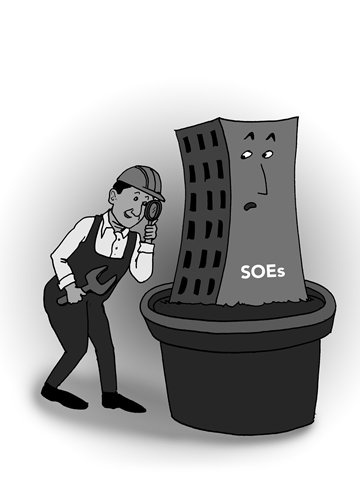
Illustration: Luo Xuan/GT
Restructuring of China's strategically important State-owned enterprises (SOEs) has gained impetus of late, in Beijing's implicit attempt to prepare its behemoth national businesses for global market competition and turn them into corporate leaders for the 21st century.
The high-profile reform also has political connotations, showing that the top leadership of China wants to reinforce State ownership and invigorate a growing flotilla of SOE giants that will be the core of domestic economic security and stability while pursuing unprecedented business clout abroad, analysts say.
Beijing's aspiration is to phase in a strong economic system - powered by colossal and globally competitive State companies that are supported by private entrepreneurship - and win a larger share of the market around the world in many industries.
Some experts believe the reform roadmap calls for regrouping SOEs by function, further consolidating their assets, while developing a small number of "mixed-ownership" businesses - public plus private - to showcase the prowess of China's distinctive economic system.
With the regrouping efforts, State-owned assets will focus more on the public sector and strategic emerging industries, which are significant in terms of living standards and national security and will create more internationally competitive enterprises, analysts have said.
All the more, the iconic Belt and Road initiative needs a formidable team of corporate giants with visionary leaders, advanced technology and strong balance sheets to navigate the uncharted waters of global business.
China pledged to intensify SOE reform early this year, promising measures such as introducing a mixed-ownership system and making the SOEs healthier and more market-oriented, especially in the steel, coal and power sectors.
Last month, the government decided to merge its largest thermal power generator China Guodian Corp with its largest coal miner Shenhua Group. The alliance created a State energy giant, a holding company with gross combined assets exceeding 1.8 trillion yuan ($255 billion).
The much-noted alliance followed a string of other SOE mergers earlier this year, including the marriage of Wuhan Iron & Steel Corp with the Shanghai-based Baosteel Corp to create the world's second-largest iron and steel manufacturer; the merger of China National Nuclear Corp with China Nuclear Engineering Corp Group to facilitate China's nuclear technology exports; China National Cereals, Oils and Foodstuffs Corp's acquisition of China Grain & Logistics Corp and Huafu Group; and the merger of China National Machinery Industry Corp (Sinomach) with China High-tech Group.
More mergers are in the pipeline, sources have said. It seems plausible that more mergers including companies in the areas of petrochemicals, vehicles, shipping and telecommunications may be implemented.
Analysts claim that accelerated SOE mergers show the unique efficiency of China's leadership in choreographing and enforcing key reforms.
Once Beijing determines that a reform measure will help its economy and give the country a competitive advantage, the government just gets it done - especially in sectors with global potential and those that are regarded as strategic industries.
One of the major objectives of the reforms is to prepare SOEs and State holding companies for greater international expansion. Mega-mergers will allow these entities to become even greater players in the global economy.
As a result, foreign companies - those from the developed countries in particular - will have to prepare for increased competition from the SOEs, both within and outside of China, analysts predict.
Before 2013, when the two globally renowned train manufacturers China North and China South Locomotive and Rolling Stock Corp were merged to speed up exports of Chinese-made high-speed trains, many in China still hoped that the country's mostly rigid SOEs would be broken up or even sold off so that private investments could take their place and unleash unprecedented efficiency and productivity.
But while at the beginning of the millennium, some SOEs were broken up to promote market competition, the new emphasis is on mergers. In total, 16 ministries and government agencies including the Ministry of Finance, the National Development and Reform Commission, the People's Bank of China and the State-owned Assets Supervision and Administration Commission have formed a coordination group to implement SOE acquisitions and mergers.
It is true that, from a laissez-faire market economy perspective, mergers seem a questionable strategy as they foster monopolies and inhibit competition. However, mergers are certain to prevent damaging price wars among SOEs operating in the international market. Previously, for example, Chinese iron and steel plants often engaged in cutthroat competition for iron ore supplies in other countries by incessantly raising prices.
There is another silver lining to the megamergers: they will help reduce overcapacity in some industries and aid China's supply-side structural reforms.
China is now firmly convinced that mergers are the right approach, and the authorities are expected to reinforce the government's grip on the economy by strengthening the SOEs' dominance, not weakening it. In theory, merging SOEs creates synergies and increases resources - employees, capital and client networks. But mergers can create a host of problems, too, including redundant staff and dueling executive teams.
Many still fear that the regrouping of central SOEs will lead to market monopolies. The mergers are intended to reduce overcapacity and improve SOEs' competitiveness on the global stage. However, some observers have warned that mergers of the top companies would create unwieldy monopolies and reduce efficiency.
The author is an editor with the Global Times. bizopinion@globaltimes.com.cn
