

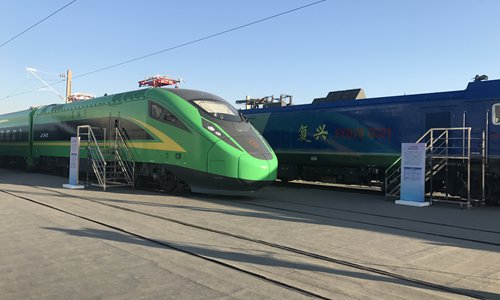
A view of CR200J Fuxing bullet train at a testing track in Beijing's Chaoyang district on Monday Photo: Li Xuanmin/GT
New variants of China's Fuxing high-speed bullet trains, which can run at medium speeds on existing rail infrastructure, bode well for the exports of standardized electric multiple units (EMUs) and domestic rail technology because they'll offer foreign buyers cheaper and more flexible options, industry insiders and analysts said.
Experts said that countries in Southeast Asia may be particularly attracted by these new bullet train options.
On Monday, China Railway Corp unveiled several new Fuxing bullet trains. These include the CR400AF-B, a 17-coach bullet train with a designed speed of 350 kilometers (km) an hour; the CR300BF, an eight-car model with a maximum speed of 250 km per hour, and the CR200J, centrally powered electric trains with a maximum speed of 160 km an hour. The trains were unveiled at a test track in Beijing's Chaoyang district.
The gray-and-orange CR300BF, which can carry up to 613 passengers, is expected to gain operating certification in June 2019.
The gray-and-red CR400AF-B and green CR200J (known as The Hulk on China's social media networks), will be put into service in January next year.
The CR400AF-B is a 17-coach bullet train that is longer than the 16-coach Fuxing trains that are already running between Beijing and Shanghai.
The 439.9-meter-long train could carry up to 1,283 passengers, or 7.5 percent more than the capacity of the 16-coach Fuxing bullet trains.
The shorter versions of the CR200J have nine cars, while the longer ones can have 11-20.
"This new type of Fuxing train [CR200J], because of its power source, can use the same inspection and maintenance equipment as regular rail lines, reducing costs while providing a more efficient, safer and quieter ride," Zhang Bo, a research fellow at the China Academy of Railway Sciences, told the Global Times on Monday
Zhang said that the model will eventually replace some regular trains in China's railway network, "bringing regular rail lines into the bullet-train era."
"Compared with the previous generation of Fuxing bullet trains, the new models use a higher percentage of domestic technology. They also have improved significantly in intelligent operation and communication," Zhang said. These new Fuxing bullet trains "have reached advanced levels" in terms of global rail technology.
China's railway leads the world in terms of speed and network length. The country's Fuxing high-speed trains, to which it holds independent intellectual property rights, run between Beijing and Shanghai at speeds of up to 350 km an hour.
China has a high-speed rail network of about 29,000 km and a wealth of experience in building rail lines that could endure extreme climates such as tropical and Alpine conditions, Zhang noted.
Experts said that the new Fuxing models, specifically the green CR200J, might also boost the export business of China's high-speed rail system.
Xu Liping, a senior research fellow at the Chinese Academy of Social Sciences, told the Global Times on Monday that densely populated countries in Southeast Asia, which are in the process of urbanization and industrialization, will be attracted by the new CR200J.
"Since this bullet train does not require the construction of new rail beds, which will greatly reduce the construction cost, these countries may find it an attractive replacement for their current rail systems," Xu noted.
High-speed rail exports are mainly hindered by high construction costs, even though China's bids are competitive compared with counterparts in other countries such as France, Xu said.
"With a maximum of 160 km an hour, which is quite moderate, they will also find it a good choice for freight transport," Xu noted.
China constructed its first overseas high-speed rail project in Turkey in 2014, and signed construction deals with Russia and Indonesia in 2015.
