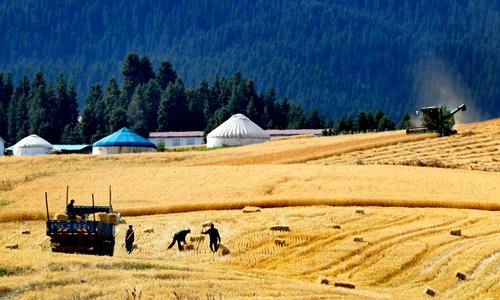
A view of a farmland in Turpan, Northwest China's Xinjiang Uyghur Autonomous Region. File photo: VCG
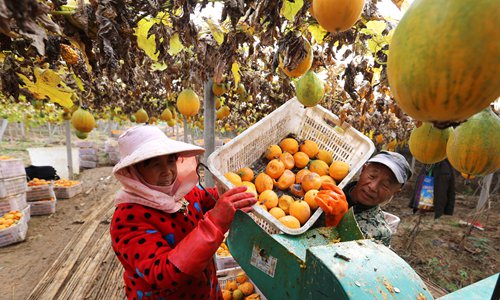
Inset: Farmers use machines to process fruits in Xiangyang, Central China's Hubei Province in November. Photo: VCG
A brand new combine harvester buzzes up and down a field in eastern China without a driver on board, chopping golden rice stalks and offering a glimpse of what authorities say is the automated future of the nation's mammoth agricultural sector.
The bright green prototype was operating last autumn during a trial of driverless farm equipment, as the Chinese government pushes firms to develop within 7 years, fully-automated machinery capable of planting, fertilizing and harvesting each of China's three staple crops - rice, wheat and corn.
That shift to automation is key to the farming sector in the world's No.2 economy as it grapples with an ageing rural workforce and a dearth of young people willing to endure the hardships many associate with toiling on the land.
Other countries like Australia and the US are taking similar steps in the face of such demographic pressures, but the sheer scale of China's farming industry means the stakes are particularly high in its drive to automate agriculture.
"Automated farming is the way ahead and demand for it is huge in China," said Cheng Yue, general manager of tractor maker Changzhou Dongfeng CVT Co, which provided an autonomous vehicle that was also used at the trial in the rice field in Xinghua, a county in East China's Jiangsu Province.
However, the road to automation is long and littered with obstacles such as high costs, the nation's varied terrain and the small size of many of its farms.
"I have heard of driverless tractors. But I don't think they are practical, especially the really large ones," said Li Guoyong, a wheat farmer in North China's Hebei Province.
Most farms in his area are only a few hectares in size, he said.
Going local
To try to achieve its ambitious 7-year goal, China is supporting trials of local technology across the country organised by the industry group Telematics Industry Application Alliance (TIAA).
TIAA members include state-owned tractor maker YTO Group, navigation systems producer Hwa Create and Zoomlion Heavy Industry Science & Technology Co, which helped develop the combine harvester used in the Xinghua trial along with Jiangsu University.
The next trials are slated for the Northeast China's Heilongjiang Province and for the hills around the Southwest China's Chongqing in the first half of this year.
Those come after a string of automation developments in the sector.
YTO developed its first driverless tractor in 2017 and is aiming to start mass production soon, depending on market demand, said Lei Jun, an executive at the firm's technology center, without giving a more detailed timeline.
Lovol Heavy Industry Co signed a deal with Baidu in April last year to apply the tech giant's Apollo automated driving system to its agricultural machinery.
"China is expected to climb the autonomous technology ladder very quickly, mainly because Chinese companies can access the local satellite navigation system, which gives them an advantage over their international peers," said Alexious Lee, head of China Industrial Research at Hong Kong brokerage CLSA.
He was referring to China's BeiDou homegrown satellite navigation system, a rival to the US Global Positioning System (GPS).
Beijing has included agricultural machinery in its "Made in China 2025" goal, meaning the vast majority of its farm equipment should be produced domestically by that time.
Semi-automated technology is already fairly common on farms in places such as the US, but fully-automated tractors and combines have yet to be mass-produced anywhere.
Too small
But with many Chinese farms still too small for a regular tractor, driverless ones that could be as high as four times more expensive at around $90,000 will be a long way out of reach for many in the short-term.
More than 90 percent of farms in China are less than 1 hectare, while in the US nearly 90 percent are larger than 5 hectares.
"It is not just about whether you have a product, its about the entire system. It is about commercializing agriculture," said Lee.
Although analysts and industry officials said that the underlying trend would be for farms to get larger as ongoing reforms to land rights should allow farmers to lease more space.
Sensors in equipment that help monitor crop conditions also need to be improved so that machines can adjust more quickly to different situations, said Wei Xinhua, deputy director of the school of agriculture equipment engineering at Jiangsu University.
China's $60 billion farm machinery industry has been burdened by overcapacity and low profit-margins. Analysts said it was too early to say how much the automated farming machinery sector could be worth.
Automated farming machines are also useful in recording data on details such as volumes of the crop or other materials used in cultivating crops, potentially helping farmers target consumers demanding higher-quality produce as some of that information could be included on food labels.
"Take a bowl of rice. I want to know exactly how it was planted, and how much fertilizer or pesticide was applied to it," said Cheng at Changzhou Dongfeng.
