IN-DEPTH / IN-DEPTH
Unmarried mothers demand rights for children born out of wedlock
Single-minded mission
By and Zhang Yu Published: Mar 10, 2019 05:00 PM

○ A deputy to the National People's Congress proposed unconditionally giving household registration to children born out of wedlock
○ Current policies make it difficult for single women to get access to assisted reproductive technologies
○ Some netizens argued the right to give birth should not be bound with marriage
"The woman at the hukou registration department in Chengdu was stubborn and insisted on asking me to find my daughter's father. I finally had to tell her that I had my daughter through artificial insemination. Then she asked us to hand in the materials, including the certificate from the overseas sperm bank where I got the sperm," Cheng said.
Cheng, 32, became pregnant after she and her homosexual partner sought help through a sperm bank in Los Angeles in 2016. The couple then welcomed their daughter in October that year.
Cheng is one of the growing number of women who do not or cannot get married, but want a child. However, current policies put restrictions on these women from getting access to assisted reproductive technology in China.
During the ongoing two sessions, Huang Xihua, a deputy to the National People's Congress from South China's Guangdong Province, proposed abolishing policies on "discriminating against birth out of wedlock," and to protect these children's rights, including unconditionally giving them household registration, the Beijing News reported on March 5.
Huang believes that the current policies of imposing social maintenance fees on out-of-wedlock birth and the restrictions on single women seeking assisted reproductive technology have deprived single women of their right to give birth.
Huang's proposals have attracted a great deal of attention and discussion in recent days, as changes in women's thinking and social values have made it a topic of contention for some time.
Long journey
Cheng said that she wanted to have a child to mollify her family.
"As the only child in my family, I was under great pressure from my parents. I thought that having a child could make it easy for my parents to accept my relationship with my partner. And more importantly, I had made full psychological and financial preparations for having a baby," Cheng told the Global Times.
The couple had thought of many ways to get artificial insemination, and even entertained the idea of "ambushing" people who went to donate sperm in sperm banks.
China's current regulations stipulate that relevant departments should not offer assisted reproductive technology services to single women or couples who fail to meet the requirements under China's family planning policies.
"There were some underground sperm donors, but we had concerns about their safety. After searching for more information, we finally decided to go to Saipan. The first time, we failed, and then we went to Los Angeles, and I finally got pregnant," Cheng said.
The entire "mission" cost them around 125,000 yuan ($18,600), a fee that was affordable for the couple. But it only marked the beginning of another long journey - raising a baby as a single mother.
Getting a hospital appointment for pregnancy examination and obtaining a hukou for the child required the father's details.
"To avoid more problems, I told the hospital that I was a single mother. But it took a longer time to get the household registration, since we were asked to get the certificate from the overseas sperm bank. The whole procedure cost about 2,000 yuan," Cheng said.
"It wasn't that troublesome," Cheng said, noting that back in 2016, there were already nationwide discussions on facilitating procedures for single mothers to obtain a hukou for their children, and the social environment began to change.
According to China's Marriage Law, children born out of wedlock enjoy the same rights as children born in wedlock, and no one may harm or discriminate against them.
In reality, though, the law is badly enforced. "The marriage law didn't set the details on how to protect these children's rights. As a result, many provinces have discriminatory regulations against these children, including not allowing them to obtain hukou, or charging their parents 'social maintenance fees,'" said He Yafu, an independent demographer based in Guangdong Province.
According to the Beijing News report, starting from 2016, Beijing started to allow children born out of wedlock to register for hukou as long as their Beijing parents had a DNA test to prove they were biologically related.
However, the regulation has not extended to other parts of China.
Many experts are calling for these rights to be implemented nationwide.
Many netizens believe that the current policies on out-of-wedlock birth should be updated, as more women today are rejecting marriage due to better education and greater financial independence.
Take Ah Lan, 28, for example, who works in Beijing. She has released a video online to seek a sperm donor.
"Instead of having a husband, I want to have a baby. Not all marriages are as happy as some people say, and life has more possibilities," Ah Lan told the Global Times. She noted that more women are beginning to realize that the right to give birth should not be bound with marriage.
Echoed with Ah Lan, Cheng said that "I am not a feminist and I'm not advocating that women refuse marriage. If you can have a loving relationship and raise children in a family full of love, that's perfect. But marriage is no longer the only choice for women. We no longer expect it to bring protection to us nor do we expect it to bring the children we want."
While some believe abolishing discriminatory policies on out-of-wedlock birth gives rights back to women, others worry the change will challenge the idea of traditional marriage and do nothing to protect women's rights.
France has the highest proportion of out-of-wedlock births in the world, with about six out of every 10 children born outside marriage, according to a report by Eurostat, the statistical office of the European Union. The same report says that over 50 percent of births occur outside wedlock in Bulgaria, Slovenia, Sweden, Denmark and Portugal. In the US, the figure is about 40 percent, according to a 2018 UN report.
In contrast, the percentage of children born outside marriage is as low as 2 to 3 percent in Asian countries like Japan and South Korea, according to an OECD report. So far, there are no official statistics on the percentage of out-of-wedlock births in China due to its grey-area status in many provinces, but He estimates that the number is below 5 percent.
"In Asian countries, where traditional values still rule, the percentage is still very low and many women keep a low profile if they have a baby outside wedlock," he told the Global Times.
But this may be changing. Many factors, including the trend among Chinese in recent decades to get married older, are now making out-of-wedlock births more acceptable.
In Shanghai, for example, the average age of marriage for men and women was 30.3 and 28.4 respectively in 2015, up five and 5.4 years compared with 2005.
"Since Chinese are getting married later and the number of people getting married has dropped in recent years, there is a higher likelihood that more babies will be born out of wedlock," he told the Global Times.
Huang also told the media that women who are able and willing to raise children on their own should be given the right to give birth and enjoy social welfare. Their children's legal rights should also be protected.
Huang's proposal won wide support on social media and from academia.
"Children born outside marriage are innocent and they should enjoy equal rights with all Chinese citizens, including hukou registration," He said.
Some netizens say the move could also help boost China's birth numbers, which has been declining in recent years and causing alarm among demographers.
But Huang Wenzheng, a researcher of demographics at the think tank Center for China and Globalization, said this is neither the goal nor the motivation behind their advocacy.
"Ensuring the rights of children born out of wedlock may have a small positive effect on China's overall birth rate, since it will give legal support for single women who want to have children through alternative measures such as sperm donors. However, the proportion of these women is still tiny in China, and it's unlikely they will boost China's birth rate," he told the Global Times.
For Cheng, making contributions to the country's birth rate is not her aim.
"I never, never regret bringing my daughter into the world even when there were and always will be difficulties. She is an angel not only to me but also to my family," Cheng said.
Cheng said that one day she will tell her daughter the story of her birth, and hopes this will give her a more tolerant attitude.
○ Current policies make it difficult for single women to get access to assisted reproductive technologies
○ Some netizens argued the right to give birth should not be bound with marriage
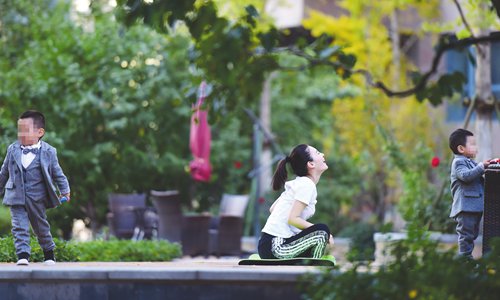
Zhao Yuequ, 27, an unmarried mother from Shanxi Province, has pictures taken with her twin sons. She attended a beauty contest in 2015 to show that women of any age and situation could be both confident and beautiful. Photo: VCG
The ongoing heated discussion on protecting children born out of wedlock and single mothers' rights to give birth has brought back memories to Cheng Zi (pseudonym) of her struggle to get her daughter a hukou (household registration) in Chengdu, capital of Southwest China's Sichuan Province in 2016."The woman at the hukou registration department in Chengdu was stubborn and insisted on asking me to find my daughter's father. I finally had to tell her that I had my daughter through artificial insemination. Then she asked us to hand in the materials, including the certificate from the overseas sperm bank where I got the sperm," Cheng said.
Cheng, 32, became pregnant after she and her homosexual partner sought help through a sperm bank in Los Angeles in 2016. The couple then welcomed their daughter in October that year.
Cheng is one of the growing number of women who do not or cannot get married, but want a child. However, current policies put restrictions on these women from getting access to assisted reproductive technology in China.
During the ongoing two sessions, Huang Xihua, a deputy to the National People's Congress from South China's Guangdong Province, proposed abolishing policies on "discriminating against birth out of wedlock," and to protect these children's rights, including unconditionally giving them household registration, the Beijing News reported on March 5.
Huang believes that the current policies of imposing social maintenance fees on out-of-wedlock birth and the restrictions on single women seeking assisted reproductive technology have deprived single women of their right to give birth.
Huang's proposals have attracted a great deal of attention and discussion in recent days, as changes in women's thinking and social values have made it a topic of contention for some time.
Long journey
Cheng said that she wanted to have a child to mollify her family.
"As the only child in my family, I was under great pressure from my parents. I thought that having a child could make it easy for my parents to accept my relationship with my partner. And more importantly, I had made full psychological and financial preparations for having a baby," Cheng told the Global Times.
The couple had thought of many ways to get artificial insemination, and even entertained the idea of "ambushing" people who went to donate sperm in sperm banks.
China's current regulations stipulate that relevant departments should not offer assisted reproductive technology services to single women or couples who fail to meet the requirements under China's family planning policies.
"There were some underground sperm donors, but we had concerns about their safety. After searching for more information, we finally decided to go to Saipan. The first time, we failed, and then we went to Los Angeles, and I finally got pregnant," Cheng said.
The entire "mission" cost them around 125,000 yuan ($18,600), a fee that was affordable for the couple. But it only marked the beginning of another long journey - raising a baby as a single mother.
Getting a hospital appointment for pregnancy examination and obtaining a hukou for the child required the father's details.
"To avoid more problems, I told the hospital that I was a single mother. But it took a longer time to get the household registration, since we were asked to get the certificate from the overseas sperm bank. The whole procedure cost about 2,000 yuan," Cheng said.
"It wasn't that troublesome," Cheng said, noting that back in 2016, there were already nationwide discussions on facilitating procedures for single mothers to obtain a hukou for their children, and the social environment began to change.
According to China's Marriage Law, children born out of wedlock enjoy the same rights as children born in wedlock, and no one may harm or discriminate against them.
In reality, though, the law is badly enforced. "The marriage law didn't set the details on how to protect these children's rights. As a result, many provinces have discriminatory regulations against these children, including not allowing them to obtain hukou, or charging their parents 'social maintenance fees,'" said He Yafu, an independent demographer based in Guangdong Province.
According to the Beijing News report, starting from 2016, Beijing started to allow children born out of wedlock to register for hukou as long as their Beijing parents had a DNA test to prove they were biologically related.
However, the regulation has not extended to other parts of China.
Many experts are calling for these rights to be implemented nationwide.
Updated thinking
Many netizens believe that the current policies on out-of-wedlock birth should be updated, as more women today are rejecting marriage due to better education and greater financial independence.
Take Ah Lan, 28, for example, who works in Beijing. She has released a video online to seek a sperm donor.
"Instead of having a husband, I want to have a baby. Not all marriages are as happy as some people say, and life has more possibilities," Ah Lan told the Global Times. She noted that more women are beginning to realize that the right to give birth should not be bound with marriage.
Echoed with Ah Lan, Cheng said that "I am not a feminist and I'm not advocating that women refuse marriage. If you can have a loving relationship and raise children in a family full of love, that's perfect. But marriage is no longer the only choice for women. We no longer expect it to bring protection to us nor do we expect it to bring the children we want."
While some believe abolishing discriminatory policies on out-of-wedlock birth gives rights back to women, others worry the change will challenge the idea of traditional marriage and do nothing to protect women's rights.
France has the highest proportion of out-of-wedlock births in the world, with about six out of every 10 children born outside marriage, according to a report by Eurostat, the statistical office of the European Union. The same report says that over 50 percent of births occur outside wedlock in Bulgaria, Slovenia, Sweden, Denmark and Portugal. In the US, the figure is about 40 percent, according to a 2018 UN report.
In contrast, the percentage of children born outside marriage is as low as 2 to 3 percent in Asian countries like Japan and South Korea, according to an OECD report. So far, there are no official statistics on the percentage of out-of-wedlock births in China due to its grey-area status in many provinces, but He estimates that the number is below 5 percent.
"In Asian countries, where traditional values still rule, the percentage is still very low and many women keep a low profile if they have a baby outside wedlock," he told the Global Times.
But this may be changing. Many factors, including the trend among Chinese in recent decades to get married older, are now making out-of-wedlock births more acceptable.
In Shanghai, for example, the average age of marriage for men and women was 30.3 and 28.4 respectively in 2015, up five and 5.4 years compared with 2005.
"Since Chinese are getting married later and the number of people getting married has dropped in recent years, there is a higher likelihood that more babies will be born out of wedlock," he told the Global Times.
Huang also told the media that women who are able and willing to raise children on their own should be given the right to give birth and enjoy social welfare. Their children's legal rights should also be protected.
Huang's proposal won wide support on social media and from academia.
"Children born outside marriage are innocent and they should enjoy equal rights with all Chinese citizens, including hukou registration," He said.
Some netizens say the move could also help boost China's birth numbers, which has been declining in recent years and causing alarm among demographers.
But Huang Wenzheng, a researcher of demographics at the think tank Center for China and Globalization, said this is neither the goal nor the motivation behind their advocacy.
"Ensuring the rights of children born out of wedlock may have a small positive effect on China's overall birth rate, since it will give legal support for single women who want to have children through alternative measures such as sperm donors. However, the proportion of these women is still tiny in China, and it's unlikely they will boost China's birth rate," he told the Global Times.
For Cheng, making contributions to the country's birth rate is not her aim.
"I never, never regret bringing my daughter into the world even when there were and always will be difficulties. She is an angel not only to me but also to my family," Cheng said.
Cheng said that one day she will tell her daughter the story of her birth, and hopes this will give her a more tolerant attitude.
