China's ZTE returns to black in Q1 2019 as US suppression even empowers telecom vendor
US suppression even empowers telecom vendor
By Published: Mar 28, 2019 07:23 PM

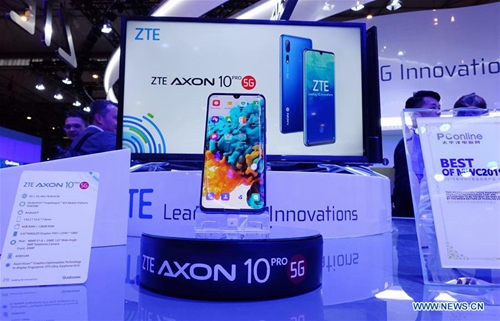
China's ZTE presents its Axon 10 Pro 5G cellphone at Mobile World Congress (MWC 2019) in Barcelona, Spain, Feb. 26, 2019. The four-day MWC 2019 opened its door on Monday, which presents the newest 5G products of the high-tech giants from all around the world. (Xinhua/Guo Qiuda)
Although the US has been pressing its allies to steer away from Chinese tech companies and their equipment, citing so-called national security concerns, ZTE Corp, the Chinese telecommunications company that was pushed to the brink of bankruptcy due to US sanctions last year, swiftly returned to making a profit in the first quarter of 2019.
The company estimated a net profit of around 800 million yuan to 1.2 billion yuan ($118.9 million to $178.3 million) in the first quarter of 2019, compared with a year-earlier loss of 5.4 billion yuan due to US cutting chips supplies, the company said.
ZTE stock climbed 9.36 percent on Thursday.
ZTE is expected to open two more labs in Italy and Belgium in 2019 to allow customers to have access to its source code, the company said in a statement sent to the Global Times.
The faster-than-expected comeback was not only due to the company's strong comprehensive power and its leading place in the industry, but also a result of the US' continuous pressure that forced the company to upgrade and reshuffled its management, an industry analyst said.
The world's fourth-largest telecommunications equipment maker by market share was forced to stop most of its business between April and July last year due to US sanctions. It paid a $1.4 billion fine to lift the sanctions.
"ZTE, together with Huawei, is one of the rare companies in the world that can provide a whole set of services from terminal products to system equipment. Its leading strength in the industry is the main reason for its rebound in such a short time," said Xiang Ligang, a Beijing-based telecom analyst.
Xiang said another contributor to the company's fast development was the US sanctions last year.
As part of a move to lift US sanctions, almost all of the senior executives of ZTE resigned, which according to Xiang, benefited the company's long-term development.
"The situation forced the company to start using younger people, which rejuvenated its management team and stimulated vitality in the company. Young people are the main impetus to leading technology companies in the world," Xiang said.
"The monitor sent by the US to watch its business practice also prompted ZTE to regulate and upgrade its management and operational levels," Xiang added.
Indeed, the US was the biggest contributor to the fast development of Chinese tech companies in the past year, not only in ZTE's case, but also Huawei, another major company on top of the US suppression list, Xiang added. "They are marching faster under rising pressure from the US."
According to a Reuters report, Huawei's revenue jumped 36 percent over the first two months of 2019 and was set for a 15 percent annual spike to $125 billion.
Huawei Rotating Chairman Eric Xu Zhijun said during an interview on Wednesday that the US campaign against Huawei is having little impact on the company's sales, adding that "it is unlikely many countries will follow the US in banning Huawei from building next-generation mobile networks."
EU's common 5G security approach released on Tuesday did not exclude any companies from the 5G network assessment, ignoring the US push for a blanket ban on Chinese companies in Europe.
Xiang said that US pressure also forced China's technology companies to step up research in core technologies to shake off reliance on chip imports.
HiSilicon, Huawei's semiconductor subsidiary designed and manufactured chips worth more than $7.5 billion in 2018. ZTE also vowed to strengthen research and development in the 5G sector in its financial report released on Wednesday to grab opportunities in the new era.
"The US might have tried to use every means to suppress Chinese tech companies, from bluffing and cutting exports of key US telecom products, to pressing its allies to ban their equipment, but all it did was empower China's tech companies and make them stronger," Xiang said.
