China to control fentanyl-related substances
Regulations show commitment to zero-tolerance on drug abuse
By Published: Apr 01, 2019 11:08 PM

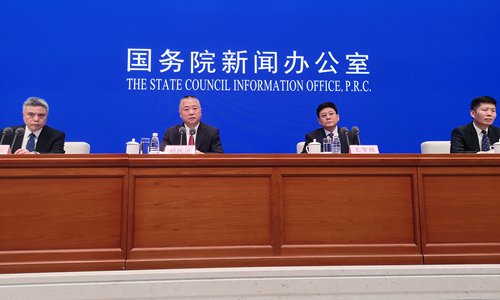
Liu Yuejin (2nd from left), deputy director of China's National Narcotics Control Commission, speaks at a press conference at the State Council Information Office on Monday. Photo: GT/Deng Xiaoci
Chinese government agencies on Monday announced that all fentanyl-related analogs will be added to the country's list of controlled drugs effective May 1, a move that aims to step up efforts to stringently combat the illegal manufacturing, distribution and smuggling of the world's most lethal synthetic opioid.
The joint announcement came from the Ministry of Public Security, the National Health Commission and the National Medical Products Administration on Monday at a press conference at the State Council Information Office in Beijing.
Starting May 1, fentanyl-related substances, which are defined as substances structurally related to fentanyl, will be added to the Supplementary List of Controlled Narcotic Drugs and Psychotropic Substances with Non-medical Use, Liu Yuejin, deputy director of the China National Narcotic Control Commission (CNNCC,) announced at the Monday event.
Liu characterized the Chinese government's decision as a "major innovative move" in the history of the country's anti-drug legal system, saying it officially marks the government's placement of all varieties of fentanyl-related substances into the country's drug control domain.
China's government had adopted one of the world's strictest controls on fentanyl even before Monday's announcement. It listed 25 kinds of fentanyl analogs and their two precursors that are most often abused or are of concern to the international community. This exceeds the 21 types of fentanyl-related analogs listed under control by the UN.
Chinese President Xi Jinping in December 2018 announced that the country would act to regulate all fentanyl-related analogs. The move further exemplifies the strict anti-drug policy that Communist Party of China and the government have consistently pursued, demonstrating the responsibility the Chinese government places on its role in global co-governance of the drug problem, Liu said.
"Enlisting all fenanyl-related analogs will completely close the loopholes where lawbreakers could bypass legal punishment by making simple [molecular] modifications and creating a new type of drug. It also provides a solid and concrete legal foundation for law-enforcement and judicial agencies to effectively combat and handle such illegal activities so as to prevent large scale abuse, illegal manufacturing, distribution and smuggling of the substances," the official said.
Fentanyl is a chemically synthesized opioid that acts on opioid receptors in the body with anesthetic and analgesic effects. It is 100 times more effective than morphine and commonly used in the treatment of moderate to severe pain, Hua Zhendong, technical director of the CNNCC national narcotics laboratory, told the Global Times in February.
By simply tweaking a molecule in the chemical structure of fentanyl, analogs with similar structures and similar effects, or even stronger effects, can be obtained. These compounds can produce euphoria, leading to severe drug abuse, said Hua.
The US has suffered the most from the fentanyl drug abuse. According to the US Centers for Disease Control and Prevention, fentanyl was used in one in four overdose deaths in the US in 2018, killing just over 18,000 people in one year and overtaking heroin and oxycodone as the country's most deadly drug, CNN reported Monday.
Instead of focusing on its domestic drug abuse phenomenon, Washington has accused China of being the primary source of the problem. According to a document issued by US Department of Homeland Security on October 2 2018 titled "US Immigration and Customs Enforcement", the US law enforcement has identified China as the primary source of illicit fentanyl and the painkiller's analogues that entering the US.
Liu said Monday that it is impossible that fentanyl legally produced for medical use in China could flow into the US.
China's agencies have busted a number of cases of illegal manufacturing and trafficking of fentanyl analogs to the US through international parcels, which were carried out by domestic and foreign lawbreakers. However it cannot possibly be the main source of the fentanyl compounds flowing to the US, and US accusations against China in this regard lack evidence and are contrary to the facts, Liu said.
Liu ascribed the outbreak of fentanyl addiction in the US to domestic reasons ranging from over-prescription of painkillers and the lucrative profits in the US market.
To tackle the problem, Liu urged the US to enforce its drug abuse prevention education and start the fight against mass drug abuse by reducing domestic demand, instead of simply pointing fingers at others.
Not a trade concession
Following the conference, Liu told reporters that US concerns [on the fentanyl matter] have been "resolved, all resolved." But he declined to respond to a Global Times inquiry on what comes next to further tap the potential of China-US cooperation on fentanyl control.
Fentanyl-related issues have been often tied to China-US ties, with US Trade Representative Robert Lighthizer saying he hopes to include China's commitments to curb the drug in any agreement to end the two countries' bitter trade war, Reuters reported.
However, during the Monday press conference, when asked how the new drug regulation would impact the ongoing China-US trade talks and bilateral ties, China's anti-drug authorities said the new regulations answer how to fight drug abuse and how to form international cooperation to address the problem, and they would not touch on any other topic.
It would be absolutely wrong to consider China's toughened regulations on the lethal opioid as a concession made under US pressure during the trade negotiations, Ni Feng, deputy director of the Chinese Academy of Social Sciences' Institute of American Studies, said.
China, as a nation that significantly suffered from drug abuse in its modern history, has consistently held a zero-tolerance attitude to drug abuse, and the new regulations on one of the most dangerous and out-of-control drugs, fentanyl, simply show that China will make no exceptions, Ni noted. "China's expansion of its controls on fenantyl was a decision made at its own pace, other than resulting from external pressure."
Liu said China is drawing bitter lessons from the US experience with fentanyl, and China is taking precautions to combat fentanyl-related problems and safeguard its people's health and interests in a practical fashion.
Drug control is not part of the China-US trade talks, but anti-drug efforts made by the two countries would serve as a good example that they are able to meet half way, and make contributions to addressing international problems which will benefit everyone, Ni said.
