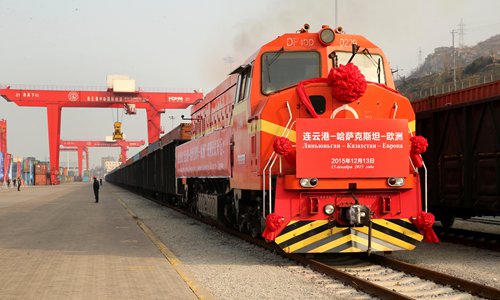
A general view of an international container train traveling from China through Kazakhstan to Germany at a container terminal in Lianyungang, East China's Jiangsu Province on December 13, 2015 Photo: IC
After Italy's endorsement of China's Belt and Road Initiative (BRI) on March 23, people are speculating which country would become the second G7 member to join the initiative.While the German government has objected to Italy's decision, the country's numerous small and medium-sized enterprises are eyeing an opportunity to boost trade and businesses through China's flagship initiative.
"From the point of view of the BVDSI [an organization promoting the BRI in Germany], the BRI is the most important and the largest infrastructure program in the world. It includes the opportunity for cooperative development of emerging economies with China," Hans V. Helldorff, spokesperson with Federal Association of the German Silk Road Initiative (BVDSI), told the Global Times in an exclusive interview.
For Helldorff, the strengths of the German medium-sized businesses can also "contribute as an innovation engine and as an investment engine for the benefit of many."
The BVDSI was founded on March 29 in Bremen, Germany. It is positioned to represent the interests of the midium-sized German economic sector, which has long maintained close economic ties with countries along the new Silk Road, according to Helldorff.
Helldorff said that they are constantly in contact with German and European politicians on BRI-related topics.
"Our goal this year is to organize a German Silk Road Summit to initiate the dialogue between critics, advocates and those still undecided," he said.
China remained Germany's most important trading partner for the third consecutive year in 2018. The trade volume of the two countries reached 199.3 billion euros ($225.7 billion) last year, according to preliminary figures by the German Federal Statistical Office.
Anxiety apparent
Helldorff told the Global Times that many German politicians are still "in the process of clarifying what effects the dynamic development of the BRI in Europe will have on securing the value creation potential of German companies in the countries along the Belt and Road."
"There are fears that the projects currently being planned and in question are not applying the EU's standards of competition, for example, on tenders and environmental standards," he said. He added that some others are worried local jobs will be hurt if China makes direct investment and buys strategic companies in Germany and other parts of Europe.
One reason for the existing fears is a lack of knowledge. "The West, including Germany and the EU, are facing a new experience. Suddenly, China is no longer just the extended workbench of its own economies, but a global player at eye level," he said.
Chinese State Councilor and Foreign Minister Wang Yi said at this year's two sessions in March that the BRI isn't a "geopolitical tool," but a good opportunity for shared development.
The Mombasa-Nairobi Standard Gauge Railway in Kenya has generated nearly 50,000 jobs and also increased economic growth by 1.5 percentage points. In Uzbekistan, Chinese and local workers jointly built a 19-kilometer tunnel in 900 days, which enables people in remote areas to travel by train through mountains in just 900 seconds, Wang added.
Ruan Zongze, executive vice president of the China Institute of International Studies, told the Global Times that the BRI is not perfect, but China and other countries are working together to improve it. And it has been welcomed by people in many countries.
Helldorff suggested that the most important and credible tool China can use to dispel doubts is "a commitment to transparency."
"China should consider whether and how it may adopt German and Western standards in order to engage more closely with the doubters in the EU and in the Western world in a productive dialogue with regard to its own goals," he said. "The BVDSI believes that only cooperation, and not isolation and confrontation will lead to sustainable wealth creation in all regions along the BRI."
Some German companies have already reaped the benefits of the BRI. "Hardly a week goes by that Chinese firms don't reach out to German companies," Helmut Naujoks of the World Public Diplomacy Organization told Handelsblatt Today.
That outreach has translated to a contract worth 86 million euros for a subsidiary of GP Günter Papenburg to build a 50-kilometer stretch of highway in Uzbekistan, said the Handelsblatt Today report.
Due to the BVDSI's support for the BRI, it is facing some criticism within the country. "We had to countervail some doubts concerning our loyalty. These doubts were primarily strongly-worded in the BILD Zeitung, Germany's most populist paper," Helldorf said.
"We are definitely not funded, financed or financially supported by Chinese official or NGO sources," he stressed.
5G and more to cooperate
As to whether the involvement of Huawei in the rollout of 5G in Germany is welcome, Helldorf said, "5G is an absolute must. The application of Huawei to participate in the development of the German 5G is welcome from the point of view of the BVDSI."
Germany is still one of the leading economies of the world. Unfortunately, its digital infrastructure is currently unable to meet the needs of the economy and the population, he said.
"We know that Huawei, unlike US competitors, is willing to reveal its source code. We regard this as an absolutely necessary condition, which, however, has to apply to all providers for reasons of competition law," he told the Global Times.
He noted that China is not a rival of Germany or the EU. "Neither Europe nor the US will be able to generate a sustainable future perspective by means of particular economic policies …The BVDSI sees in China a fast-growing economy that follows a plan."
"Only cooperation in the sense of fair competition benefits humanity," he added.
He suggested to the Global Times that China and Germany cooperate in fields including infrastructure, digital economy, healthcare, education and energy.
