Our cities are getting smarter
Process of urbanization moves faster with new technologies: Tianjin Forum 2019
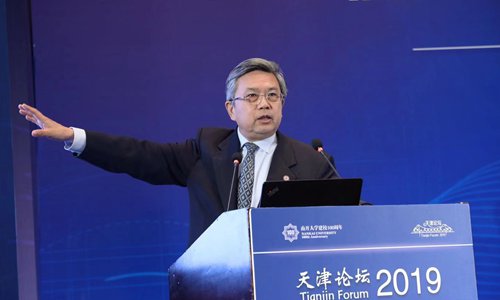
Gong Ke, Chairman of the Academic Committee of Nankai University Photos: Courtesy of Nankai University
Global urbanization, the fourth Industrial Revolution and the role of AI in urban sustainable development were topics discussed at the "High-Tech-Enabled Cities and Regional Governance Innovation" Tianjin Forum 2019, which concluded on Sunday.
With more than 20 issues on the forum's agenda, such as "Development of Science and Technology & the Innovation of Urban Public Service" and "AI Technology in Smart Cities and Healthy Cities," nearly 200 scholars, entrepreneurs and politicians from 14 countries and regions including China, South Korea, India, the US and Rwanda discussed how to utilize technologies to make cities smarter.
During the two-day event, opinions on some eye-catching topics often varied, as participants debated questions such as whether or not the application of AI, which is expected to be able to take on simple jobs, will cause more unemployment in the future.
However, most participants reached the consensus that building smart cities has become a global trend as global urbanization is currently moving at a fast pace.
During his speech, President of the Chey Institute for Advanced Studies (CIAS) Park In-kook pointed out that the process of urbanization and urban development in the world today is progressing at an unprecedented speed.
According to UN data, there were 570 million people living in cities in the 1950s, and that number had grown to 4.2 billion by 2018. Now, nearly 50 percent of the world's population lives in cities, and by 2050, 68 percent of the population is expected to be urban.
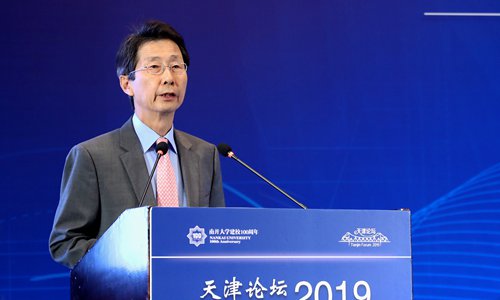
Park In-kook, President of the Chey Institute for Advanced Studies
Building smart cities
Gong Ke, Chairman of the Academic Committee of Nankai University, told the Global Times that, "Basic social services such as the distribution of energy and waste treatment are more efficient in cities than in rural area since cities are more populated. So urbanization is an inevitable upgrade for human society."
But Gong noted that rapid urbanization could lead to a lag in governance, resulting in many "headaches" like an uneven power supply and heavy traffic.
He said that when facing these issues, "There is no way for us to go back, to carry out a so-called "ruralization" process which disperses people to all parts of the world. That would greatly increase the cost of social services such as energy supply and transportation. Thus we have to move on."
Gong said that the key to solving such "headaches" is not to reverse urbanization, but rather to promote the development of a smart society. This can be done by, for example, making rational use of artificial intelligence (AI), fifth-generation mobile communications (5G), urban databases and other technologies.
Gong's idea of building smart cities and utilizing technologies to enable urban governance was echoed by other experts.
Former assistant director-general for Strategy Planning of UNSECO Hans d' Orville said during his speech, "The benefits brought by increased productivity through the use of emerging technologies such as AI, 5G, the Internet of Things and Distributed Ledger Technologies (block chain) will empower all individuals and businesses by creating new opportunities, and generate new services and employment."
In his speech themed "Planning and development of smart cities," Anthony G.O. Yeh, Chair Professor of Urban Planning at Hong Kong University, said that planning and developing smart cities has become a trend, and that most cities in the world are trying to be smarter. The age of smart cities is coming, he said.
Citing data from a study on more than 30 smart cities around the world by the McKinsey Global Institute, Gong said that the use of technology has enabled Rio de Janeiro to reduce the number of abnormal deaths each year by 300.
As a result, thanks to the application of a real-time monitoring system, the number of crimes such as robbery, theft and shootings has also been reduced, Gong said.

Hans d' Orville, former assistant director-general of UNSECO's Strategy Planning
Challenges and drawbacks
Although many new technologies including AI have entered the application stage, experts believe that drawbacks and challenges still exist. Among them, people are concerned about whether the application of more AI technology will cause a higher unemployment rate.
In response to such concerns, Charles X. Ling, a fellow of the Canadian Academy of Engineering, said that there is indeed a situation in which AI technology can replace many basic human jobs, resulting in a higher unemployment rate. But with AI technology, society will optimize the distribution of resources more efficiently.
At the same time, he believes that there are many areas of work that cannot be replaced by AI in the near future, such as analysis-based decision-making, creative work, communication and coordination jobs.
Gong's understanding of this issue is more optimistic. He believes that, from a macro point of view, the 300 years of industrial revolution have proven that the continuous use of technology can create more and more jobs, and there is no evidence that the introduction of technology will reduce employment.
Regarding specific positions, some jobs may be replaced. But if society takes measures to help harness AI, it can bring structural changes to social employment, Gong noted.
While remaining optimistic, Gong also pointed out that AI is lacking in critical thinking, creative thinking, communication and cooperation. As a tool of urban governance, it is not mature enough yet.
It is highly dependent on data, with legal and ethical issues, a lack of flexibility and a huge energy consumption, all of which need to be carefully studied and discussed, Gong noted.
The two-day event saw the deliveries of six keynote speeches, two roundtable discussions, one international forum and four sub-forums, in addition to the development and application of AI. The participants also focused on current heated topics such as "Interaction between Great Power Relations and Northeast Asia's Geopolitical Patterns."
While experts and scholars from various countries have reached consensuses on many issues, disagreements still exist.
Despite this, Zhu Guanglei, host of the forum's closing ceremony and former vice president of Nankai University, said that this was the purpose and value of the Tianjin Forum - to build a platform for scholars so that they can exchange views, learn from each other and jointly promote the development of other industrial fields.
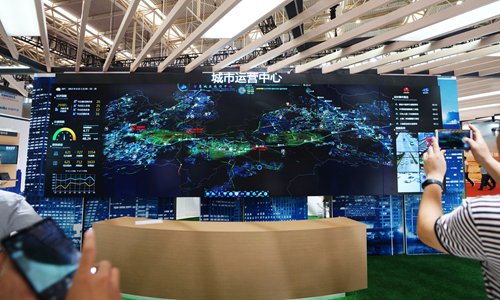
A view of a smart city operating system showcased during the second World Intelligence Congress held in Tianjin, North China, in May, 2018 Photo: IC
Spirit of Nankai University
After the event, Hans told the Global Times that in his understanding, the forum provides excellent presentations, promotes partnerships for universities and people-to-people exchanges.
"I also met somebody from Belgium and he told me things which I was unaware were happening in Belgium and France, although I live in France," Hans said.
"I heard very fascinating presentations. The one by professor Gong about artificial intelligence is the most fascinating thing I've ever heard."
Tianjin Forum consists of a series of international academic forums co-sponsored by Nankai University and the Chey Institute for Advanced Studies. Launched in 2015, it takes "Urban and Regional Governance" as its central topic every two years.
Gong said that the forum provides an interdisciplinary, cross-border platform for scholars around the theme of urban development.
"Nankai University's motto is 'Dedication to public interests, acquisition of all-round capability and aspiration for progress with each passing day' (which can be summarized in three words: responsibility, capability and creativity) and 'responsibility' has different connotations in different generations," said Gong.
"In today's era of intelligence and rapid urbanization, our 'responsibility' should be linked to social development. The creation of the Tianjin Forum and the choice of its urban development theme are, in fact, based on our very understanding of the motto," Gong said.
