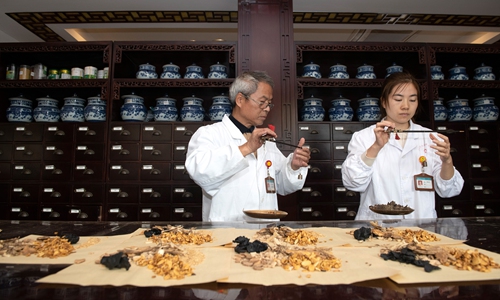
Two employees in a TCM store in Dongyang, East China's Zhejiang Province, measure herbal medicine on October 31, 2018. File Photo: VCG
The outbreak of the global coronavirus epidemic has shown the important role that can be played out by traditional Chinese medicine (TCM). The vaccine will not be available in a short time, and the demand for TCM has been rising in overseas markets, as it provides a valuable alternative.
A source close to Yiling Pharmaceutical (Yiling) told the Global Times on Monday that at present, there is a significant increase in the demand for the company's Lianhuaqingwen capsules in six countries.
Lianhuaqingwen capsules, which were developed to tackle the SARS outbreak in 2003, are believed to be effective in treating COVID-19, leading to a spike of 50-60 percent in its first-quarter profits, industry analysts said.
In accordance with the drug administration law of China and the clinical practice of epidemic treatment, the company added a prescription in the function of the capsules for the treatment of coronavirus pneumonia for light conditions.
To help foreign countries tackle the pandemic, Yiling has been offering huge donations of its products where it is needed the most.
At the request of the Iraqi Red Crescent Society, they donated 118,400 yuan ($16,742) to Iraq on April 6. Meanwhile, on April 9, they donated two million yuan to the Red Cross foundation of China, which was directed to the international humanitarian assistance fund to fight the epidemic and support the international epidemic prevention and control work.
In early march, Yiling donated 1.89 million yuan to Iraq and 1.48 million yuan to Italy.
Meanwhile, Yiling's sales of Lianhuaqingwen capsules in registered countries and regions are completed through local agents, and a settlement is made with agents according to the agreed agent price, according to the statement that the company sent to the Global Times.
The shortage of Lianhuaqingwen capsules in the domestic market has been alleviated, and the company has gradually adjusted the production plan according to the market demand since March, and has now returned to normal production, according to Yiling's statement.
In addition, the market supply in registered countries and regions is sufficient, with overseas purchases by Chinese groups increasing significantly.
This came after China's renowned respiratory expert Zhong Nanshan said his team was testing the effectiveness of medicines such as chloroquine and TCM formulae such as Lianhuaqingwen and Xuebijing, which have been effective in treating critically ill patients.
Zhong believed that a vaccine will not be available in the near future and placing all hopes on a vaccine while disregarding other methods is a negative approach.
Of the confirmed COVID-19 cases in China, 74,187, or 91.5 percent, have used TCM, according to data released by the national administration of traditional Chinese medicine.
However, Yu Zhibin, a director with the China Chamber of Commerce for Import & Export of Medicines & Health Products told the Global Times on Monday that Lianhuaqingwen has been donated via diplomatic channels instead of normal commercial trade and customs clearance, since the drug is still in the 2nd phase of clinical trials in the US.
"Therefore, even if there is a growing demand for the medicine, its delivery will not be smooth as the pharmaceutical export qualification for Lianhuaqingwen is not there," Yu said.
"TCM has been proved to be very effective in treating the coronavirus, and China is willing to help foreign countries if they are willing to use Chinese medicine.; Wwe will do our best to help them, but will not push them to use it," Yu said.
A director surnamed Liu with the China Association of Traditional Chinese Medicine told the Global Times on Monday that donations are short-term, but in the long run, they are exported through trade and the normal approval process.
"During the outbreak, the export of traditional Chinese medicine increased by five5 percent. Demand will continue to grow, even faster than it is now. But how much growth there is depends on the growth of outbreaks abroad," Liu said.
