SOURCE / INDUSTRIES
Smart city industry attracts more investors in China

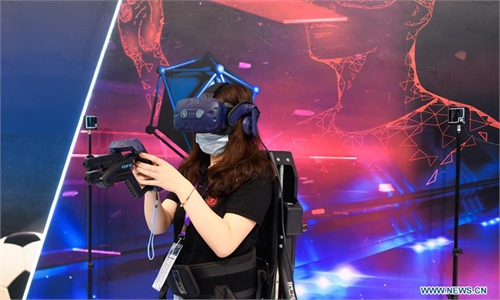
A visitor plays a VR game via 5G-powered devices at the 10th China Smart City and Intelligent Economy Expo in Ningbo, east China's Zhejiang Province, Sept. 11, 2020. Unveiled here on Friday, the 10th China Smart City and Intelligent Economy Expo showcases the latest products and technologies in the area.Photo:Xinhua
The construction of new infrastructure with 5G, artificial intelligence, and the Internet of Things (IoT) has become a key growth engine driving up China's economy, as more companies are flocking to the hi-tech industries.
Terminus Group, a smart service provider, recently announced its AI CITY strategy in Beijing, the embodiment of Terminus Group's experience gathered over the past five years, and unveiled the TACOS - Terminus AI CITY Operating System, for the first time.
In the AI CITY, various solutions including smart communities, smart fire protection, smart security, smart finance and smart cultural tourism are all packed into digital layers that are ready to be deployed in upgrading the target industries, and they are all integrated into the city smart operating system TACOS.
TACOS, the city hub, will be a collection and a distribution center for diverse information and instructions coming from the IoT devices spread around the city, and will help the city operators obtain instant information and make more responsive and optimal decisions.
China has included the smart city initiative in its national strategy and made significant investments in many projects, with first-tier cities as well as small- and medium-sized cities launching smart city projects.
Cities are becoming bigger and denser in an era of unprecedented urbanization. At the same time, large-scale mobile digital layers exist atop these dense environments. Combining these two trends to better understand the city will lead to a great age of Urban Digitization, which can be used to help residents, businesses, and governments gain insights into how cities work.
Arup and Alibaba Cloud Research Centre recently jointly published a white paper, revealing a new vision for planning future cities in the digital age.
The white paper explores how the urban planning and design industry can make the best use of data and digital technology to improve efficiency and effectiveness, and turn people-oriented development into a reality.
The white paper said that digital master planning can provide a framework to realize management, integration and application of massive urban data, and serve as a blueprint for digital infrastructure development.
Global Times
RELATED ARTICLES