In January, Ellie Mitchell started getting a barrage of texts and emails from her internet service provider, warning her she was running out of data.
"The messages kept coming: 'You've used 75 percent, 80 percent, 90 percent...'" Mitchell, director of youth nonprofit Maryland Out of School Time Network, told Reuters in a phone interview.
"It felt like we were being held hostage," said Mitchell, who was working from home in Baltimore, Maryland alongside her husband and their two children attending school online.
The move drew the ire of elected officials and digital rights activists in Baltimore, who have been calling on the company to make broadband accessible for all students during the pandemic.
With millions forced to work and learn from home, COVID-19 has laid bare the digital divide across the country, with technological inequality disproportionately affecting poor and minority communities.
Some 16 million children, or 30 percent of all US public school students, lack either an internet connection or a device at home adequate for distance learning, according to Boston Consulting Group.
"We see [the Comcast cap] as preying on people's vulnerability," Baltimore city councilman Zeke Cohen said in a phone interview.
A Comcast company spokesman said that only about 5 percent of its customers would regularly go over the 1.2 TB limit, adding that it had a policy of working with customers on payment plans if they could not afford their bills.
On January 26, Cohen, two other council members and the Baltimore Digital Equity Coalition (BDEC), sent a letter to Maryland's Attorney General, requesting he investigate Comcast for price gouging.
Upset families
When Baltimore's public schools first went remote in March 2020, Aliyah Abid was a high-school senior and a member of the group Students Organizing a Multicultural and Open Society (SOMOS), which pushed Comcast to make broadband quicker and cheaper.
"These days, the internet is how you access your education - so, with Comcast we are being asked to pay for a public education that's supposed to be free," she said.
In July, SOMOS launched a petition asking Comcast to ensure students in the city could get online for free during the COVID-19 crisis.
Chief among their demands was improving the speed and lowering the cost of the "Internet Essentials" program, a discounted plan for low-income customers that costs $9.95 per month.
"What we are hearing from students is that the speed is abysmal for Essentials," said Adam Echelman, BDEC cofounder and executive director of the nonprofit Libraries Without Borders.
Comcast said it would be increasing the Essentials speed this week.
"We're continually improving our Internet Essentials program and have increased speeds multiple times, including today to 50 MB [and] 5 MB, all while keeping the price at $9.95/month for the last decade," the company said in an emailed statement.
"These speeds support multiple concurrent video conferencing sessions and enable family members to learn and work from home."
AT&T, another major internet service provider, previously suspended its data coverage charges through the end of 2020, and announced it would waive the data caps it places on its low-income plans through June 2021.
Unequal access
Like many American cities marred by residential segregation, the distribution of internet to homes in Baltimore is highly unequal, said John Horrigan, a senior fellow at the Technology Policy Institute, a think tank in Washington DC. In his research, Horrigan has found that 206,000 African-American households in Maryland State were without a wire line broadband connection in 2020.
A report he published in May 2020 showed that in Baltimore alone, more than 40 percent of households did not have a fixed line connection, with many homes using their phones to access the internet.
"Having good internet is extremely important to people's emotional wellbeing at this time - not having access leads to both economic and social exclusion," he said.
The primary reason families lack broadband, he said, is that they cannot afford the monthly bill.
According to a 2020 report by the Institute for Local Self-Reliance (ILSR), a group critical of major telecom firms, 22 million US customers living in Comcast service areas have no other option for broadband service.
California congresswoman Anna Eshoo sent the company a letter in December asking it to suspend all data caps until after the pandemic. Comcast had already waived its caps on data in California and other places until the end of the 2020 school year.
The company said that the alerts being sent now to customers will not translate into additional charges until their August 2021 bill, and the messages were only meant to help customers decide if they should change to a plan with more data.
Unless something changes, Mitchell said she will likely have to start paying the additional $30 a month for an unlimited plan.
"This is our work lifeline, this is our education lifeline - so we either have to ration or just add another thing to our monthly budget," Mitchell said. "It's death by a thousand cuts."
"The messages kept coming: 'You've used 75 percent, 80 percent, 90 percent...'" Mitchell, director of youth nonprofit Maryland Out of School Time Network, told Reuters in a phone interview.
"It felt like we were being held hostage," said Mitchell, who was working from home in Baltimore, Maryland alongside her husband and their two children attending school online.
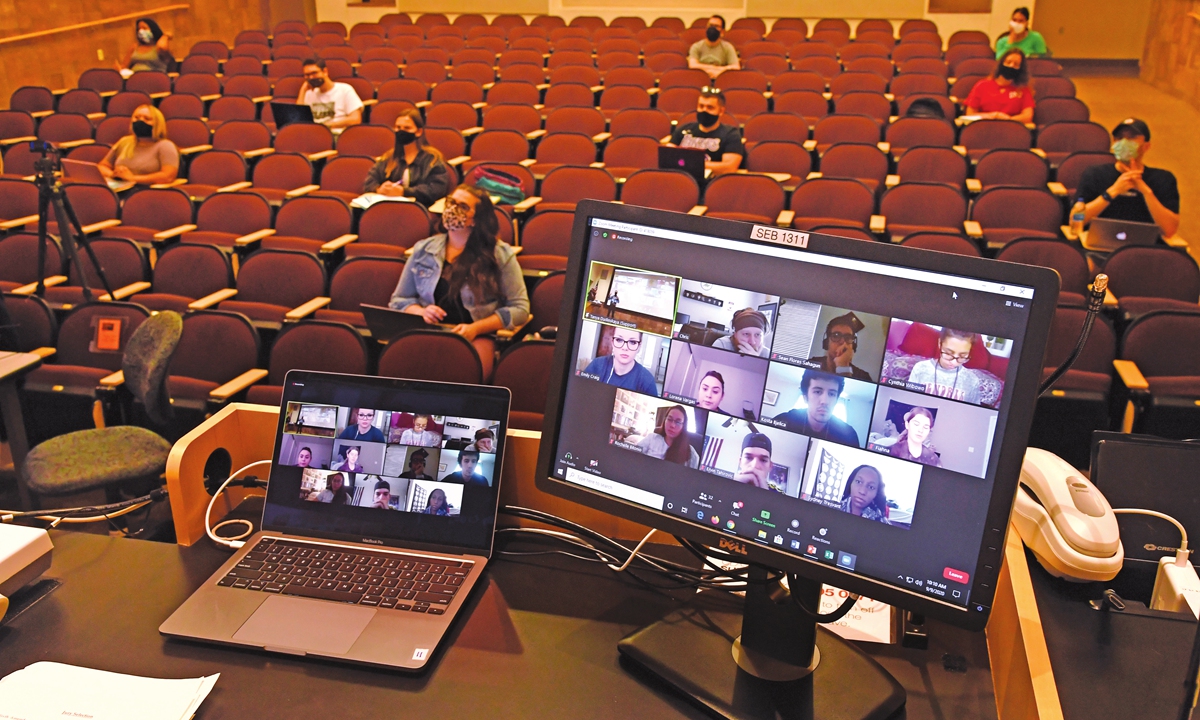
Remote students are shown on screens as the University of Nevada, Las Vegas Professor Dr Joel Lieberman teaches, amid the spread of the coronavirus in Las Vegas, Nevada, the US, on September 9, 2020. Photo: AFP
Comcast Corp, one of the largest internet providers in the US, announced in November it would be capping data usage for residential customers not on an unlimited plan in several cities in the northeast. Customers who use more than 1.2 terabytes (TB) of data are charged $10 for every additional 50 gigabytes, up to a maximum of $100.The move drew the ire of elected officials and digital rights activists in Baltimore, who have been calling on the company to make broadband accessible for all students during the pandemic.
With millions forced to work and learn from home, COVID-19 has laid bare the digital divide across the country, with technological inequality disproportionately affecting poor and minority communities.
Some 16 million children, or 30 percent of all US public school students, lack either an internet connection or a device at home adequate for distance learning, according to Boston Consulting Group.
"We see [the Comcast cap] as preying on people's vulnerability," Baltimore city councilman Zeke Cohen said in a phone interview.
A Comcast company spokesman said that only about 5 percent of its customers would regularly go over the 1.2 TB limit, adding that it had a policy of working with customers on payment plans if they could not afford their bills.
On January 26, Cohen, two other council members and the Baltimore Digital Equity Coalition (BDEC), sent a letter to Maryland's Attorney General, requesting he investigate Comcast for price gouging.
Upset families
When Baltimore's public schools first went remote in March 2020, Aliyah Abid was a high-school senior and a member of the group Students Organizing a Multicultural and Open Society (SOMOS), which pushed Comcast to make broadband quicker and cheaper.
"These days, the internet is how you access your education - so, with Comcast we are being asked to pay for a public education that's supposed to be free," she said.
In July, SOMOS launched a petition asking Comcast to ensure students in the city could get online for free during the COVID-19 crisis.
Chief among their demands was improving the speed and lowering the cost of the "Internet Essentials" program, a discounted plan for low-income customers that costs $9.95 per month.
"What we are hearing from students is that the speed is abysmal for Essentials," said Adam Echelman, BDEC cofounder and executive director of the nonprofit Libraries Without Borders.
Comcast said it would be increasing the Essentials speed this week.
"We're continually improving our Internet Essentials program and have increased speeds multiple times, including today to 50 MB [and] 5 MB, all while keeping the price at $9.95/month for the last decade," the company said in an emailed statement.
"These speeds support multiple concurrent video conferencing sessions and enable family members to learn and work from home."
AT&T, another major internet service provider, previously suspended its data coverage charges through the end of 2020, and announced it would waive the data caps it places on its low-income plans through June 2021.
Unequal access
Like many American cities marred by residential segregation, the distribution of internet to homes in Baltimore is highly unequal, said John Horrigan, a senior fellow at the Technology Policy Institute, a think tank in Washington DC. In his research, Horrigan has found that 206,000 African-American households in Maryland State were without a wire line broadband connection in 2020.
A report he published in May 2020 showed that in Baltimore alone, more than 40 percent of households did not have a fixed line connection, with many homes using their phones to access the internet.
"Having good internet is extremely important to people's emotional wellbeing at this time - not having access leads to both economic and social exclusion," he said.
The primary reason families lack broadband, he said, is that they cannot afford the monthly bill.
According to a 2020 report by the Institute for Local Self-Reliance (ILSR), a group critical of major telecom firms, 22 million US customers living in Comcast service areas have no other option for broadband service.
California congresswoman Anna Eshoo sent the company a letter in December asking it to suspend all data caps until after the pandemic. Comcast had already waived its caps on data in California and other places until the end of the 2020 school year.
The company said that the alerts being sent now to customers will not translate into additional charges until their August 2021 bill, and the messages were only meant to help customers decide if they should change to a plan with more data.
Unless something changes, Mitchell said she will likely have to start paying the additional $30 a month for an unlimited plan.
"This is our work lifeline, this is our education lifeline - so we either have to ration or just add another thing to our monthly budget," Mitchell said. "It's death by a thousand cuts."
RELATED ARTICLES