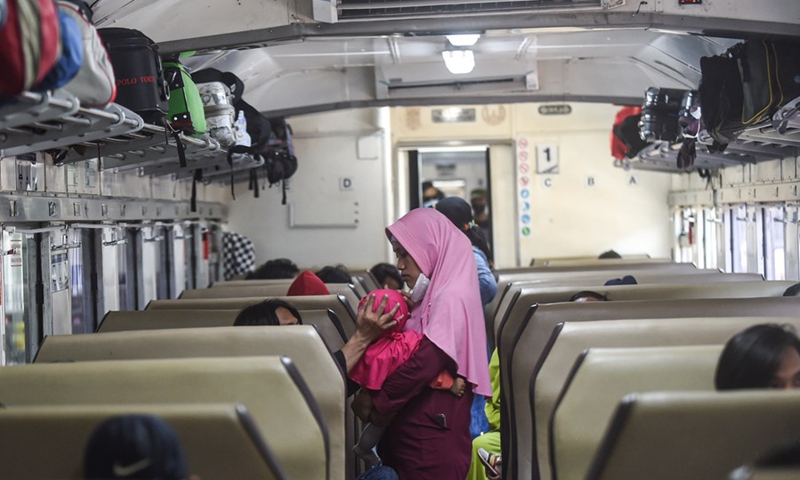
Photo taken on May 1, 2021 shows passengers on the train to travel back hometown for Eid al-Fitr festival in Jakarta, Indonesia, May 1, 2021.(Photo: Xinhua)
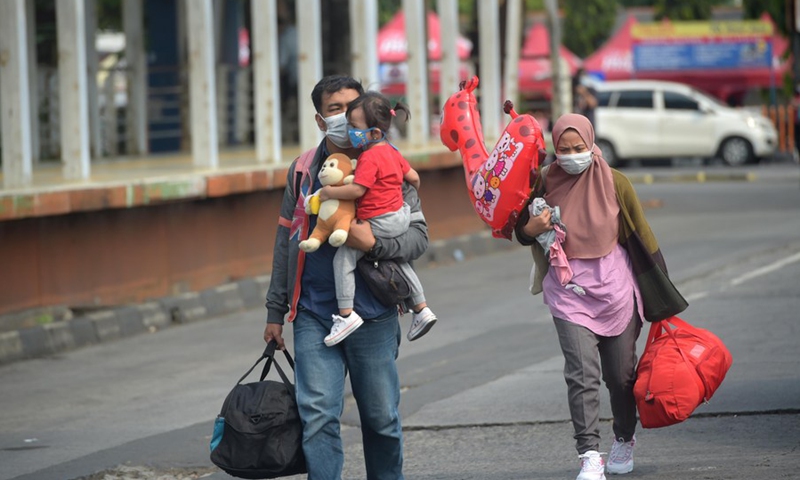
Passengers are seen at a bus terminal in Jakarta, Indonesia, May 5, 2021.(Photo: Xinhua)

A health worker takes a nasal swab sample from a man for COVID-19 test as requirement for passengers before they ride train to travel back to hometown for Eid al-Fitr festival in Jakarta, Indonesia, May 1, 2021.(Photo: Xinhua)
Indonesia's Merak port which separates the two major islands of Java and Sumatra will only open two of its eight docks on May 6-17 in observing a travel ban on the annual exodus, locally known as "mudik", ahead of the Islamic holy festival Eid al-Fitr to curb the spread of COVID-19.
"The two docks are only for vehicles carrying logistics and staples," Ira Puspadewi, managing director of the state-owned passenger ferry operator PT ASDP Indonesia Ferry, said.
In the years before the COVID-19 pandemic, this big port was usually crowded with hundreds of thousands of people on their way back home to celebrate the Eid al-Fitr festival with their families. This year, vehicles carrying passengers were prohibited from crossing to Sumatra Island and they were asked to turn around.
The travel ban imposed by the government also applies to travel by air or land, with road blocks erected on toll roads and regional borders.
"This policy applies to all passenger cars, buses, ships and aircraft, in order to prevent the spread of COVID-19," said Adita Irawati, an official at the Transportation Ministry.
Indonesia is a Muslim-majority country with a tradition of urban migrants returning to their hometowns to celebrate Eid al-Fitr with their families after the fasting month Ramadan. This year, Eid al-Fitr falls on May 14 in the Southeast Asian country.
According to a survey by the transportation ministry, 7 percent of the surveyed people have said they would continue their homecoming journey despite a travel ban.
President Joko Widodo admitted he was worried that many people would be reckless to "mudik" this year. Moreover, Indonesia has a history of long holidays followed by increased mobility, and consequently a spike in COVID-19 cases and deaths.
Such situation in the past had caused a strain on the medical system, with hospitals filled with new patients and bed occupancy rate exceeding the normal limit. The death toll from COVID-19 had jumped to 2,000 per month following long holidays, compared to up to 900 in other months.
"I understand, we all definitely miss our relatives, especially for Eid. But let's prioritize safety together by not going back to our hometowns," said Widodo.
The president has urged governors, regents and mayors throughout Indonesia to continue to convey the ban on "mudik" to the public and order health protocol discipline.
At the same time, the Indonesian government is anticipating a spike in COVID-19 cases. Moreover, three new variants of the coronavirus, which are more contagious, have entered Indonesia.
The Indonesian police have deployed a total of 155,000 personnel in 381 checkpoints from South Sumatra in the west, the most populous Java Island, to Bali in the eastern part of the archipelagic country.
"On the first day of the ban, we intercepted 23,573 vehicles that were suspected of going on a homecoming trip," said Indonesian National Police spokesperson Argo Yuwono.
Some people had flocked back to their hometowns before the travel ban took effect on Thursday. In Central Java, one of the 34 provinces in Indonesia, for example, official data showed around 2,000 urban migrants returned home per day before May 6.
"This shows that we really have to be prepared," said Central Java Governor Ganjar Pranowo.
The confirmed COVID-19 cases in Indonesia rose by 3,922 to 1,713,684, with the death toll adding by 170 to 47,012 as of Sunday.
