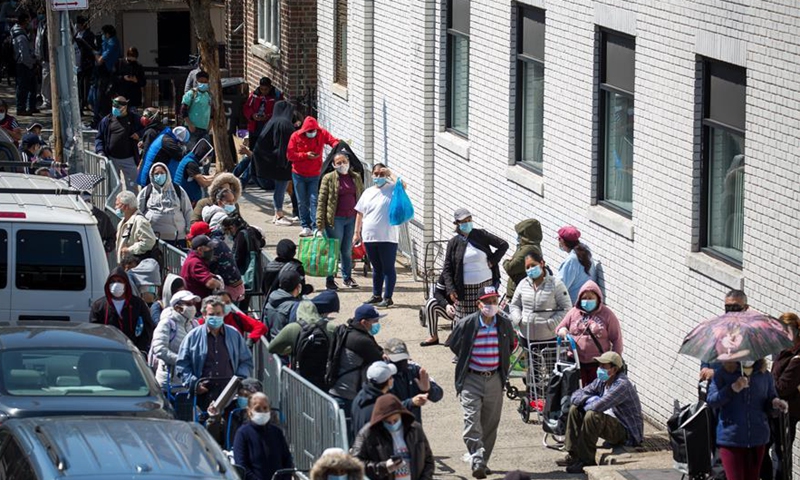
People wait to receive food at a food distribution site in the Brooklyn borough of New York, the United States.File photo:Xinhua
Tenants in the United States breathed a sigh of relief. They are blessed with another 60-day "grace period." But if they still can't pay off missed rent and the pandemic isn't over by that time, what then?
The eviction moratorium, first introduced by the US Centers for Disease Control and Prevention (CDC) last year, expired on Saturday. Following pressure from democratic lawmakers, the order was temporarily extended on Tuesday, this time applying to only 80 percent of US counties since the CDC doesn't have the full legal authority either.
The renewal was made over concerns that a sharp increase in homelessness will worsen the pandemic situation with the highly transmissible Delta variant. The Eviction Lab from Princeton University found that regions with higher eviction filing rates were more likely to have lower vaccination rates.
More than 11 million Americans are behind on their rent or mortgage payments, according to the Center on Budget and Policy Priorities. A Pew Research Center article said young people, racial and ethnic minorities, and those with lower incomes are more likely to rent. Such demographics have been the hardest hit groups during the pandemic.
It's not that the White House was not aware of the issue. A June 29 Supreme Court ruling said that an extension would require congressional authorization. But a divided Congress was unable to pass legislation extending the ban.
The White House is also paying a price for misjudging the time to return to normal. In May, the US CDC advised fully vaccinated people can take off their mask in most places, allowing the Delta variant to spread faster among mask-less crowds.
The low efficiency and dysfunction of the US government has long been criticized. But one thing US politicians always respond to with the highest attentiveness: confront China.
From sanctioning Chinese solar enterprises in Xinjiang to discrediting the first-phase origin tracing report by a team of World Health Organization and Chinese experts, the US went to great lengths to crack down on Beijing but has developed a choice blindness for the dire needs of its own citizens.
What's worse is those who are dedicated to their duties in the US fell victim to bureaucracy and political struggle, striking a blow to the already eroding American health system.
In early July, Tennessee's top vaccine official Dr. Michelle Fiscus was sacked after she passed along legal guidance to state health providers saying teenagers do not need parents' consent to get vaccinated.
"It was my job to provide evidence-based education and vaccine access so that Tennesseans could protect themselves against COVID-19," said Fiscus in a statement published in The Tennessean. "I have now been terminated for doing exactly that."
In stark contrast, China is handling the spike in cases in connection with the Delta variant at full steam. Since the pandemic began, China has proven the effectiveness of its governing mechanism with hard facts.
While quickly rolling out mass testing in hotspot cities, China made sure officials failing at their job are held accountable: On Wednesday, 18 officials in Zhangjiajie, a tourism city in Central China's Hunan Province faced punishments for ineffective virus control. Two senior officials were also removed from their positions on July 31 in the central Chinese city Zhengzhou, which reported a surge in cases on the same day.
The struggle to renew the eviction ban is the latest example that again puts the limits of the US political ecosystem under the spotlight.
Using data as of Monday, the US CDC predicted 350,000 to 1,800,000 cases will be reported by August 28. Time to look in the mirror, America. The smear campaign against China would only squander your time and resources that should have been allocated to taking care of your people and making concrete contributions to the world's fight against the pandemic.
