China Southern Airlines Photo: cnsphoto
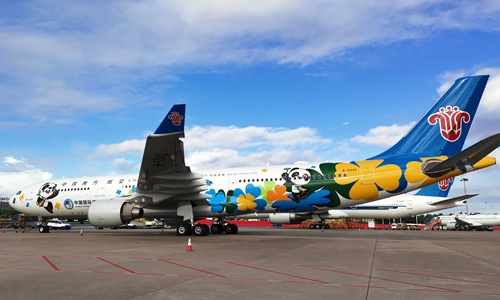
On Saturday, an aircraft featuring livery for the 14th National Games of China by Joy Air flew from Haikou, South China's Hainan Province after more than two months of detailing work on the plane's body.
The "Golden Flower" logo seen on the airplane is composed of five lotus petals, each of which is made by superimposing four to five different levels of color, using a gradient spraying process. The mascot of the Games appears on the left side of the fuselage, including an ibis and the panda. The elements of the ancient city of Xi'an, the event's host city, including its famous wall and bell tower also feature.
Advertising through livery on the skin of an aircraft is not a new concept. At first, some large sports events used aircraft as flying billboard, starting with the 1998 World Cup. Since then, various types of advertisement appeared on the fuselage of many foreign airlines, according to news portal jiemian.com on Tuesday.
In 1996, Sichuan Airlines advertised giant panda cigarettes on fuselage of its planes.
The sale of fuselage advertising is part of its ancillary business income, which is common among both full-service and low-cost airlines.
Spring Airlines launched its own streaming promotion last year. Among other possible purchases, advertisers can pay to have the body of a Spring Airlines aircraft painted.
"An advertisement covering the full body of the plane would usually cost 14 million yuan ($1.97 million) for a whole year. Now it's about 50 percent off, down to 6.66 million yuan," said Wang Zhenghua, founder of Spring Airlines, during a livestream.
In a note sent to the Global Times, Spring Airlines said it received enquiries from companies in the games, fast-moving consumer goods and finance sectors, all of which expressed an interest in cooperation.
Aircraft body advertisements are divided into full-body advertisements and partial-body advertisements. Taking Qingdao Airlines as an example, the price of full-body spraying of an aircraft is 14 million yuan per year; part of the fuselage (not exceeding 60 square meters) is 8 million yuan.
RELATED ARTICLES