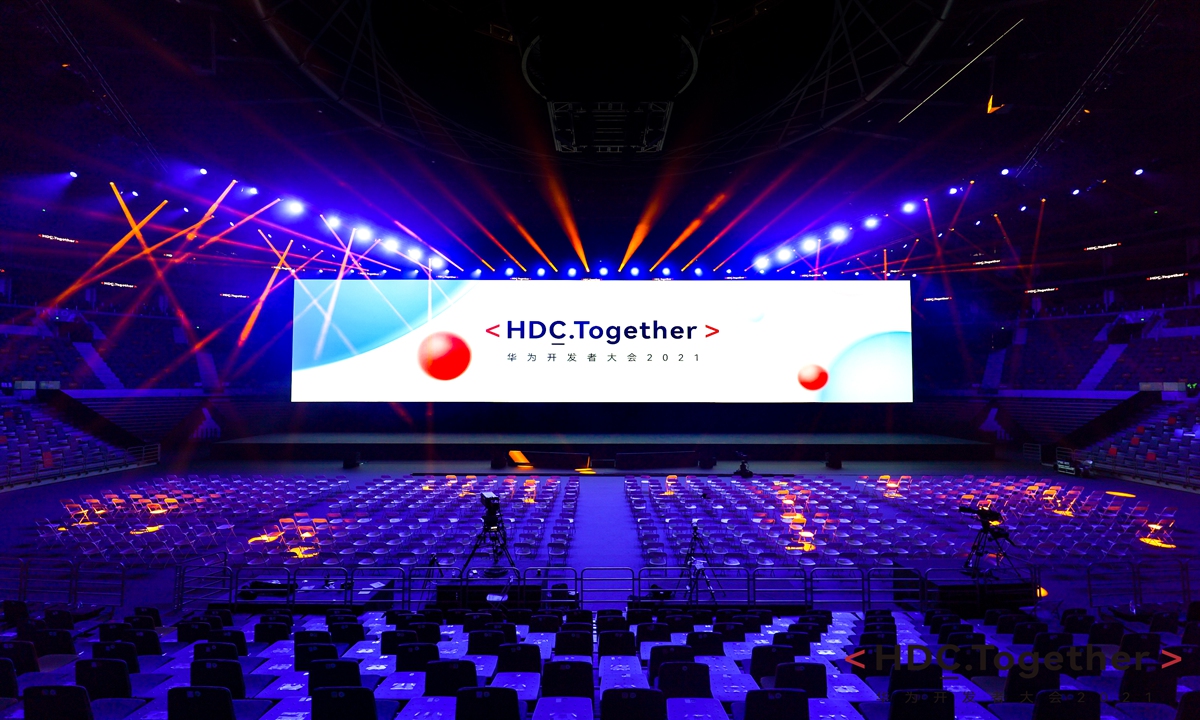
The venue of the 2021 Huawei Developer Conference Photo: Courtesy of Huawei
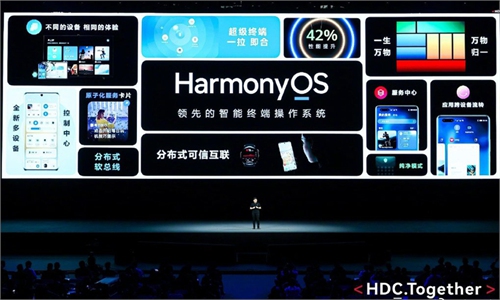
Huawei held its annual Huawei Developer Conference (HDC) in Dongguan, South China's Guangdong Province on Friday, with the official launch of the HarmonyOS 3 for developers and a series of leading development technologies, tools and platforms including its most powerful Huawei Mobile Services(HMS)Core 6 system, aiming to assist developers to build innovative smart terminals and application services more efficiently.
"Openness is the only way to promote advances in science and technology," Huawei's rotating chairman Richard Yu Chengdong said, noting that Huawei has basically completed the construction of a new ecological infrastructure, as the HarmonyOS and its ecology has taken shape.
Yu also announced at the conference that the devices updated to Huawei's HarmonyOS, including its smartphones, watches and tablets, have already surpassed 150 million, making it the fastest-growing intelligent terminal OS ever.
Launch of HarmonyOS 3
Huawei officially launched the updated version of the self-developed operating system (OS), the HarmonyOS 3 for developers on Friday, as the continuous innovation focuses on the three core values of elastic deployment, super terminal, and multi-end deployment with a one-time development, bringing comprehensive upgrade of system performance and development tools.
The updated HarmonyOS 3 developer preview version introduced new visual and elastic deployment automation tools that allow device developers to flexibly select components based on different hardware requirements and easily complete the OS assembly, allowing more devices to be equipped with the HarmonyOS.
Moreover, the updated preview version has brought significant upgrades to the major HarmonyOS application and service development tools, which will help developers complete end-to-end cross-device HarmonyOS applications and services across devices with high efficiency but low cost.
The HarmonyOS 3 beta version will be officially launched in the first quarter of 2022. In addition, Huawei announced that it will release a newly developed programming language for HarmonyOS to add the final link to the Harmony ecosystem infrastructure.
Up to now, HarmonyOS has been applied on more than 150 million smartphones, tablets, watches, smart screens and other devices, becoming the digital dock in the era of everything smart. Yu also expected that the number could surpass 200 million by the end of 2021.
The HarmonyOS and its ecology has been developing at an unprecedented speed, as the HarmonyOS-powered smart cockpit is expected to launch soon and the openEuler operating system, the open source operating system for digital infrastructure, will achieve capability sharing and ecological interoperability with the HarmonyOS.
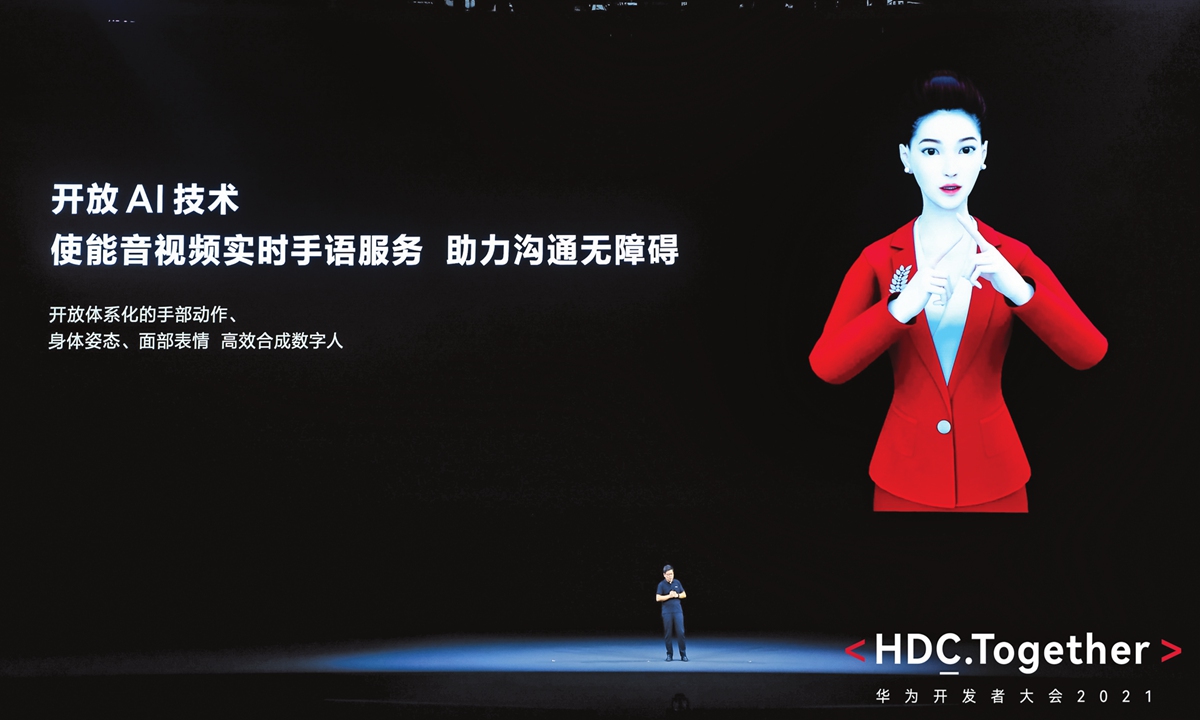
Richard Yu, Huawei's rotating chairman, at the 2021 Huawei Developer Conference Photo: Courtesy of Huawei
Most powerful system
Other than the launch of the HarmonyOS 3, Huawei also introduced its most powerful HMS to date. The HMS Core 6 system, equipped with the leading all-scene, multi-terminal, and multi-operating system mobile service core capability, will provide cross-OS mobile service core capability for developers to ensure consistent application experience.
The updated tool meanwhile opens 69 kits and 21,738 active pharmaceutical ingredients (APIs) in seven major areas to global developers, with 13 open capabilities across its operating systems.
Moreover, HMS Core 6 system also opens up a number of new capabilities and services such as audio and video editing, copyright protection, and digital yuan payments.
The 3D Modeling Kit allows users to quickly and automatically generate 3D geometric models and textures of objects with just an ordinary smartphone and take images of objects from different angles, which can be applied in e-commerce, animation and other fields, and can be combine with 3D printing to solve telemedicine challenges in the future.
This HDC also adopted live virtual human AI sign language, which is based on the SignPal Kit open sign language service and integrates expert knowledge of sign language linguistics to achieve coherent and natural body gestures with a language accuracy rate surpassing 90 percent.
With the support of 5.1 million developers worldwide, the HMS ecosystem continues to grow at a high rate, with more than 173,000 apps being integrated with the HMS Core. In the first three quarters of 2021, the app distribution for Huawei's application market AppGallery reached 332.2 billion, and global developers' share revenue grew 62 percent.
Simultaneously, Huawei has been integrating leading artificial intelligence technology (AI) into its ecosystem to further understand user needs more clearly, provide users with the services they need more accurately, and create a full-scene smart life experience for consumers.
For instance, the super terminal can use innovative Sensor Grid technology to utilize each device as a sense of the super terminal, enabling more accurate judgment of user intent, while integrating the use of cell phones, watches, treadmills, and scales as "personal trainers" to better understand the user's body data and exercise requirements.
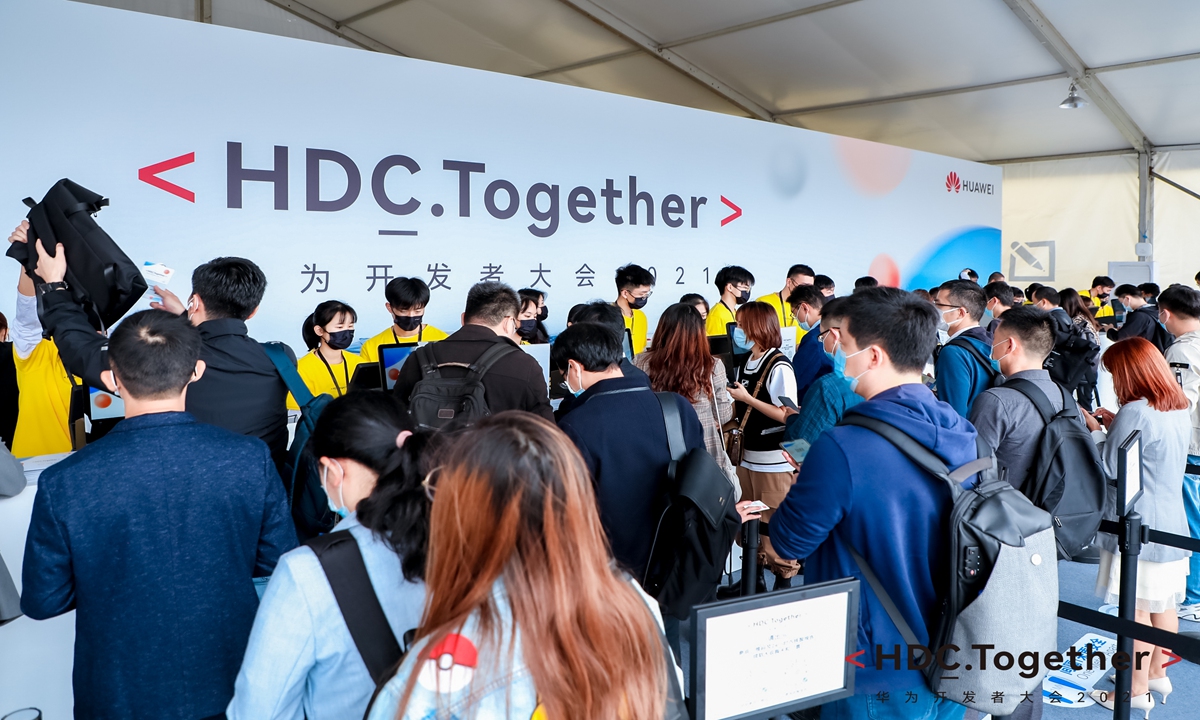
Guests are checking in for the 2021 Huawei Developer Conference. Photo: Courtesy of Huawei
Building a secure digital world
Huawei has made network security and privacy protection the company's top priority, placing its responsibility for network and business security above its business interests.
Huawei put forward "four propositions" and "three promises" at the conference to ensure the consumer business security and privacy protection, as the company has already provided comprehensive protection for users in daily life scenarios such as data security, payment security, permission management, social privacy, identity protection, and service security.
Huawei also officially released a guidebook for eco-partners to follow when developing products.
RELATED ARTICLES