Evolving industry
Bangladesh’s hazardous shipyards launch race for cleaner, safer future
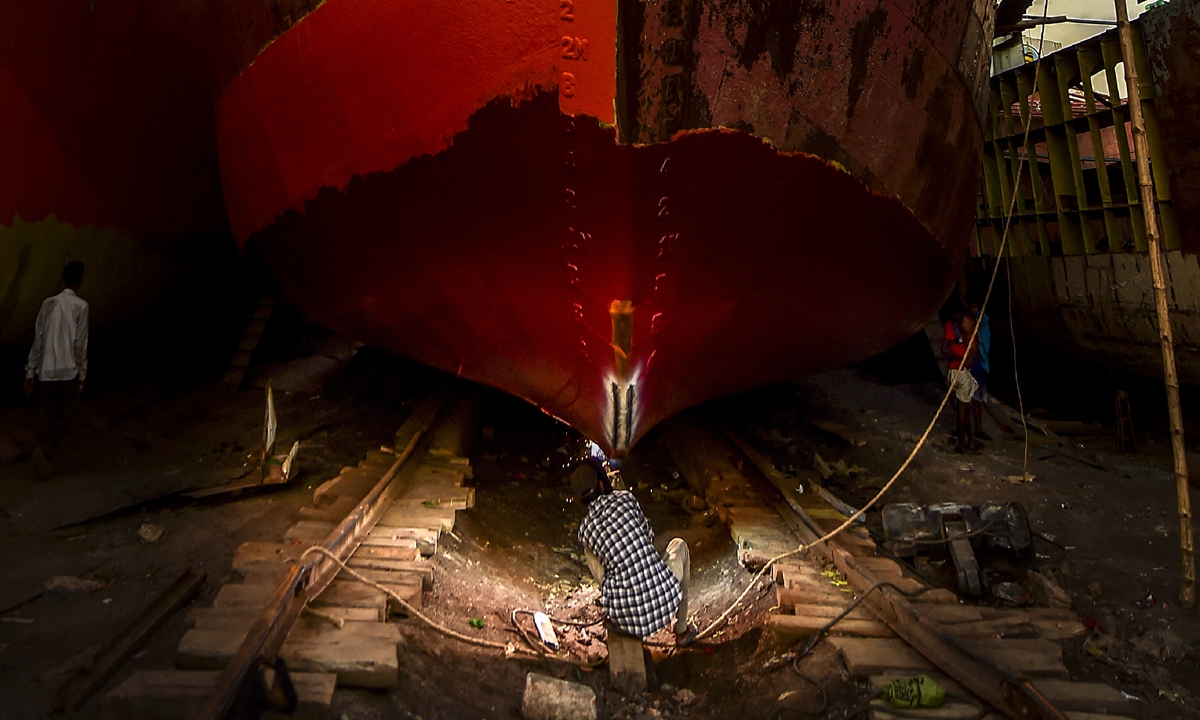
A Bangladeshi laborer works in a dockyard beside the Buriganga River in Dhaka on June 23, 2019. Photo: AFP
When Samrat Hossain first started cutting up old ships weighing thousands of tons in a southeast Bangladesh shipbreaking yard a decade ago, all he would wear was a cap or a helmet.But these days, the 27-year-old spends nearly an hour each day before work putting on his protective gear, which includes special masks, gloves, boots and a suit.
"A lot has changed in the last 10 years. Before, PPE [Personal Protective Equipment] was not a factor. But today we are not allowed to work without it," said Hossain, an employee of PHP Ship Breaking and Recycling Industries in the coastal city of Chattogram.
It is the nation's only yard - of a total of about 80 - that complies with international health, safety and environmental rules for the risky occupation.
"It's not the same everywhere," added Hossain. "Some workers from other yards told me they buy their own gloves."
The industry in Bangladesh is evolving to come in line with new regulations, officials say.
The government, through a parliamentary act in 2018, ordered yard owners to clean up their practices by 2023 and implement standards laid down in the Hong Kong International Convention for the Safe and Environmentally Sound Recycling of Ships.
That pact, adopted in 2009 and ratified by 17 nations so far, aims to improve worker safety and environmental protection, but has yet to come into force globally.
The changes will include training workers on safety, preventing emissions of ozone-depleting substances and building storage for toxic waste from ships like asbestos and lead.
Bangladesh is one of the world's top locations for dismantling end-of-life ships, with at least 144 broken down on its beaches in 2020, or about one in every five worldwide, according to Shipbreaking Platform, a global coalition that campaigns for clean, safe ship recycling.
The sector has been criticized for failing to prevent workers' deaths - caused by gas explosions, employees falling from a height or being hit by ship parts - and for damaging the environment through oil spills and spreading harmful waste.
At least 11 workers have died in Bangladesh's shipbreaking sector so far in 2021, according to Young Power in Social Action (YPSA), a local nonprofit that focuses on shipyards.
Slow progress
In Bangladesh, only PHP - which started work to reform its practices back in 2014 - has so far met the Hong Kong pact's goals.
Although most of the country's shipbreaking yards have now submitted improvement plans, government and NGO officials expect just five or so to comply with the convention by 2022.
They attribute the slow progress mainly to the high investment needed to update the yards' operations, as well as lockdowns due to the COVID-19 pandemic over 2020.
"A good number of yard owners don't have the financial capacity," said Mizanur Rahman, a senior official at Bangladesh's Ministry of Industries.
Many yards lack proper waste storage systems, due to a lack of trained people and investment, he noted.
But he is confident all yards will comply by the time the convention comes into force, which could happen in 2025 provided Bangladesh ratifies it by 2023.
The Hong Kong convention will take effect when it has been approved by countries that break 40 percent of the world's ships by tonnage, a figure that currently stands close to 30 percent.
Once it comes into force, ships sent for recycling must carry an inventory of hazardous materials contained in their parts. It will also be prohibited to use new parts made of these toxic substances.
Bangladesh's PHP Ship Breaking and Recycling Industries - which has been certified by international auditing groups as meeting the convention's regulations - has spent at least $8 million since 2014 on developing its methods, said its managing director Zahirul Islam.
For example, it now uses cranes to carry blocks - cut from ships moored on the tidal mud flats - directly to an impermeable concrete platform where the rest of the cutting is done to avoid spillage onto the beach.
Recycling waste
PHP's yard also has a sealed negative pressure unit that removes asbestos - which can cause cancer - from ship parts and stops the mineral from escaping into the air.
It has so far collected 32 kinds of waste, including ozone-depleting substances, paint chips and glass wool.
For now, shipyards are expected to store waste temporarily until the government creates a central storage area and disposal system for collection and recycling, due to be ready by 2024.
Until then, PHP is planning to pay vendors to remove waste from its yard. It recently started exporting asbestos to Germany to be used as landfill and is in talks to supply glass wool to a cement firm.
From a global perspective, making shipbreaking yards greener and reusing materials can also help tackle climate change, said government official Rahman.
Bangladesh already gets most of its steel from dismantled ships instead of extracting it from iron ore through a process that produces high carbon emissions.
The government will also monitor what happens to substances from shipbreaking that deplete the Earth's protective ozone layer, such as hydrofluorocarbons used in refrigeration, which are also greenhouse gases, said Rahman.
Jobs disappear
The upgrades at PHP have come at a cost, though. The mechanization of the yard saw Islam's workforce decrease from about 3,000 people to 300.
In the past, ship parts were carried by groups of about 50 people on their backs but the arrival of magnetic cranes in many yards has changed that, explained yard boss Islam.
Rahman from the industry ministry believes the sector must accept such "technological changes."
"We don't want these jobs to remain because this is not decent work and there is an occupational risk," he said.
Workers who lose their jobs at shipyards mainly find employment at nearby steel mills, scrap shops or as daily laborers, said a labor ministry official.
Reuters
