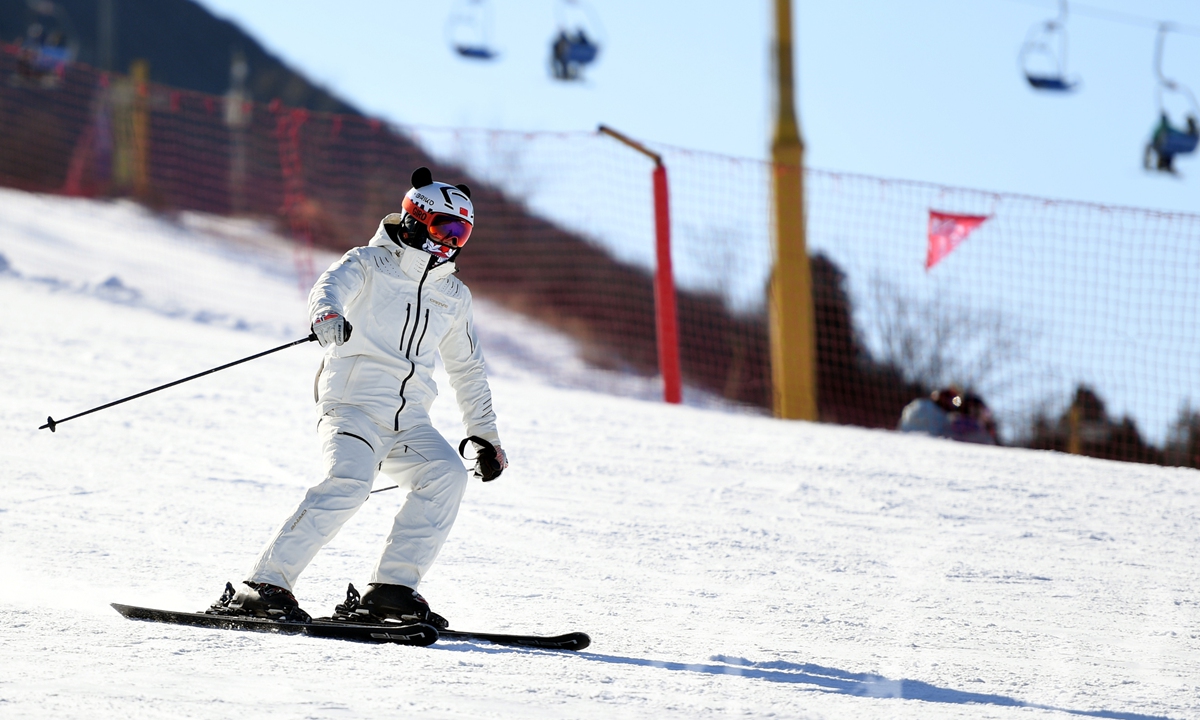
A citizen is skiing in Beijing. Photo: Xinhua
When China was awarded the right to host the Beijing 2022 Winter Olympic and Paralympic Games back in July 2015, the country was perhaps the least experienced of all its predecessors when it came to winter sports.
In fact, at that point when the decision was made in Kuala Lumpur, Chinese athletes had no Winter Olympics experience in a third of the 109 events that will be on show in Beijing next month.
China's role as host means that it will have a chance to put that right in many events, where hosting offers a path to qualification, while a push across winter sports has seen many athletes reach the hitherto unreachable qualifying standards.
"We are quite confident of achieving a full quota through our efforts in ranking points competitions in January," Chinese alpine skiing national team manager Liu Zhen told domestic media last month.
Team China will see debuts in the men's ice hockey and the country's lugers, while the Olympics will also see Chinese ski jumpers for the first time. These new athletes are not in Beijing to make up the numbers - Geng Wenqiang, the skeleton racer who only took up the sport in the same year that Beijing was awarded hosting rights, won a World Cup title last year. Excitement is building.
"As the organizer we have to be prepared 100 percent and now we are ready. I should say there are challenges definitely but we are very confident to host the Games to provide the best conditions for the world," said Yang Yang, China's first Winter Olympic gold medalist and chairperson of the Beijing 2022 Athletes' Commission last month. "I think my first gold brought some attention to Chinese people. They understood there are winter sports, because winter sports were not big in China."
That is true no longer as recent reports have shown the leaps and bounds made on the snow and ice in recent years.
China has surpassed its target of 300 million of its populace taking part in winter sports ahead of the Beijing 2022 Winter Olympics, according to a recent report conducted by the National Bureau of Statistics of China.
The report stated that some 346 million people had taken part in winter sports since the Beijing 2022 Games were awarded in 2015, already more than the legacy target set by Games organizers.
China has come a long way since its Winter Olympics debut back in 1980 at Lake Placid, where the delegation included 13 men and 11 women across just five sports - alpine skiing, biathlon, cross-country skiing, figure skating and speed skating. None of those pioneering athletes troubled the medal table on their debut. The top finisher was women's alpine skier Wang Guizhen, who finished the slalom in 18th place to mark China's best showing on the snow.
The delegation expanded for the Sarajevo Games in Yugoslavia four years later - 37 athletes - though they competed in the same five sports as Lake Placid. They too did not mark the Winter Games with a medal with Wang outperformed by slalom teammate Jin Xuefei who finished one place ahead of her in 19th to mark China's best finish in the Balkans.
A first medal would come in Calgary in 1988 where short-track speed skater Li Yan won a gold and two silvers but the events were not counted toward the official medal tally as short-track speed skating was a demonstration sport at those Games. That was a rare bright spot as China sent only 13 athletes in three sports.
The real breakthrough would come in Albertville four years on - the last Winter Olympics to share the same year as its Summer counterpart. China sent 33 athletes to France and Ye Qiaobo took silver in the women's 500-meter speed skating, beginning what would be a rich seam of medals for the country's skaters. She then won another silver in the women's 1,000 meters while Li Yan won a first Olympic medal proper in the official debut of the women's 500 meters short-track speed skating.
China built on that foundation in Lillehammer in 1994 where 28 athletes traveled to represent the country. They would miss out on a first gold as speed skater Zhang Yanmei slipped at the finish line and had to settle for silver in the women's 500-meter short-track while Ye battled to bronze in the 1,000 meters. Chen Lu also won bronze, taking China's first figure skating medal in the women's individual event.
Nagano in 1998 would represent a boom for Chinese winter sports as it sent a record 60 athletes to Japan. They came back with a record medal haul, but no gold, netting six silvers and two bronzes. All but Chen's second consecutive figure skating bronze came in speed skating events.
History was made in Salt Lake City as Yang Yang won China's first Winter Olympics golds - topping the podium in both the 500-meter and 1,000-meter short-track events as the team secured eight medals overall - two silver and four bronze. China's 72 athletes, another record, finished a historic best of 13th on the medal table.
Including Yang's breakthrough, 12 of China's 13 Winter Olympic golds have come in speed skating with the one exception coming in 2006 in Turin where Han Xiaopeng won a first snow sports medal for the country. That came in the men's freestyle aerials at a Games where Yang was China's flagbearer. The 76-athete team would leave with two golds, four silvers and five bronzes for a record 11-medal haul and a 14th-place finish. Yang would win one bronze while teammate Wang Meng won three, including gold.
At the last three Games - Vancouver 2010, Sochi 2014 and Pyeongchang 2018 - China has sent record numbers of athletes (94 in 2010) and brought home a record number of medals (11 including five golds, also in 2010).
All eyes are on what happens in Bejing, where China will have more than 100 athletes and will be looking to improve on the nine total medals won at each of the last two Games - a nation, including some 300 million winter sports fans, expects.