Envoy suggests Iran nuclear deal tied to freeing of citizens
US pushes for hostage release
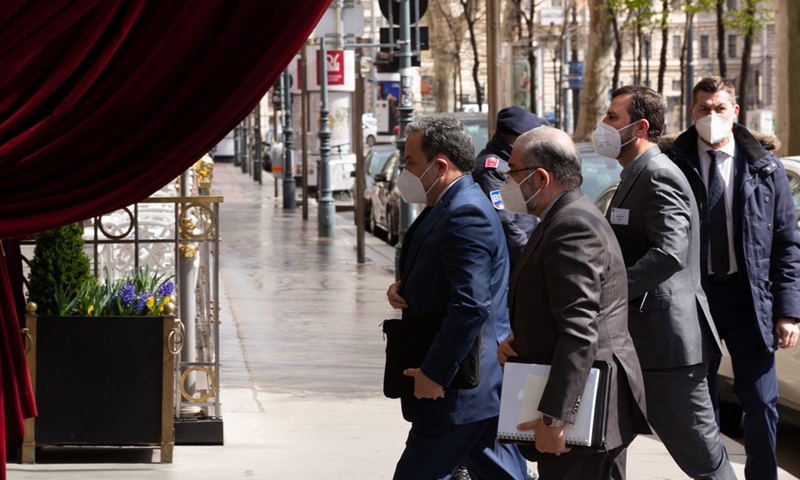
Iranian Deputy Foreign Minister Abbas Araqchi arrives at the venue of Iran nuclear deal talks in Vienna, Austria, April 6, 2021. (Photo: Xinhua)
The United States is unlikely to strike an agreement with Iran to save the 2015 Iran nuclear deal unless Tehran releases four US citizens Washington says it is holding hostage, the lead US nuclear negotiator told Reuters on Sunday.
The official, US Special Envoy for Iran Robert Malley, repeated the long-held US position that the issue of the four people held in Iran is separate from the nuclear negotiations. He moved a step closer, however, to saying that their release was a precondition for a nuclear agreement.
"They're separate and we're pursuing both of them. But I will say it is very hard for us to imagine getting back into the nuclear deal while four innocent Americans are being held hostage by Iran," Malley told Reuters in an interview.
"So even as we're conducting talks with Iran indirectly on the nuclear file we are conducting, again indirectly, discussions with them to ensure the release of our hostages," he said in Vienna, where talks are taking place on bringing Washington and Tehran back into full compliance with the deal.
In recent years, Iran's elite Revolutionary Guards have arrested dozens of dual nationals and foreigners, mostly on espionage and security-related charges.
Rights groups have accused Iran of taking prisoners to gain diplomatic leverage, while Western powers have long demanded that Tehran free their citizens, who they say are political prisoners.
Tehran denies holding people for political reasons.
Malley was speaking in a joint interview with Barry Rosen, a 77-year-old former US diplomat who has been on hunger strike in Vienna to demand the release of US, British, French, German, Austrian and Swedish prisoners in Iran, and that no nuclear agreement be reached without their release.
Rosen was one of more than 50 US diplomats held during the 1979-1981 Iran hostage crisis.
"I've spoken to a number of the families of the hostages who are extraordinarily grateful for what Mr Rosen is doing but they also are imploring him to stop his hunger strike, as I am, because the message has been sent," Malley said.
Rosen said that after five days of not eating he was feeling weak and would heed those calls.
"With the request from Special Envoy Malley and my doctors and others, we've agreed (that) after this meeting I will stop my hunger strike but this does not mean that others will not take up the baton," Rosen said.
The indirect talks between Iran and the United States on bringing both countries back into full compliance with the landmark 2015 nuclear deal are in their eighth round. Iran refuses to hold meetings with US officials, meaning others shuttle between the two sides.
RELATED ARTICLES