COMMENTS / EXPERT ASSESSMENT
Lost flights from China? Canberra needs to redress flawed policies
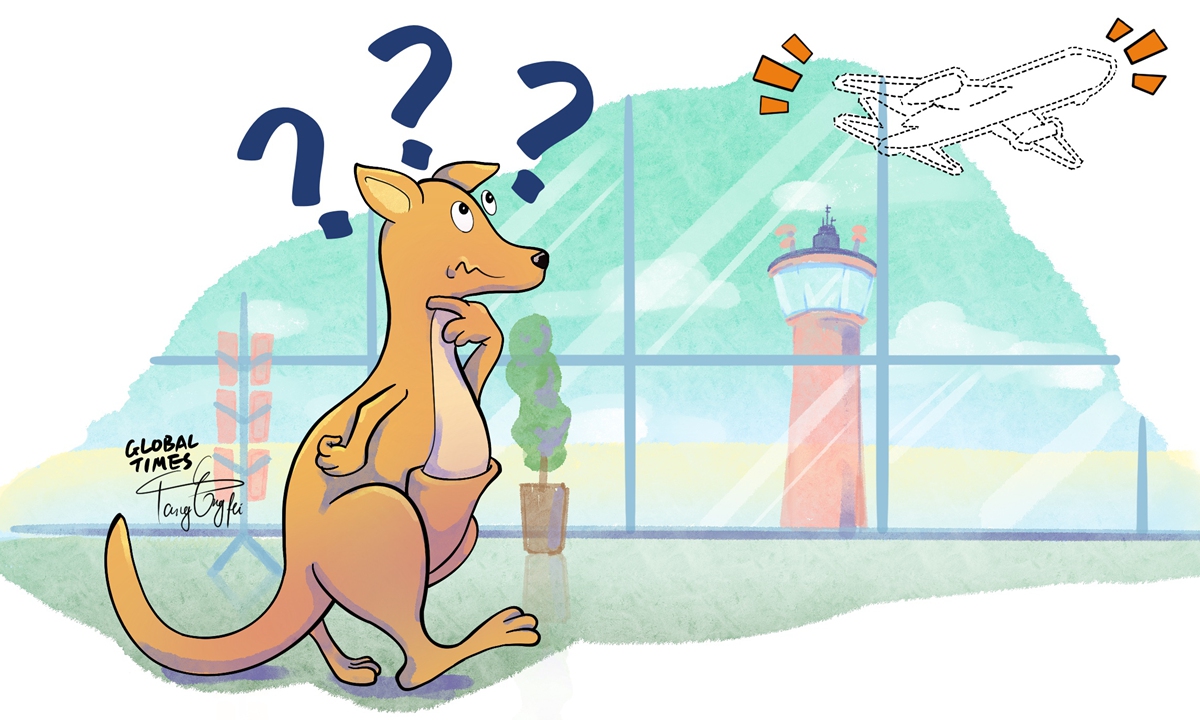
Illustration: Tang Tengfei/Global Times
While global civil aviation industry keeps struggling amid the COVID-19 pandemic, some in Australia found that the missing Chinese flights in their skies were caused not only by the health crisis, but also an "enmity prevails between the two" that prevented Chinese airlines from returning to Australia even after the pandemic.
Previously packed flights bringing Chinese visitors - the largest source of overseas visitors for Australia - have disappeared. In the year ended June 2021, the number of Chinese visitors declined to 3,400 from more than 1.4 million in 2019, which means the AU$12.4 billion ($8.85 billion) those visitors would contribute to the Australian economy has evaporated, an article published on an Australian industrial information website Traveller said.
The AU$ 12.4 billion economic loss is one example for the pain being felt by many Australian industries brought about by the Morrison government's reckless approach to the bilateral relationship, in which it has deliberately undermined its largest trading partner.
Before Canberra torpedoed the relations, normal economic and personnel exchanges between Australia and China were frequent, benefiting both countries. Instead of cherishing the mutually beneficial ties, Morrison chose to undermine it in order to serve the US' anti-China gambit.
Facts have shown that joining US' anti-China grouping was misguided and unwise. On one hand, normal exchanges with China were impacted, including the reduction of flights; on the other hand, ironically, the US and its allies are "picking up" Australia's lost market share in China, according to an analysis conducted by the University of Technology Sydney in November 2021.
The value of 12 Australian exports to China fell by $17.3 billion in the first nine months in 2021, compared to that in 2019; while during the same period, the value of American exports of the same products rose by $6.3 billion, the report noted.
Canberra should acknowledge that it is foolish to trash relations with its largest trading partner, though external voices influencing Morrison's government will not disappear in short term, such as from Washington or London tethered to their cold-war mindset and desperate to impede China's rapid development.
And, Canberra has fabricated "economic coercion" and other malicious accusations against China, attempting to deflect the real cause behind the frosty bilateral ties between China and Australia. It is Canberra which banned Chinese Huawei from participating in the country's 5G construction under the disguise of "national security", cancelled the BRI agreement between the state of Victoria and China, and launched over 100 anti-dumping investigations into Chinese products.
It is also a truth that Australian economy has benefited greatly from its trade with China in the past many decades. Against the backdrop of the global economic gravity shifting from the West to the East, the significance of a normal relationship with China for Australia is plain for all to see, especially with the Regional Comprehensive Economic Partnership (RCEP) recently coming into effective.
In 2021, China's trade with 14 other RCEP members increased 18.1 percent year-on-year despite the pandemic. Maintaining a productive and friendly relationship with China and regional economies is in line with Australia's national interest, and far more preferable than being hijacked by a few anti-China politicians in Canberra.
Chinese flights to Australia and other mutually beneficial economic exchanges could be resumed in the future, but an amicable political atmosphere is the premise. Canberra needs to redress its wrong policies.
The author is an editor with the Global Times. bizopinion@globaltimes.com.cn
RELATED ARTICLES