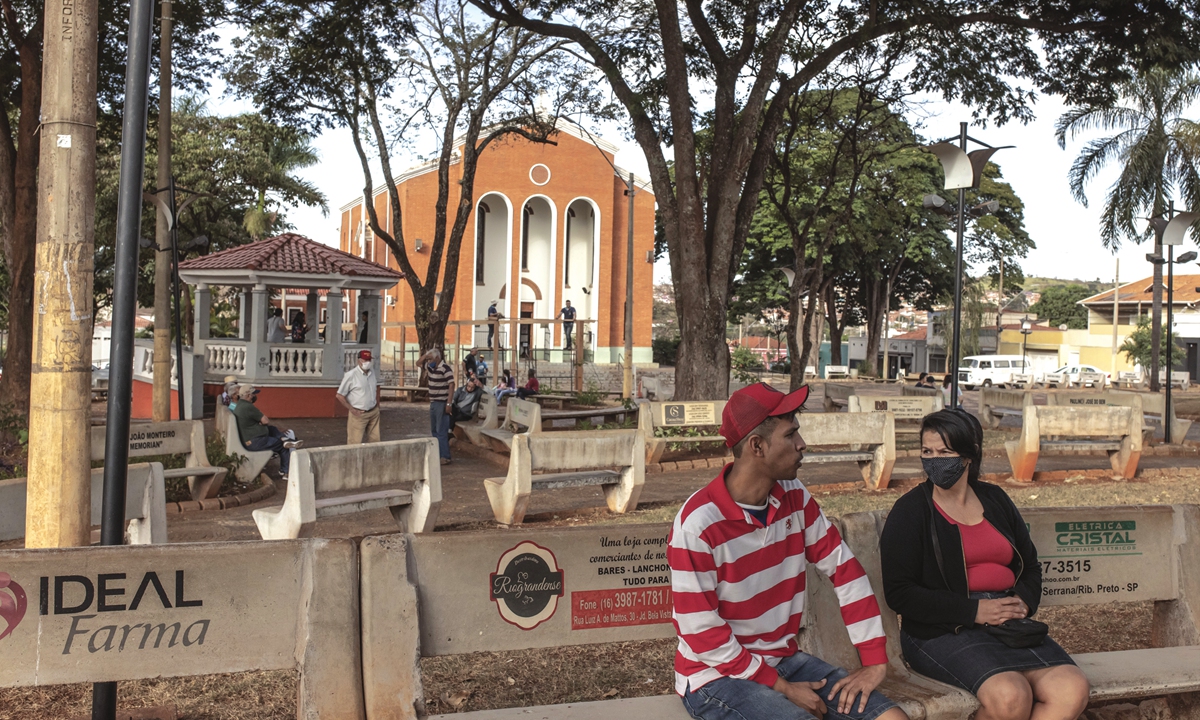
People sit in a park in Serrana, Brazil, on May 26, 2021. Photo: VCG
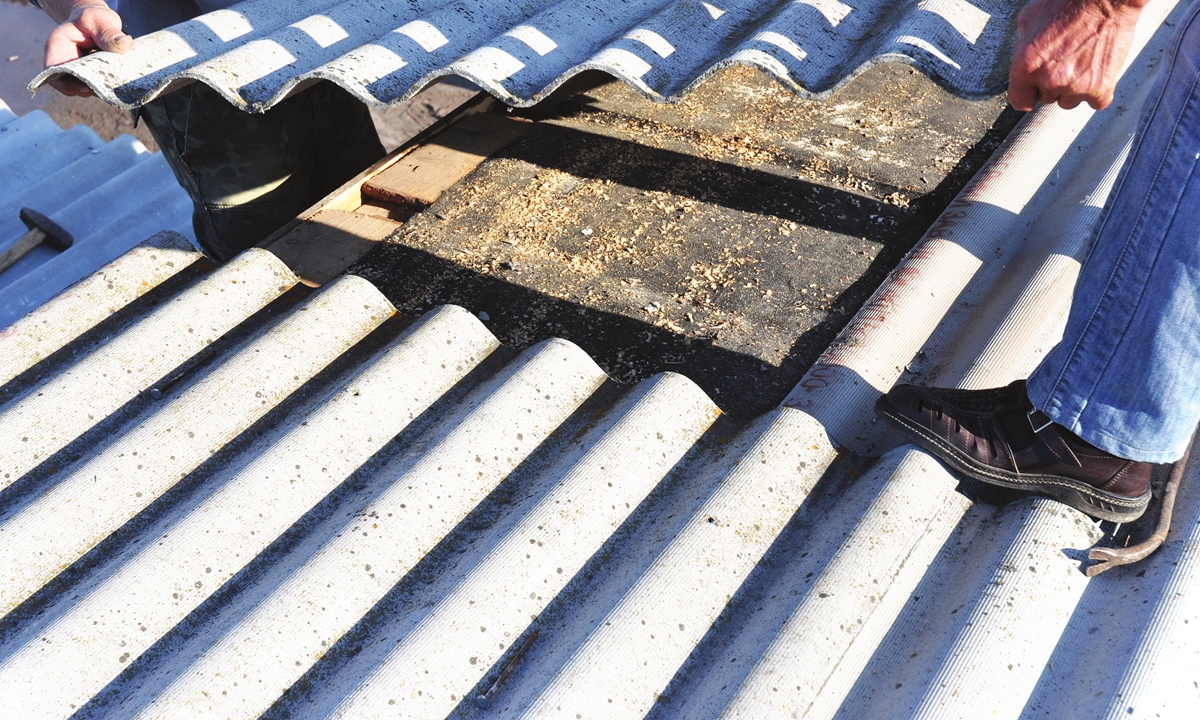
Workers repair asbestos roofs. Photo: VCG
In the Brazilian town of Minaçu, it used to snow, locals like to tell visitors. But the white powder that covered the streets and roofs from 1967 through the late 1980s was far from harmless snowflakes. It was a dangerous carcinogen: asbestos.
The "snow" is a memory from when the town's chrysotile (white) asbestos mine lacked safety procedures to contain the powder and stop it from spreading across the nearby urban area.
To many residents, those were the good old days, when the town of 28,500 in the central state of Goiás thrived and jobs were plentiful at Sama, the company that extracts asbestos from Cana Brava, a mine covering an area almost as large as Minaçu.
Asbestos is a fire-proof fiber used as a building material and in industrial products, but is also well-known as carcinogenic substance.
About 107,000 people die annually from asbestos-related diseases, the World Health Organization said in a 2014 paper, adding that local levels of asbestos-linked deaths only decline decades after its use ends.
Due to these health risks, asbestos is banned in about 60 countries.
Brazil imposed a ban in 2017, but a state law under dispute in the courts keeps the Cana Brava mine operational.
Minaçu is now at a crossroads. It is home to the last asbestos mine in Brazil, but the mineral no longer sustains the town, which has fallen on hard economic times.
At any point, a court decision could suspend the mining activity, as it did for 16 days in 2021, or end it for good.
Alongside a recent hiring boom, thanks to the development of a new rare earths mine in the region, some residents believe Minaçu should reinvent itself and move on from asbestos.
For others, without asbestos, the town is over.
"If Sama stops, the town stops," said Joaquim de Souza, 54, who lives near Minaçu's massive hill of asbestos tailings.
Between 1985 and 1991, Souza worked for Sama's contractors, bagging the white powder. Now his son works for Mineração Serra Verde, the rare earths mining company, which plans to provide elements for wind turbines, mobile phones, and electric cars.
Souza believes Serra Verde is the future, but would not think twice before allowing his grandson to work at Sama when he grows up.
"There is no danger," he told the Thomson Reuters Foundation.
'Mother of Minaçu'
After Brazil's Supreme Court ended asbestos use inside the country in 2017, locals protested in T-shirts with the slogan, "We defend chrysotile asbestos," according to Arthur Pires Amaral, an anthropology professor at Catalão Federal University.
Since 2019, when Goiás lawmakers passed a bill allowing continued asbestos mining for export purposes, all production has been shipped abroad.
That law is now being disputed in court by Brazil's National Association of Labor Prosecutors.
Asbestos is interwoven with Minaçu's identity. Businesses, streets, a river, and even a government-run clinic are named after chrysotile asbestos, "amianto crisotila" in Portuguese.
Stones filled with asbestos fibers are used to mark key sites such as the town's entrance. Its upscale neighborhood, called Sama Village, has asbestos roofing on every house.
Many refer to Sama, which is owned by building materials company Eternit, as the "mother of Minaçu."
"It is a mother who cares, who feeds," said Amaral, who is due to publish a book on the town in February. "But it is also a perverse mother, who makes people sick, then turns her back on them."
Sama assists any workers who have had health issues due to proven asbestos exposure, Eternit said in a statement issued to the Thomson Reuters Foundation in response to questions.
"There are no reliable statistics on the number of workers exposed to chrysotile fibers who developed lung diseases in Brazil, as a large number of diagnoses proved to be wrong after carrying out a more accurate examination," Eternit added.
Human toll
When the asbestos industry was strong in Minaçu, Sama funded cultural, religious and sporting events, and was a major political donor in 2012, electoral data shows.
"[Sama] chose the mayors, the councilors - and dominated the church. You had priests and pastors defending asbestos during services," said Amaral.
In Minaçu, it may be taboo to disparage Sama publicly - but thousands have quietly signed settlements with the company.
As far back as 2002, Sama had done more than 3,000 out-of-court deals where it agreed to make pay outs or provide health insurance to former employees, labor prosecutors claimed in an ongoing lawsuit filed in 2020.
Olivia, who asked for her real name not to be used because she fears repercussions from the local community, sued for damages relating to the death of her father, a Sama employee from 1982 to 1994, who died of lung cancer 14 years later.
"Even with a medical report saying [the cancer] was caused by asbestos, justice has been done," he told the Thomson Reuters Foundation. "We were able to prove it, but the lawsuit is ongoing."
A Goiás labor court in November 2021 ordered Eternit to pay for regular medical exams for all former mine employees for the next 30 years and the medical fees of any worker who develops health issues "likely to be associated with exposure to asbestos."
But in Minaçu, many still deny asbestos is harmful. "Most of the workers there smoked. Then they started to get sick from the cigarettes and accused Sama, [saying] it was asbestos," said Minaçu councilman Wedney Divino de Miranda.
Reuters
RELATED ARTICLES