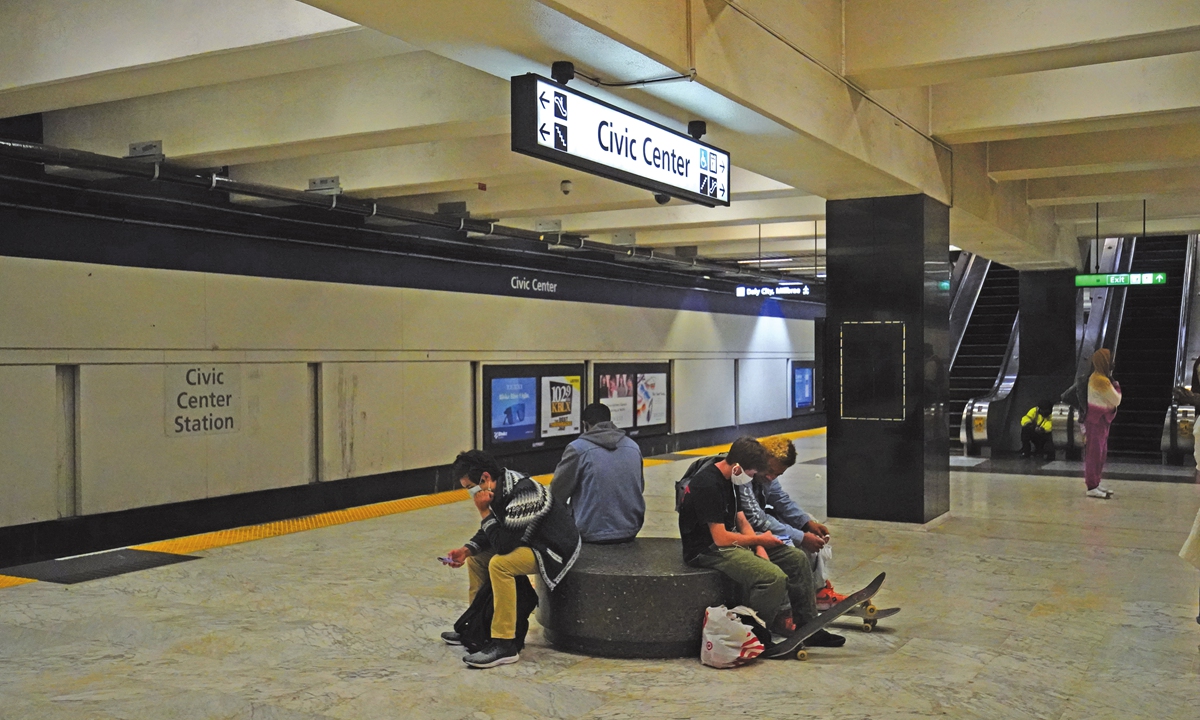
People are seen waiting for a train at a subway station in San Francisco, the US in August 2021. Photo: VCG
When the transit system in Richmond, Virginia, decided at the start of the COVID-19 pandemic to stop collecting fares on its buses, the initial motivation was to have the public board through the rear doors to keep bus drivers safe.
But it quickly became clear that the effects were far broader, with ridership on local routes rising higher than it had been before the health emergency, officials said, even as public transport use was plummeting all over the country.
"People were still catching the bus, even though the majority of the city was working from home. We realized the only reason they'd get on the bus and risk transmission is they had to be essential workers," said Faith Walker, executive director of the Richmond advocacy group RVA Rapid Transit.
"I see the horribleness of the pandemic, but fortunately it also allowed us to have this kind of conversation" around scrapping fares for good, she said.
After switching to no-fare transit to try to slow the COVID-19 outbreak, some cities are seeing signs that the move could improve social equity and boost local economies, and they are now wondering if the future of public transport is free.
Walker shared with the Thomson Reuters Foundation recordings her organization made of riders who had used Richmond's free transit.
The city's Zero Fare bus service, which went into effect in March 2020, was a "critical lifeline," said one rider named Wyatt Gordon.
"Having the bus be available and free and easy to get around has been really transformational to my ability to get to all of the things I need to do, whether it's shopping or getting to work," he said in the recording.
About three-quarters of the Richmond system's riders make less than $50,000 a year, according to a 2019 survey by the GRTC Transit System, said its communications director Carrie Rose Pace.
With Zero Fare, "full-time workers are still using the bus and now can use it even more because they don't have to penny-pinch to go to the grocery store, go to the doctor," Rose Pace said by phone.
"Now they can do it all. That barrier has been removed."
In December 2021, Richmond received a state grant through 2025 to continue studying the effects of free public buses, "including, hopefully, after the pandemic crisis period," said Rose Pace.
The American Public Transportation Association, a nonprofit with 1,500 public and private sector members, has not tracked the number of transit systems going free, but it supports local decisions on the issue, said spokesperson Chad Chitwood.
Access for low-income riders
There is no comprehensive tally of the transit systems that have reduced or eliminated their fares over the past two years, but they have included public transport in some of the nation's largest cities.
In January 2022, Los Angeles wrapped up a nearly two-year no-fare program on its Metro bus services, and is currently studying the results.
And starting March, Boston's transport system eliminated fares on three bus routes for two years, an expansion of a smaller pilot, after new mayor Michelle Wu made the issue a central plank of her campaign.
"There's a lot of discussion on this nationally. This is a movement that has been intensified by the pandemic," said Josh Baker, general manager and CEO of the DASH bus system in Alexandria, Virginia.
The DASH system went free in September 2021 with a commitment to remain so for four years, and a hope that it could stay that way "indefinitely," Baker said.
"This is a change in the way we see public transit," he said. "It doesn't need to make money, but it needs to be there to help the community and visitors in a way that generates economic growth and revitalization."
The issue has also percolated up to Congress, where a proposed law would create a $5 billion fund to help transit agencies that want to go fare-free.
Low-income families spend up to 30 percent of their household income on transportation, Massachusetts Senator Edward J. Markey, co-author of the Freedom to Move Act, said in a statement.
It's still too early to measure the impact of dropping fares, said Yonah Freemark, a senior research associate with the Urban Institute, a Washington think tank.
"[But] there is evidence that free fares will allow people, particularly those with low incomes, to dramatically expand their access to things like healthcare and other needs," he said.
A 2019 experiment in Boston, for instance, provided low-income riders with half-off transit cards and found they took about 30 percent more trips, particularly to medical and social services.
'We love this'
Some worry the new focus on free public transport could have the opposite of its intended effect, with systems forced to reduce their already infrequent and limited services to make up for lost revenue.
"The policy discussion about fareless transit in the US is really a distraction from the more important obstacles to transit ridership," said David Bragdon, executive director of the national research and advocacy group TransitCenter.
"If you really want to improve equity in the US, you have to increase transit service. A bus that doesn't charge a fare but only runs every two hours, that's no bargain."
In 2020, officials asked voters if they should make the Zero Fare 0system a permanent, taxpayer-funded service, and the measure passed by a 20 percent margin, she said. That change is slated to happen in 2022.
"It became a point of community pride," she said. "[People said] ]We love this. This benefits all of us, even people who aren't riding.'"
Reuters
RELATED ARTICLES