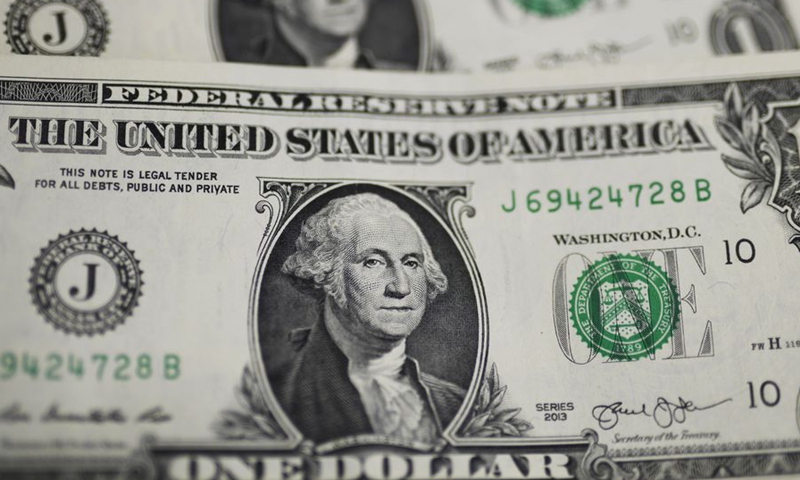
Photo taken on Sep 18, 2019 shows US dollar banknotes in Washington DC, the United States. File photo:Xinhua
Nominal US Treasury yields are expected to top their Chinese counterparts more frequently in the foreseeable future, a Chinese economist said, though in real-world terms Chinese yields remain competitive, meaning the impact on foreign capital outflows is limited.
The 10-year US Treasury yields topped its Chinese equivalent on Monday for the first time in a dozen years, causing the China-US yield spread to end in negative territory.
As the Federal Reserve moves to cut its asset holdings and raise interest rates sharply, the US benchmark 10-year yield reached 2.77 percent on Monday. That topped the 10-year Chinese yield, which rose to 2.768 percent on Monday, official data showed.
The divergence, which was foreseen in an Op-Ed piece by the Shanghai Securities News last week, was seen as a contributing factor to the weak performance of the Chinese A-share market on Monday, as the Shanghai bourse fell 2.61 percent.
Li Huiyong, chief economist with Shanghai-based Hwabao WP Fund Management Co, told the Global Times on Monday that it is normal that nominal US Treasury yields are higher than those in China, as the two countries' monetary stances have diverged.
China will focus on shoring up economic growth in the face of the COVID-19 epidemic that has hit many vital parts of the country, while US policy won't change unless inflation is tamed. US inflation is at a 40-year high and the Russia-Ukraine conflict has pushed up commodity prices.
Further loosening by China and further tightening by the US means the divergence in 10-year yields will last, Li said.
However, Li noted that in real-world terms, yields from China are still higher than those of the US, even though the spread has narrowed. "As a result, foreign investment in yuan-denominated assets will be suppressed but the impact will be limited."
In the Op-Ed, the Shanghai Securities News reported that higher US Treasury yields will mainly affect short-term investor sentiment when it comes to global asset allocation. Stronger US Treasury yields will not weigh on China's monetary policymaking, and the yuan's exchange rate is also expected to remain firm and steady, it said, citing experts.
Chinese securities experts also noted on Monday that cross-border capital flows are mainly affected by exchange rates and fundamentals, and there is no pressure for the yuan to depreciate in a one-sided trajectory.
China's foreign exchange reserves fell by $25.8 billion, or 0.8 percent, in March, data from the State Administration of Foreign Exchange (SAFE) showed on Thursday.
However, a SAFE official told financial news outlet Caixin that the volatility of foreign investment in domestic stocks and bonds is a normal phenomenon amid the recent changing external environment and complex international economic and financial situation, adding that the fluctuation of cross-border capital is within a normal and controllable scope.
Experts said pressure for capital outflow will be further diffused in the long-term, with China's strong economic fundamentals contrasted with the US market, which could face rising recession woes.
RELATED ARTICLES