ARTS / ART
Kazak heritage helps lift people out of poverty in NW.China’s Xinjiang
Colorful business
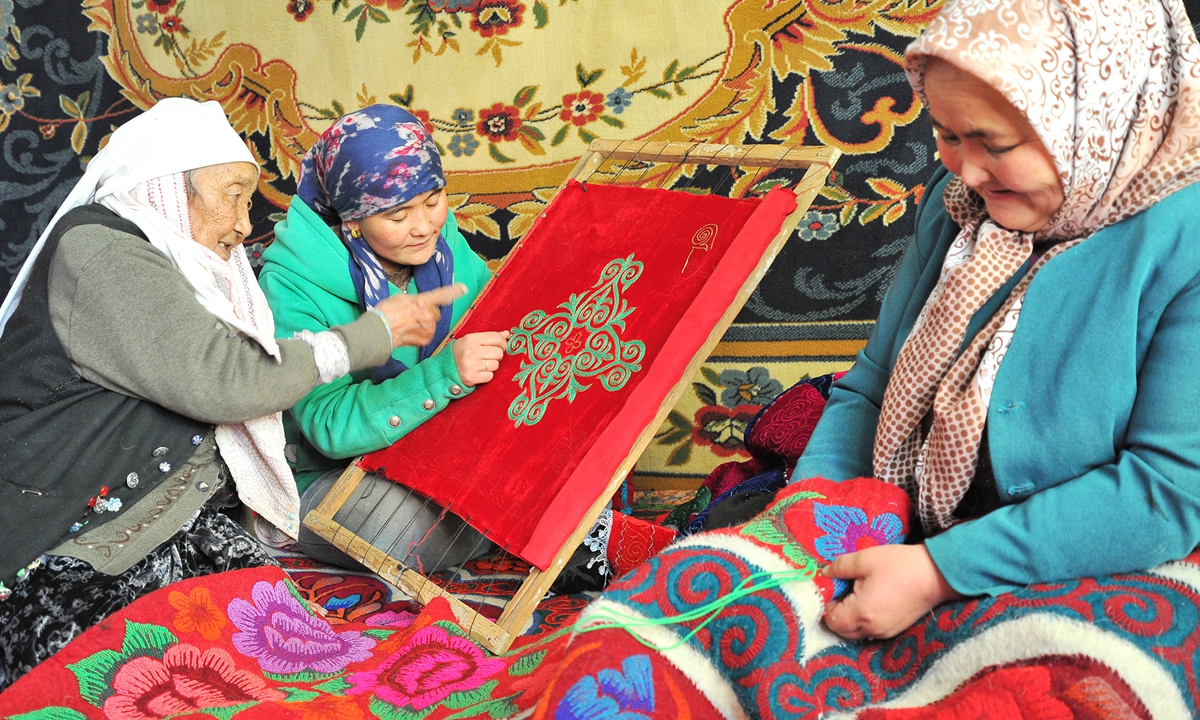
Women embroider handicraft items in Balikun county, Northwest China's Xinjiang Uygur Autonomous Region. Photo: VCG
Needles thread through clothing, blankets and other handicraft items, gradually forming different patterns rich with the characteristics of China's Kazak ethnic group. Busy scenes like this take place at Bageguli Wolaletai's workshops every day.Influenced by her family, Wolaletai has been a big fan of Kazak embroidery since childhood. After leaving her first job, the woman living in Altay prefecture in Northwest China's Xinjiang Uygur Autonomous Region decided to transform the hobby into a tool to earn a living.
Listed as a national intangible cultural heritage in May 2021, Kazak embroidery is the oldest folk art belonging to the ethnic group that is mainly inhabited in Xinjiang.
This type of embroidery originated as a by-product of the ethnic group's nomadic lifestyle. Embroidered tapestries usually adorn the walls of their homes to act as talismans bringing good fortune. The unique art is also used to decorate their hats, bedding and yurts.
When she first started out, Wolaletai never imagined that her group's traditional heritage would help lift dozens of local residents out of poverty.
Intangible heritage, real wealth
Wolaletai now runs a foreign trade corporation that employs 36 local women well versed in the art form. The products they make such as clothing and handicrafts are sold to Mongolia and Kazakhstan, Wolaletai told the Global Times on Tuesday.
The corporation has its roots in a simple shop, only 16 square meters in size and stocked with simple and crude equipment, which Wolaletai opened in December 1998.
As business picked up, in August 2012 she officially founded her corporation. She oversees everything from the large day-to-day operation management of the company to small details such as buying needles, thread, rulers and other tools needed for embroidery.
"Every pattern has its meaning in a work. Color collocation is also particularly important when it comes to embroidery. The colors of the thread and cloth background must be chosen very carefully," Wolaletai said.
She even took courses at the Beijing Institute of Fashion Technology in 2014 for a month to learn more about advanced technology in clothing design, later bringing back what she learned to her hometown to help more people.
Wolaletai emphasized the importance of vocational and technical training in poor towns and villages throughout the region, noting that through her company and training courses, she has helped more than 100 people find jobs.
Through the endeavors of people such as Wolaletai, this ancient intangible cultural heritage is bringing tangible wealth to the local residents.
Modern innovation
Wolaletai said that the closing of customs due to the COVID-19 pandemic has impacted her business, so now her company has been focused on getting more creative with their products to attract the attention of local customers who are already familiar with the art.
"We are developing new embroidery patterns for Kazak yurts to attract more business," she noted.
"Not only patterns but also new handicrafts are being created," Wolaletai added, expressing confidence in the company's creativity.
For Kazak people, a yurt is like an "exhibition hall" for their embroidered items. The patterns on items such as bedding and clothing can vary widely to include geometric figures, antlers, floral patterns or tree branches.
Red, orange, green and black threads are most often used to complement each other and deliver the strong aesthetics of the group's nomad culture. While most embroidered items are made from woolen or cotton threads, luxurious golden and silver threads are also used to accentuate the entire pattern.
In keeping with the times, many Xinjiang residents are also experimenting with combining modern designs into their embroidery or turning to livestreams on social media to sell their goods.
Born to a traditional embroidery family in Xiangjiang's Ili Kazak Autonomous Prefecture, Kinesgul Nurtanakin has been making embroidered handicrafts since she was a child at her mother and grandparents' knee.
In order to attract more customers, Kinesgul has poured much of her energy into innovation. She has recruited four young professionals in their 20s who are majored in art and design to help incorporate more artistic designs into her company's products in order to make them more eye-catching.
Kinesgul's son, Marhulan Jarkin, also plays an important role for the company, helping market its products using the skills he learned at university in Beijing.
Using digital modeling, Marhulan has made samples of their products available online so that potential customers can get a better idea of what they look like in three-dimensional space.
To better promote their company on social media, he also built a 10.2-meter-tall yurt in 2019 that became a local landmark where internet influencers check in with their followers.
RELATED ARTICLES