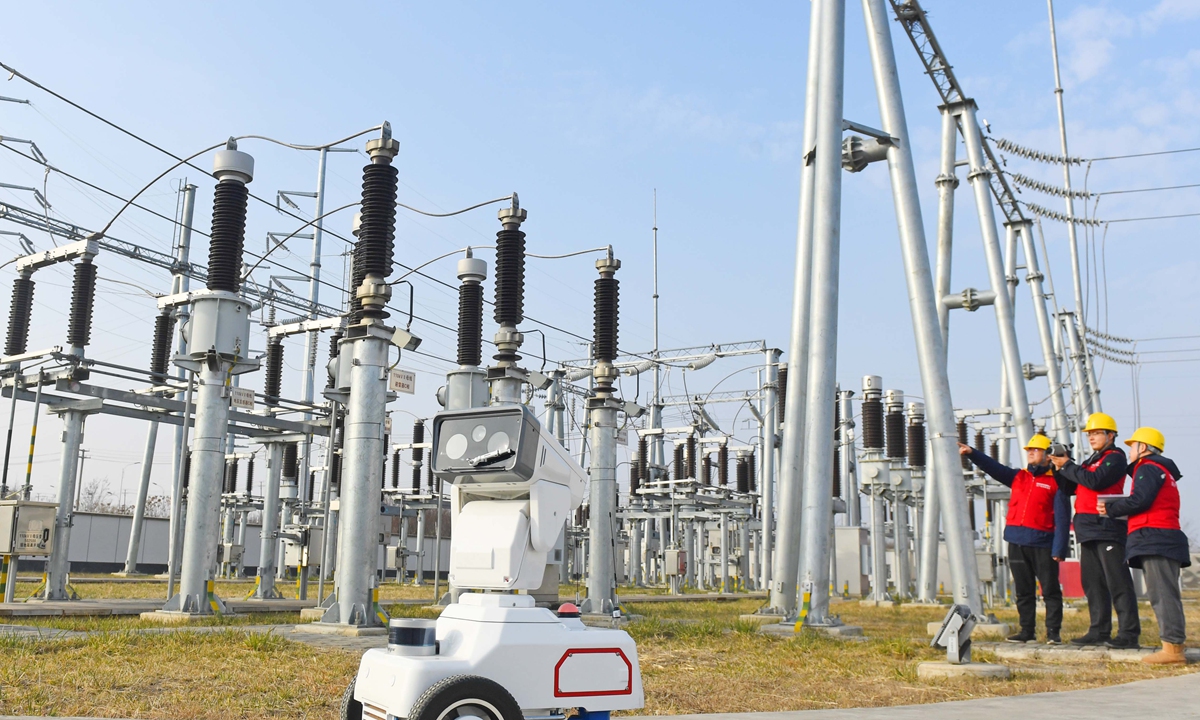
A 5G intelligent robot helps maintenance personnel inspect the power supply equipment for the high-speed railway in Chuzhou City, East China's Anhui Province on January 17, 2022. Photo: cnsphoto
Editor's Note:
Over the past year, China's economy has shown resilience despite headwinds caused by the coronavirus and supply chain disruptions, playing its role as a stabilizer to the global economy and maintaining a workable balance between pandemic control and economic development.
As an Omicron resurgence hit Shanghai, China's main financial center, some Western media commentators started predicting the country's downfall, questioning whether the world's second-largest economy could stand up to the challenge.
In a series of roundtable conversations, The Global Times sat down with some of the country's most notable economists and discussed why China's economy can withstand volatile economic conditions, and continue to grow.
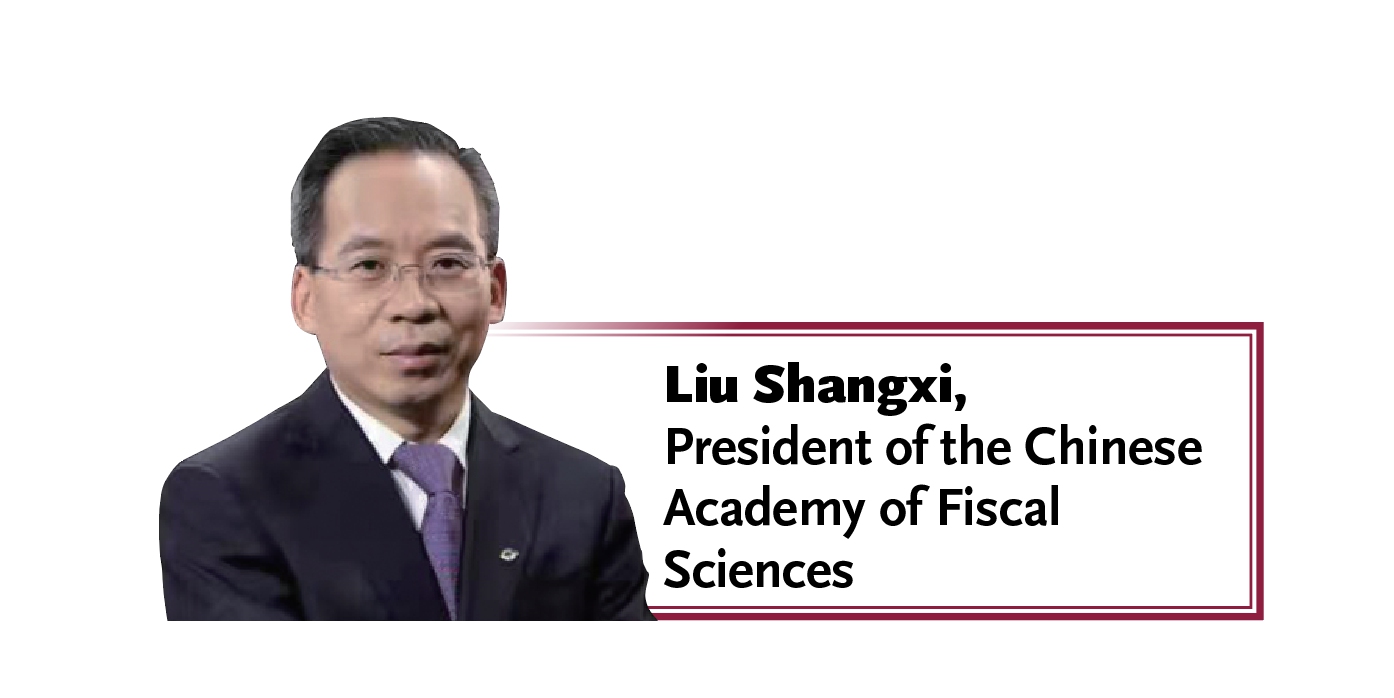
Liu Shangxi, President of the Chinese Academy of Fiscal Sciences Photo: GT
The world is currently in a period of accelerated evolution and transformation, with the original rules-based order becoming increasingly difficult to navigate, resulting in the expansion of various uncertainties and "butterfly effects" emerging one after another. Only by forming a new order can the risks be reduced, and new certainties be restored for a sustainable development.
The major changes in the world are not only about geopolitics and the game of major powers, but also the irreversible trend of the "three modernizations".
First, low-carbonization is creating new standards and requirements for global economic and social development. ESG, namely environmental, social and governance, has been embedded in accounting standards and has become an important part of corporate information disclosure. The asset value of the whole society is in the process of revaluation.
Second, digitalization is progressing. Digital technologies such as 5G, cloud computing and AI are only promoting the recombination of new and old factors, but also constantly subverting the existing economic production organization, and the way society and government operates.
The current legal system, administrative regulations and government supervision, including ideas and theories, are all built on the basis of industrialization and are the results of the industrial revolution. In the process of rapid digitization, some industrialization traditions will gradually become less applicable to the real economy. Instead, new economies, new business forms, new models and new employment forms will continue to emerge.
The third "modernization" is the 'financialization' of the economy. A typical phenomenon is that people's wealth is more reflected in their financial assets, with physical assets becoming a medium for the transfer of these assets. The assets of households, individuals, businesses and governments are all being financialized.
The financialization of the economy will change the original rules. While promoting high-quality economic development, it will also bring more challenges. We used to observe and understand the world from the perspective of real entities, but now we see more "virtual" things, such as financial products such as stocks, bonds, futures, insurance, and intangible assets such as intellectual property rights and brands.
Financialization and digitization are superimposed together, and they are even more virtual, such as digital currency, data products, digital platforms, virtual spaces.
The "three modernizations" together constitute a major trend and background for China's economic development. Under the "three modernizations", the original rules need to be reconstructed and the country needs to embrace the challenges with a spirit of innovation, adapt to the new changes, identify, make adjustment, innovate, and build greater certainty for China's economic development.
Market-oriented reform in China remains an ongoing process, and the market-oriented allocation of factors, including the establishment of a large national unified markets, needs to be achieved through innovation. Moreover, social transformation lags behind economic transformation, since the social transformation, including the 'citizenization' of farmers, the equalization of basic public services, and the equalization of opportunities for members of society, all need significant investment and support.
To push for social transformation, innovation across institutional mechanisms is necessary. In the past, we mainly focused on innovations in the economic field, such as technological innovations, innovations in business models, innovations in economic systems and mechanisms. These are still important today, but we should expand our horizons to society as a whole.
There still remains big space for the country to achieve reform and advance innovation. By innovating and reorganizing existing resources to achieve better allocation, the efficiency of Chinese economy can be greatly improved, the potential growth rate can be improved, and the certainty of China's economic and social development will be strengthened.
RELATED ARTICLES